
There are dates that divide time into before and after.
September 11, 2001, is one of them.
Twenty-five years later, nearly everyone old enough to remember that Tuesday can still recall something about where they were when they first heard the news. The images from New York, Washington and Pennsylvania became part of our collective memory. So did the uncertainty of the days that followed.
For a time, ordinary life did not feel ordinary.
And in Minnesota, as across the country, people eventually faced a difficult question: How do we begin gathering again after something like this?
For some Minnesotans, one answer was found on a dance floor.
Eleven Days Later
On Saturday, September 22, 2001—just 11 days after the attacks—a Bomber’s Moon Ball was scheduled to take place at Fleming Field in South St. Paul.
It had been planned before September 11.
But after the attacks, the meaning of the evening changed.
The Southern Minnesota Wing of what was then called the Confederate Air Force announced that all proceeds from the dance would be donated to the American Red Cross disaster relief fund. The Roseville Big Band donated its time so that still more money could go toward relief efforts. Free swing lessons preceded the dance.
People came.
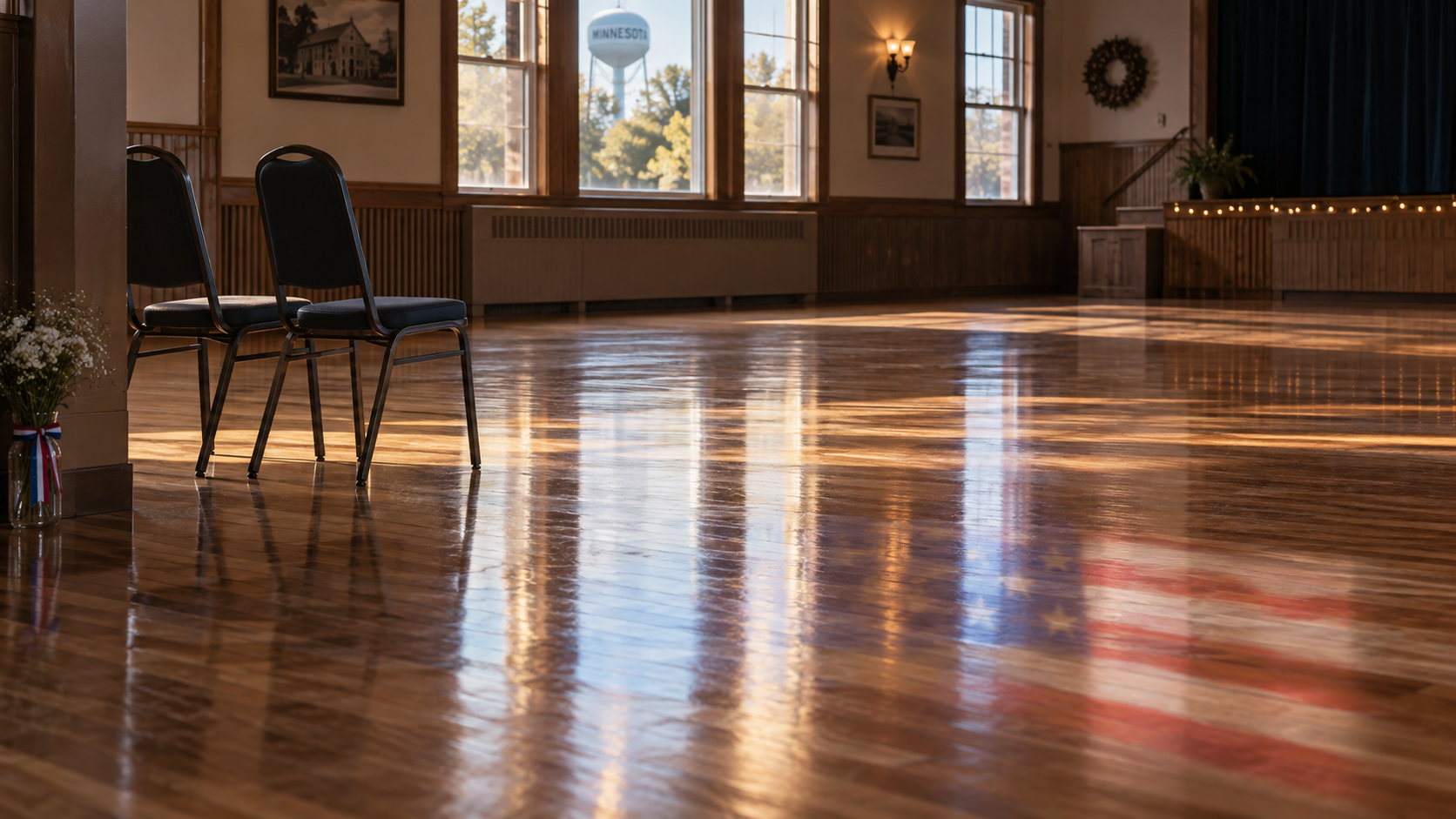
They danced beneath the wings of historic aircraft while a big band played music from an earlier American generation that had known war and profound loss of its own.
And at one point that evening, a bagpiper played Amazing Grace.
That detail is worth sitting with.
Eleven days earlier, nearly 3,000 people had been killed.
There was still smoke rising from the ruins in Lower Manhattan. Families were still waiting for news that would never come. The country was grieving and frightened.
Yet in South St. Paul, people gathered.
Not because everything was suddenly all right.
It wasn’t.
They gathered because sometimes being together is what people do when they don’t know what else to do.
Source: Roseville Big Band historical archive
Minnesota’s Dance Floors Had Always Been Gathering Places
That response makes particular sense in Minnesota.
For generations, dancing here was about more than learning steps.
Minnesota once had nearly 100 ballrooms, particularly during the decades after World War II. They were scattered across communities large and small—places where orchestras played, couples met, families celebrated and neighbors spent evenings together.
They were entertainment venues, certainly.
But they were also community rooms.
That distinction became especially meaningful after September 11.
The music itself didn’t fundamentally change because of the attacks. Neither did the waltz, foxtrot or swing.
What changed was the world outside the ballroom.
And for at least some dancers, musicians and communities, that gave gathering together a different weight.
Additional historical context: Minnesota Historical Society
What Happened at Fleming Field Wasn’t Forgotten
Months after the September 22 dance, the Roseville Big Band looked back on the night.
The band reported that it had waived its normal performance fee, allowing another $625 to be donated to the Red Cross. Sales of the band’s CDs and tapes generated another $315 for relief efforts.
Measured against the enormous need following September 11, those numbers were small.
But that may be exactly why the story matters.
Most people couldn’t travel to New York to search the rubble.
They couldn’t undo what had happened.
They could give something.
Musicians gave their evening and their fee.
Organizers gave their proceeds.
People bought tickets.
And couples danced.
It was one small Minnesota community doing what it could.
The Connection Between Dancing and Remembrance Continued
The idea of using dance as a place for remembrance did not disappear as the years passed.
On September 11, 2017, a memorial event at Como Dockside in St. Paul honored New York firefighters killed on 9/11 as well as St. Paul firefighters who had died in the line of duty.
The evening included a memorial walk, ceremony and a swing dance, with proceeds supporting health and wellness initiatives for St. Paul firefighters.
Minnesota’s broader dance community has also continued to explore the memory of September 11 through movement.
For the 25th anniversary, Minneapolis-based Threads Dance Project is again sharing Out of the Ashes, a dance film created as a reflection on those affected by 9/11 and on human connection in its aftermath.
Different forms of dance. Different generations.
But a similar recognition that movement can sometimes express something for which spoken words feel inadequate.
More information: DanceMN
Twenty-Five Years Later
A quarter century has passed.
Children born after September 11 are now adults. For them, 9/11 is history rather than memory.
For millions of others, it remains something different.
There are empty places at family tables because of that day. There are firefighters, police officers, military families, survivors and first responders whose lives continued to be shaped by it long after the television cameras moved on.
Minnesotans were among those who mourned. On the first anniversary, ceremonies were held from Moorhead to Rochester and at the State Capitol. Bells rang at the exact minute the first plane struck the World Trade Center.
Source: Minnesota Public Radio’s coverage of the first anniversary
So on this 25th anniversary, perhaps the image of couples dancing beneath an airplane wing in South St. Paul carries a little more meaning than it once did.
Not because dancing somehow erased grief.
It couldn’t.
Not because September 11 was a ballroom-dance story.
It wasn’t.
But because 11 days after one of the darkest mornings in American history, a group of Minnesotans chose to be together.
They played music.
They raised money.
They remembered.
And they danced.
Sometimes a dance floor is simply a place to dance.
And sometimes it becomes a place where people quietly remind one another that they are still here.
On September 11, we remember those who were lost, those who responded, the families who carried unimaginable grief, and all those whose lives were forever changed.
— Ballroom by Amy
AI transparency note: AI tools were used to assist with research, drafting, editing, and creation of the accompanying graphic imagery for this article. Final editorial decisions, historical review, and publication are the responsibility of Ballroom by Amy.