Ballroom How-To · East Coast Swing · Beginner
Learn the classic triple-step swing basic: triple step, triple step, rock step, counted one-and-two, three-and-four, five, six.
Illustration (AI-generated): the jukebox is warming up.
Quick Answer
To start dancing East Coast Swing, learn the basic: two triple steps and a rock step over six beats, counted 1-and-2, 3-and-4, 5, 6. Leaders triple to the left (left, right, left), triple to the right (right, left, right), then rock back on the left and recover onto the right. Followers dance the mirror image, starting to the right.
East Coast Swing is the happy one: bouncy, playful and made for rock and roll, big band and plenty of pop songs. It’s the triple-step version of the swing, and once you have it, you can dance to a huge range of music.
If you’ve already tried single-time swing with Amy, you know the shape: side, side, rock step. East Coast Swing simply turns each side step into a quick little triple. This guide breaks it down for both partners, with footwork diagrams, a count-along video, two practice tracks and a five-minute drill. No partner or experience needed.
In this lesson
What you’ll learn
Skill
The triple-step basic, both parts
Style
East Coast Swing (American Rhythm)
Level
First-timer to beginner
Partner?
Optional. Practice it solo
Step 1: Learn the count before the feet
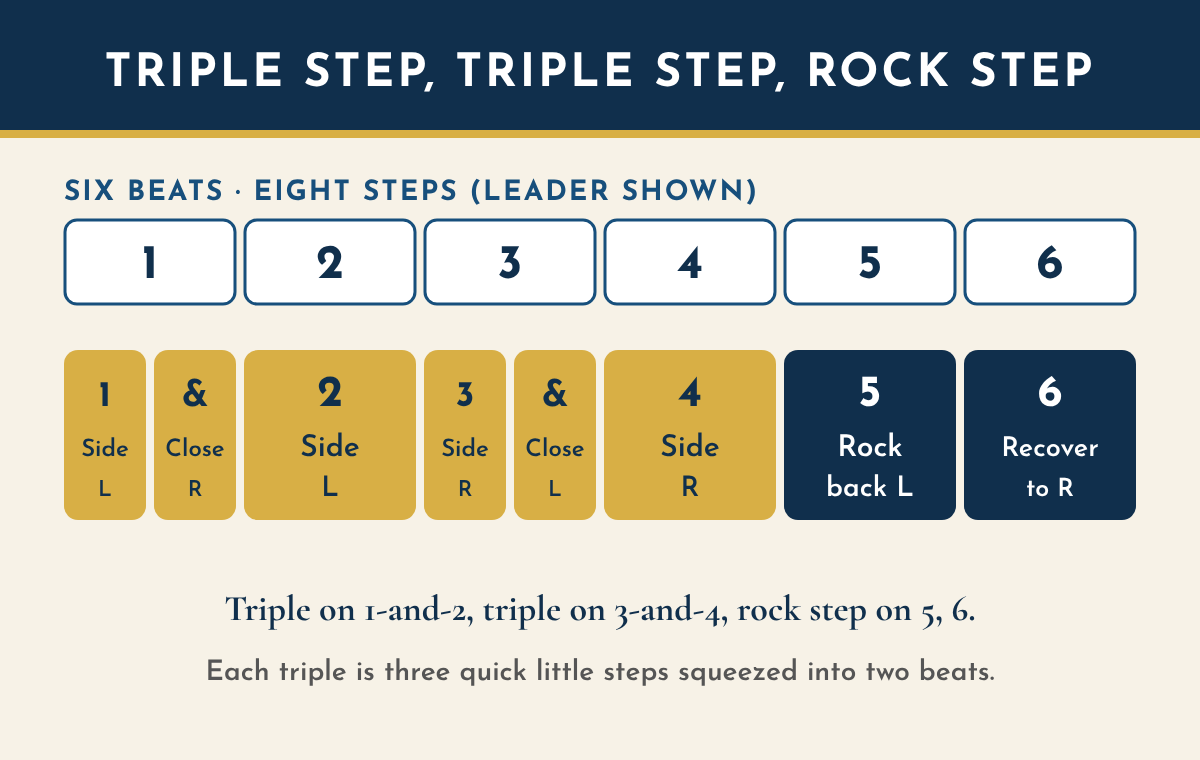
One East Coast Swing basic takes six beats: 1-and-2, 3-and-4, 5, 6. Each “1-and-2” is a triple step, three quick weight changes squeezed into two beats, and “5, 6” is a rock step. That’s the six-count pattern Ballroom Pages describes for triple-time swing, and its glossary entry on the triple step explains the three-step rhythm.
Rock step first, or triples first?
Some teachers start the basic with the rock step, counted 1, 2, 3-and-4, 5-and-6, as DanceVision does. It’s the same loop of steps with a different starting point, and Ballroom Pages calls both valid. This guide starts with the triples to match Amy’s single-time swing lesson, where the side steps come first. Amy will show you which way she counts it.
Step 2: Get the swing feel
Ballroom Pages sums up East Coast Swing as upbeat, playful and relaxed, with “a springy pulse with a small bounce, not hopping.” For your first basics:
- Keep the triples small. Three quick, clear little steps, not one big heavy step. They barely travel.
- Soft knees, small bounce. Keep your knees bent through the triples, as DanceVision suggests. The bounce comes from your knees, not from hopping off the floor.
- A small rock step. Rock back just a little, away from your partner, then come right back.
- Relaxed connection. Relaxed shoulders, soft elbows and a light but clear hand connection: no yanking or pulling.
Step 3: The leader’s basic, step by step
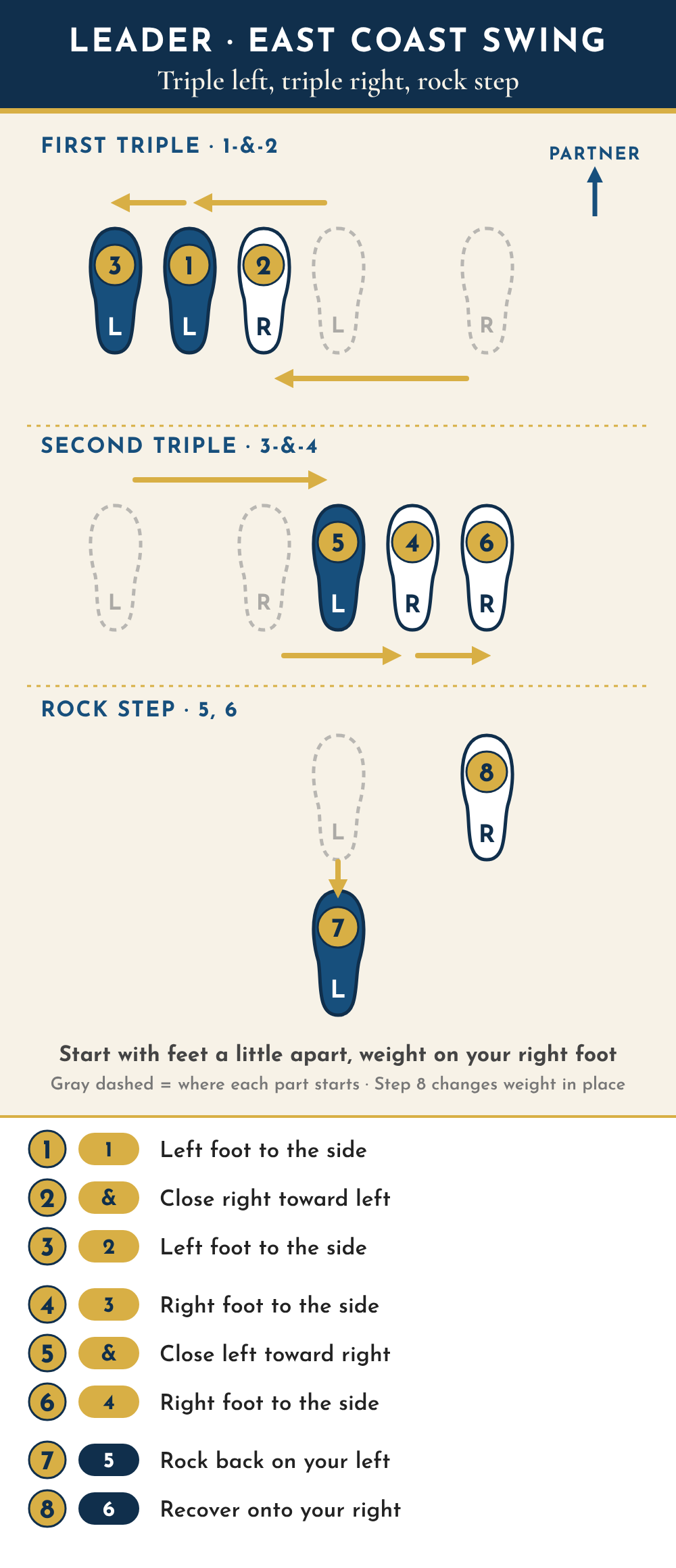
Start: feet a little apart, facing your partner, weight on your right foot, so your left foot is free.
First triple: to the left
- Count 1: step your left foot to the side.
- Count &: close your right foot toward your left.
- Count 2: step your left foot to the side again.
Second triple: to the right
- Count 3: step your right foot to the side.
- Count &: close your left foot toward your right.
- Count 4: step your right foot to the side again.
Rock step
- Count 5: rock back on your left foot, away from your partner. Keep it small.
- Count 6: recover: shift your weight forward onto your right foot. Your left foot is free to start the next basic.
Say it out loud: “Triple step, triple step, rock step.” The same leader footwork appears in the DanceVision breakdown, starting from the rock step.
Step 4: The follower’s basic, step by step
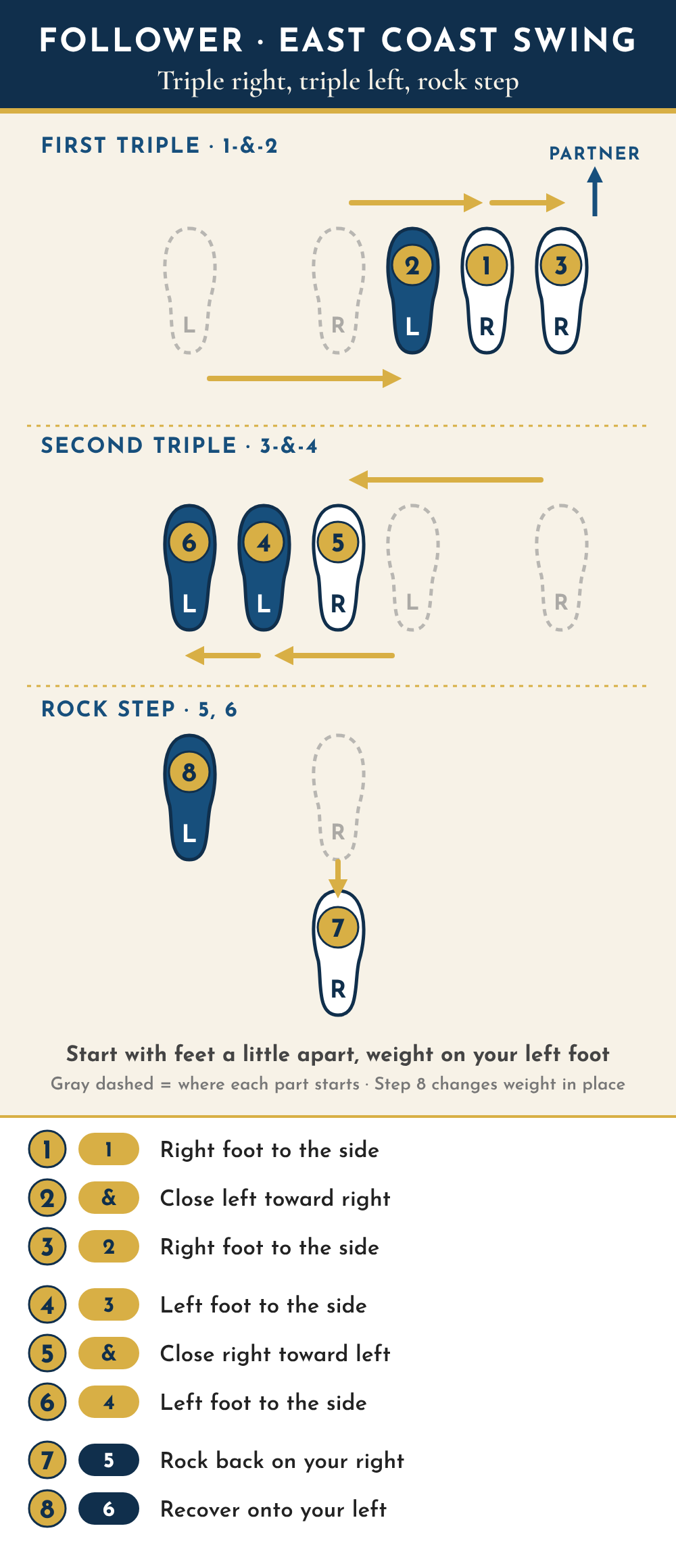
Start: feet a little apart, facing your partner, weight on your left foot, so your right foot is free.
First triple: to the right
- Count 1: step your right foot to the side.
- Count &: close your left foot toward your right.
- Count 2: step your right foot to the side again.
Second triple: to the left
- Count 3: step your left foot to the side.
- Count &: close your right foot toward your left.
- Count 4: step your left foot to the side again.
Rock step
- Count 5: rock back on your right foot, away from your partner. Keep it small.
- Count 6: recover: shift your weight forward onto your left foot. Your right foot is free to start the next basic.
Your part is the mirror image of the leader’s: you both triple the same way across the room, and you both rock back, away from each other.
Step 5: Put it together
Take a relaxed hold and dance the basic together: triple, triple, rock step. On the rock step you both step back a little, away from each other, then come back together for the next triple. Dance at least eight basics in a row.
Once it feels steady, let the basic turn slowly as you dance, the way Amy shows in her single-time lesson. Ballroom Pages notes that East Coast Swing often moves in a circle rather than a straight line.
Watch the count-along lesson (under 3 minutes)
This short video walks both parts step by step, then counts along with you at a slow practice tempo and again at dance tempo. Press play and dance along; captions are available.
Read the video transcript
Let’s learn the East Coast Swing. It’s the classic triple-step swing: happy, bouncy and perfect for rock and roll, big band and plenty of pop songs. You can practice it right where you are.
The basic takes six beats. Count it with me: one and two, three and four, five, six. One and two is a triple step. Three and four is another triple step. Five, six is a rock step.
If you’ve learned single-time swing, you already know the shape. Just turn each side step into a quick triple: three little steps, left, right, left. Keep them small and light.
Leaders, start with your feet together and your weight on your right foot. One and two: triple to the left, left, right, left. Three and four: triple to the right, right, left, right.
Five: rock back on your left foot. Six: recover onto your right. You’re ready to start the next basic with your left foot.
Followers, you dance the mirror image. Start with your weight on your left foot. One and two: triple to the right, right, left, right. Three and four: triple to the left, left, right, left. Five: rock back on your right. Six: recover onto your left.
Now let’s practice with the count. Listen for three quick bright tones on each triple step, and two deep tones for the rock step. Here we go, nice and slow.
[Practice tones at 110 beats per minute: after four count-in clicks, three quick bright tones for each triple step and two deep tones for the rock step.]
Now a little faster, at dance tempo. Stay light on your feet.
[Practice tones at 136 beats per minute.]
Two quick reminders. Keep the triples small, so they don’t turn into one big heavy step. And keep a soft bounce in your knees, not a hop. That’s what gives swing its happy feel.
Want to dance it with an instructor? Ballroom by Amy teaches private lessons across the Twin Cities. Visit BallroomByAmy.com.
Instructor tip
Happy feet, not heavy feet. If your triples sound like stomps, make them smaller.
Ballroom Pages puts it as “small bounce, clear rhythm, happy feet.”
Hear the counts: two practice tracks
These original practice tracks (no music, just tones) play the East Coast Swing basic for you. After four soft count-in clicks, three quick bright tones mark each triple step and two deep tones mark the rock step. Press play, stand up, and dance along. Neither track plays automatically.
Slow practice · 110 beats per minute
Dance tempo · 136 beats per minute
What you’ll hear (text version)
Each track has no words or music. It opens with four quiet clicks to count you in. Then the pattern repeats every six beats: three quick bright tones on 1, “and,” 2 (triple step), three more on 3, “and,” 4 (triple step), and a deep tone on 5 and another on 6 (rock step). Each pattern is one basic. The slow track plays 15 basics in about 53 seconds and the dance-tempo track 18 basics in about 51 seconds.
Beyond the basic: what comes next
Once the basic is steady, East Coast Swing opens up. These are best learned with a teacher, and Amy demonstrates them in her single-time swing lesson:
Outside underarm turn
The leader raises the left hand after the rock step and the partners trade places, keeping the same triple, triple, rock rhythm.
The basket
The follower wraps into the leader’s arm, side by side, then unwraps back out.
Inside turn
The follower turns the other way under the leader’s arm, toward the leader, and the partners trade places.
Common mistakes and quick fixes
Flattening the triple into one step
Fix: say “tri-ple-step” out loud and take three distinct little weight changes. Small steps make it easier.
Hopping
Fix: keep the bounce in your knees and keep your feet close to the floor. Swing is springy, not jumpy.
A huge rock step
Fix: rock back just a little, a short step, so you can come right back on 6.
Yanking your partner
Fix: soft elbows and a light hand connection. On the rock step you both move apart a little; nobody pulls.
Your five-minute practice
- Minute 1: play the count-along video above and say “triple step, triple step, rock step” out loud with it.
- Minutes 2-3: dance your own part alone, no music. Check that the same foot starts every basic.
- Minute 4: play the slow practice track above and dance along with it.
- Minute 5: try the dance-tempo track. If it falls apart, go back to the slow one. That’s how everyone learns.
If finding the beat is the hard part, read why some songs make the beat hard to find.
|
Print the one-page East Coast Swing practice sheet |
Music, clothes and where you’ll dance it
The steps are only half the picture. Here’s what to play, what to wear, and where East Coast Swing will actually come in handy.
What music works for East Coast Swing?
Anything upbeat in 4/4 with a clear pulse: classic swing and big band, jump blues, rock and roll, rockabilly, some country swing, and pop with a swing or shuffle feel, according to Ballroom Pages. For competition, the NDCA rule book sets American Rhythm swing at 34 to 36 bars per minute, about 136 to 144 beats, per the Ballroom Pages tempo chart. Practice slower while the rhythm settles in.
Songs to try
- Crazy Little Thing Called Love, Michael Bublé
- Some Kind of Wonderful, Huey Lewis & the News
- Ex’s & Oh’s, Elle King
- Cooler Than Me, Mike Posner
- Confident, Demi Lovato
- Mystify, INXS
From the East Coast Swing titles on the RPI Ballroom Team’s music list. Tempos vary by recording, so test yours: count “1-and-2, 3-and-4, 5, 6” along with it. If the triples feel comfortable, it will work. If they feel rushed, use single-time swing for that song instead. The practice tracks above are a good warm-up first.
What should you wear?
For lessons and practice
Clothes you can move in. Skip pencil skirts, scarves and long jewelry. Shoes matter most: smooth suede or leather soles that turn easily and stay on your feet.
For a party or wedding
Dress for the occasion, then check you can bounce and turn in it. A skirt with some swing is perfect.
For competitions
Rules vary by event and level. Some newcomer and bronze events don’t allow costumes at all, so read the dress rules before you buy.
Avoid rubber soles, flip-flops and chunky or loose heels, which stick, slip or twist. Advice drawn from Supadance’s guide to dressing for ballroom; the costume example is from the Berkeley Classic’s competition rules.
Where will you dance East Coast Swing?
- Weddings. It suits lively first dances, playful parent dances, reception entrances and surprise sections, as Ballroom Pages notes. See wedding dance lessons.
- Parties and galas. When the band plays a swing or rock-and-roll number, this is the dance. Here’s how to get ready for a gala dance floor.
- Swing and ballroom socials. Twin Cities swing nights and ballroom variety nights both play it. Find nights on Where to Go Dancing in the Twin Cities.
- Competitions. East Coast Swing is one of the American Rhythm dances.
The basic barely travels, so it fits a busy floor. Keep your rock steps small so you don’t back into the couple behind you.
A little history
Where did East Coast Swing come from?
East Coast Swing grew out of the Lindy Hop, the original swing dance that took its name and its home at Harlem’s Savoy Ballroom, which opened in 1926, according to the Frankie Manning Foundation. In the 1940s, Arthur Murray and other dance studios simplified those swing steps into a six-count pattern they could teach to everyone, as this overview of East Coast Swing and Ballroom Pages describe. You may also hear it called the jitterbug.
Next steps
Learn
How to dance single-time swing, with Amy’s video
Learn
How to do the hustle: the beginner basic
Watch
Free video lessons and step-by-step guides
|
Learn with Amy Want your swing ready for the next wedding or party? Ballroom by Amy offers private lessons and group classes for dancers across the Twin Cities. Beginners are welcome, and no partner is needed. See private lessons Or call or text 612-308-7708. Amy typically replies within one business day. |
About Amy
Amy Hanson is the three-time defending Dancer’s Cup Tour Top Teacher. She has danced professionally and internationally and built friendships with dancers many people recognize from Dancing with the Stars. People who believe they’re not coordinated, confident, or good enough are exactly the beginners Amy loves to teach, and she also helps experienced dancers keep improving. No experience or partner is required.
Sources & Further Reading
- Ballroom Pages: East Coast Swing Dance Style Guide. The six-count triple-time basic, rock-step-first and triples-first teaching, the springy feel, connection, music, weddings and social settings, history.
- Ballroom Pages Glossary: Triple Step. What a triple step is and how it’s counted.
- Ballroom Pages: Ballroom Dance Tempo Chart. NDCA tempo: American Rhythm swing 34-36 bars per minute (about 136-144 beats).
- DanceVision: How to Dance East Coast Swing. Leader and follower footwork, counted from the rock step; knees bent through the triples.
- Frankie Manning Foundation: Archival Resources. The Lindy Hop and Harlem’s Savoy Ballroom, opened 1926.
- Wikipedia: East Coast Swing. Studio origins in the 1940s; also known as jitterbug.
- RPI Ballroom Team: Music. East Coast Swing song titles.
- Supadance: How to Dress for Ballroom Dancing and Berkeley Classic: Competition Rules. Lesson clothes, shoes and a competition dress-rule example.
AI-Assisted Content Disclaimer
This educational guide was created with assistance from artificial intelligence (AI), including portions of the written content and visual materials. While we strive to provide accurate and helpful ballroom dance information, AI-generated content and illustrations may contain errors or inaccuracies, including in dance positions, footwork, timing, and technique.
Please independently verify important information and use your own judgment when practicing. Images are intended to support learning and may not always represent technically precise movements. For personalized guidance and instruction, consider learning directly with a qualified ballroom dance instructor.
Some images are AI-generated illustrations and do not show real people or places. The narration in the count-along lesson is an AI-generated voice. The footwork diagrams and practice tones were created for this guide.