Ballroom How-To · Hustle · Beginner
Watch Amy dance it, learn the rock-and-march basic, and have a party dance ready for the next wedding you attend.
Amy and her partner William demonstrate the hustle (2:17). Captions are built into the video, and the transcript is just below.
What’s in the video, and the full transcript
- 0:00 Amy introduces the hustle
- 0:10 The basic: rock away, march, march
- 0:40 Rotating the basic clockwise
- 0:58 The outside-to-inside turn
- 1:14 The basket (also called the cradle)
- 1:34 Basket into an inside turn
- 1:50 Why the hustle is Amy’s favorite party dance
Hi, I’m Amy Hanson, and today I’m going to demonstrate the hustle with my partner, William.
Okay, leaders, you’re going to be stepping back on your left foot. Followers, you’re stepping away on your right foot. Leaders left, followers right. Leaders are moving back. Followers are moving back. It’s a rock step, so we rock away and back. In between, we have a march, march. We have a rock away, rock away, march, march, rock away. We can put counts to it: 1, 2, 3, 4.
When we’re ready, we’re going to rotate clockwise for the leader, just ever so slightly, however much rotation is comfortable. Always rocking away from our partner. March, march comes a little bit more toward your partner. One, two, three, four.
We’re going to stay stationary for a minute. We’re going to demonstrate our outside-to-inside turn. Leaders, raise the hand. Rock step. One, two. Rock. The turn will happen after the rock step. Here we go. We’ll demonstrate again. One, two, rock away. One, two, rock away.
From here, we have our basket. Leaders will use two hands to wrap up their partner on the right side of their body. We rock together. He sends her out. Let’s try that again. One, two, rock. Wrap your partner. Send them out.
After our cradle, or our basket, we will then follow with an inside turn. So let’s do our basket. Send your partner out. Leaders and followers trade places. There you have it.
Okay, thank you so much for watching. The hustle is one of my favorite dances. It’s my husband’s only dance. It’s his go-to dance. We’ve been using it for years at every wedding and party we attend. If I can get him out on the dance floor, that’s what we use. I think you’re really going to like this one. Make sure to check out some of the other videos on the website. If you want to learn more about private lessons or group classes, check us out at Ballroom by Amy.
Quick Answer
To start dancing the hustle, learn the basic Amy teaches: rock, replace, march, march, one step on each beat of a 1-2-3-4 count. Face your partner and rock back, away from each other (leaders on the left foot, followers on the right), shift your weight forward again, then march two small steps. Repeat it, then let it rotate slowly clockwise.
The hustle is the smooth, spinning partner dance of the 1970s disco era, and it still fills dance floors at weddings and parties. Amy calls it one of her favorite dances. It’s also her husband’s go-to: she says they’ve used it for years at every wedding and party they attend.
This guide breaks down the beginner basic from Amy’s video above, with footwork diagrams, two practice tracks and a five-minute drill. You don’t need a partner, experience or natural rhythm to start, just a little floor space and the count.
In this lesson
What you’ll learn
Skill
The hustle basic, both parts
Style
Social partner hustle, four‑count
Level
First-timer to beginner
Partner?
Optional. Practice it solo
Step 1: Learn the count before the feet
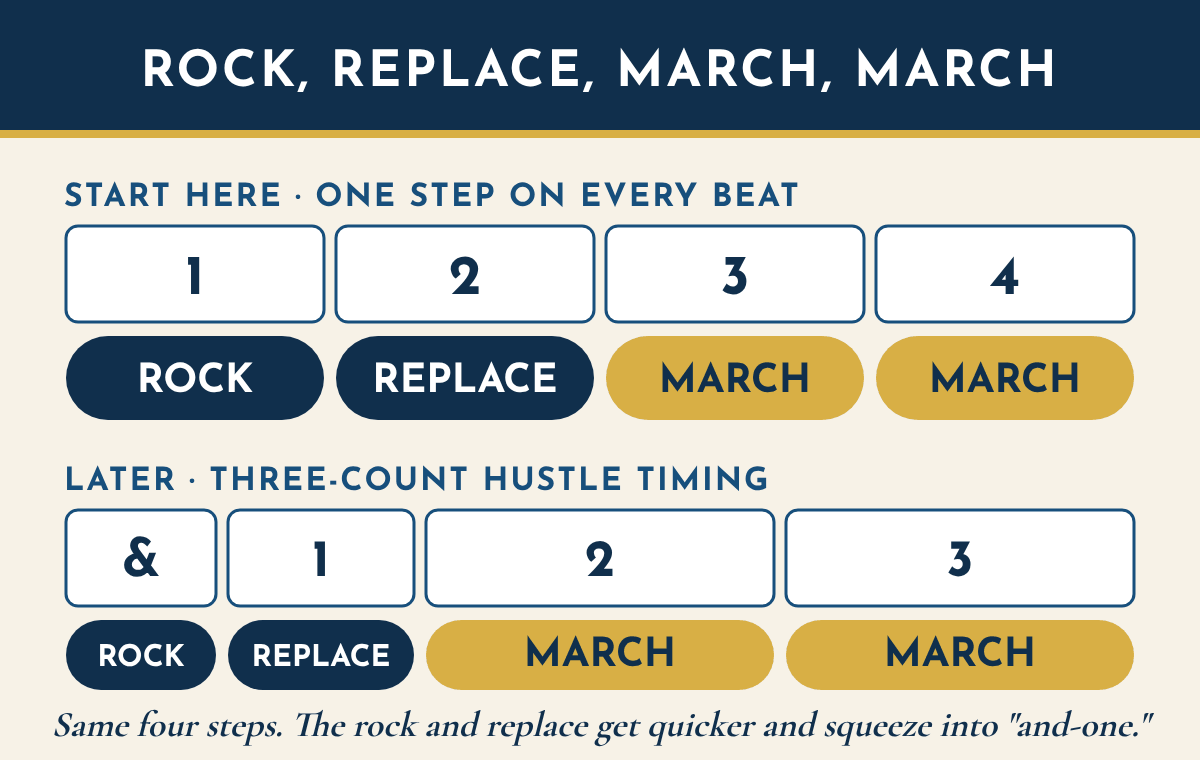
Hustle music has a steady four beats to a bar. In her video, Amy counts the basic as 1, 2, 3, 4: a rock step on 1 and 2, then two marching steps on 3 and 4. That’s one step on every beat, the easiest way to start. The Rounddancing.net hustle figures describe the same four-step basic: rock apart, recover, then two steps in place.
What about “and-one, two, three”?
Many hustle dancers count the basic “and-one, two, three.” It’s the same four steps: the rock and replace simply get quicker and squeeze into “and-one,” as the history of the dance and the Rounddancing.net figures describe. Get comfortable with 1, 2, 3, 4 first; the faster timing comes naturally.
Step 2: Face your partner
In Amy’s video, she and William start facing each other a comfortable distance apart, with hands joined low and relaxed. Three things to remember:
- Both partners rock away from each other, so the space between you stretches on the rock and closes on the marches.
- Keep the arms soft but connected. You should feel your partner move away and come back through your hands.
- Keep the steps small. The hustle is a compact dance that fits a crowded floor, as the RPI Ballroom Team’s dance guide notes.
Step 3: The leader’s basic, step by step
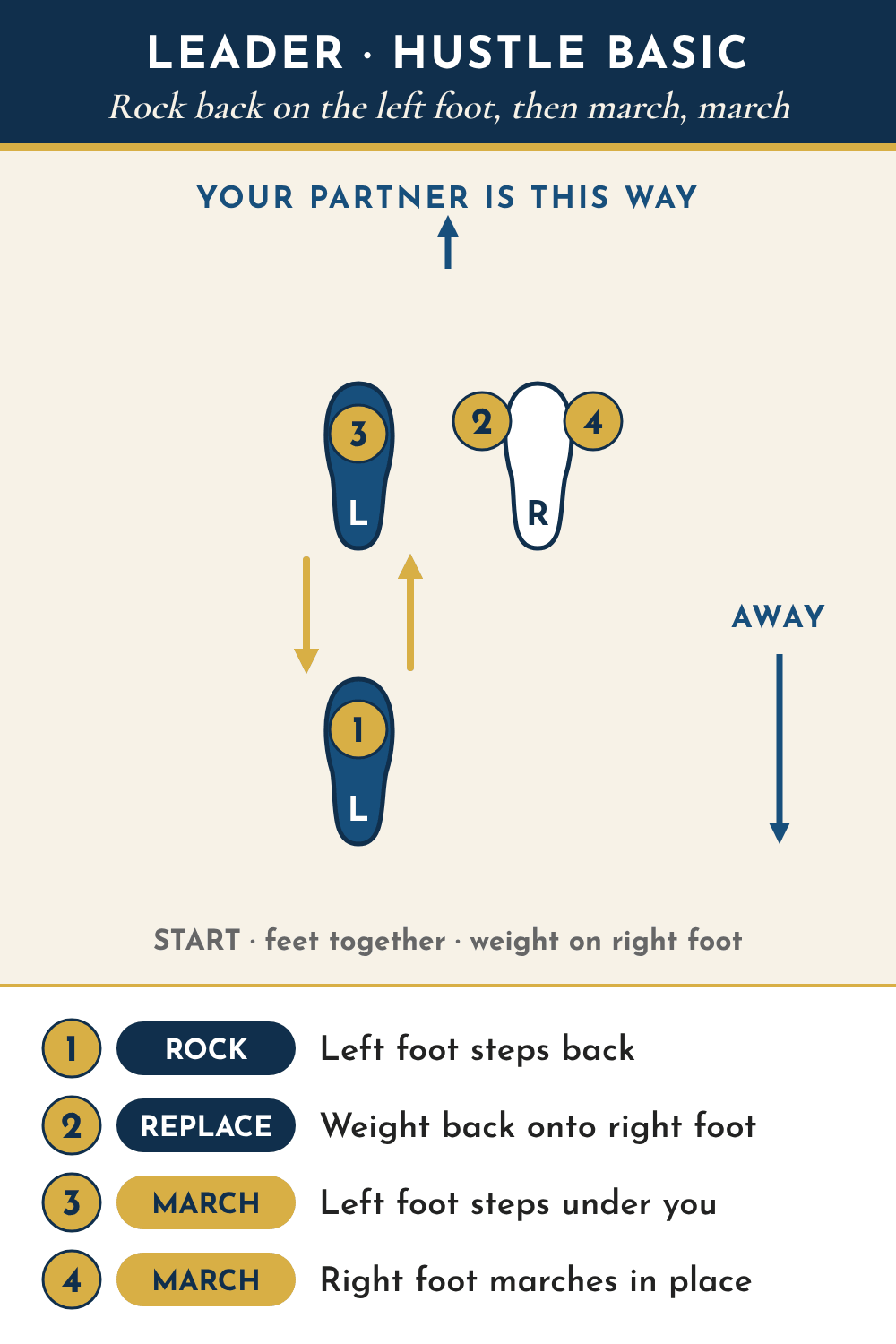
Start: feet together, facing your partner, weight on your right foot, so your left foot is free to move.
- Rock (1): step back on your left foot, away from your partner.
- Replace (2): shift your weight forward onto your right foot, where it already is.
- March (3): bring your left foot back under you and step onto it.
- March (4): march in place on your right foot. Your left foot is free again, ready to rock back.
Say it out loud: “Rock away, march, march.” The rock is the only step that really travels.
Step 4: The follower’s basic, step by step
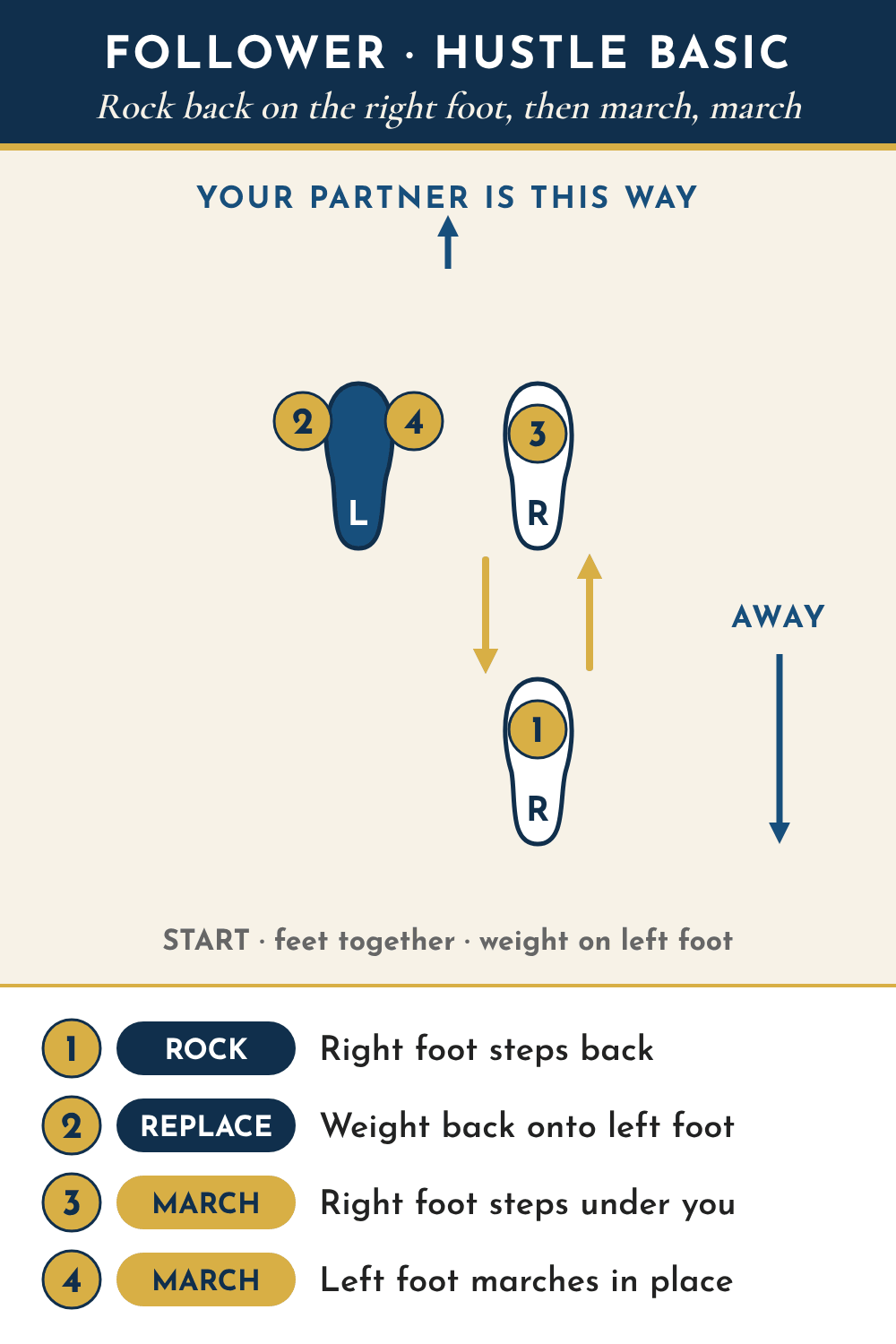
Start: feet together, facing your partner, weight on your left foot, so your right foot is free to move.
- Rock (1): step back on your right foot, away from your partner.
- Replace (2): shift your weight forward onto your left foot.
- March (3): bring your right foot back under you and step onto it.
- March (4): march in place on your left foot. Your right foot is free again, ready to rock back.
Your part is the mirror image of the leader’s. As Amy puts it: “Leaders left, followers right.” Both of you move back.
Step 5: Put it together and let it rotate
Join hands and dance the basic together: both rock away on 1, replace on 2, march, march on 3 and 4. Do it in place until it feels automatic, at least eight basics in a row.
Then add the turn of the couple. In her video (0:40), Amy has the couple rotate clockwise from the leader’s point of view, “just ever so slightly, however much rotation is comfortable.” You’ll slowly circle around each other while the basic stays the same.
Watch the count-along lesson (under 3 minutes)
This short video walks both parts step by step, then counts along with you at a slow practice tempo and again at dance tempo. Press play and dance along; captions are available.
Read the video transcript
Let’s learn the hustle basic. It’s the spinning partner dance from the disco era, and you can practice it right where you are.
The hustle basic has four steps, one on every beat: rock, replace, march, march. Count it with me: one, two, three, four.
Face your partner. On the rock, you both step back, away from each other. On the marches, you come back together.
Leaders, start with your feet together and your weight on your right foot. On one, rock back on your left foot.
On two, shift your weight forward onto your right foot. On three, step your left foot back under you. On four, march in place on your right.
Followers, you dance the mirror image. Start with your weight on your left foot. One, rock back on your right. Two, replace onto your left. Three, march on your right. Four, march on your left.
Now let’s practice with the count. Listen for a deep tone on the rock, a middle tone on the replace, and two bright tones for march, march. Here we go, nice and slow.
[Practice tones at 100 beats per minute: a deep tone for the rock, a middle tone for the replace, two bright tones for march, march.]
Now a little faster, closer to dance tempo. Rock away, then march back together.
[Practice tones at 120 beats per minute.]
Two quick reminders. Always rock back, away from your partner, never toward them. And keep the rock small, about half a normal step, so you’re on time for the marches.
Want to dance it with an instructor? Ballroom by Amy teaches private lessons and group classes across the Twin Cities. Visit BallroomByAmy.com.
Amy’s tip
“Always rocking away from our partner. March, march comes a little bit more toward your partner.”
From Amy’s hustle video, at about 0:48.
Hear the counts: two practice tracks
These original practice tracks (no music, just tones) play the basic for you. After four soft count-in clicks, a deep tone marks the rock, a middle tone marks the replace, and two bright tones mark march, march. Press play, stand up, and dance along. Neither track plays automatically.
Slow practice · 100 beats per minute
Dance tempo · 120 beats per minute
What you’ll hear (text version)
Each track has no words or music. It opens with four quiet clicks to count you in. Then the pattern repeats, one tone per beat: a deep tone (rock), a middle tone (replace), a bright tone (march), a bright tone (march). The slow track repeats the basic 18 times and the dance-tempo track 22 times, each in about 47 seconds.
Beyond the basic: the turns in Amy’s video
Once the basic is steady, Amy’s video shows where it goes next. These are best learned with a teacher, but here’s what to watch for:
Video 0:58
Outside-to-inside turn
The leader raises the hand, the couple dances the rock step, and the turn happens after it.
Video 1:14
The basket (cradle)
The leader uses two hands to wrap the follower on the right side of their body, they rock together, and the leader sends the follower out.
Video 1:34
Into an inside turn
After the basket, an inside turn sends the follower out, and leaders and followers trade places.
Common mistakes and quick fixes
Rocking toward your partner
Fix: the rock always goes back, away from each other. If you bump knees, one of you rocked forward.
A giant rock step
Fix: keep it short, about half a normal step. A big rock makes you late for the marches.
“Wrong foot” on the next rock
Fix: make each march a real weight change. If you only tap, the wrong foot will be free when the next rock starts.
Pulling with the arms
Fix: let the rock stretch your arms gently, then let the marches bring you back together. Nobody yanks or tugs.
Your five-minute practice
- Minute 1: watch Amy’s basic at 0:10 in the video, saying “rock, replace, march, march” along with it.
- Minutes 2-3: dance your own part alone, no music, counting 1, 2, 3, 4 out loud.
- Minute 4: play the slow practice track above and dance along with it.
- Minute 5: try the dance-tempo track. If it falls apart, go back to the slow one. That’s how everyone learns.
If finding the beat is the hard part, read why some songs make the beat hard to find.
|
Print the one-page hustle practice sheet |
Music, clothes and where you’ll dance it
The steps are only half the picture. Here’s what to play, what to wear, and where the hustle will actually come in handy.
What music works for the hustle?
The hustle grew up on disco, so look for a song with a steady, driving 4/4 beat: disco, funk, dance-pop and some R&B all work, as Ballroom Pages’ hustle guide explains. The RPI Ballroom Team lists hustle tempos of about 104 to 121 beats per minute, so a song that feels like a brisk walk is about right.
Songs from the hustle’s history
- The Hustle, Van McCoy and the Soul City Symphony
- Spanish Hustle, The Fatback Band
- Latin Strut, Joe Bataan
Songs tied to the dance’s early years, as listed in the history of the hustle. Tempos vary by recording, so test yours: if you can count a steady “1, 2, 3, 4” and dance rock, replace, march, march without rushing, it will work. The practice tracks above are a good warm-up first.
What should you wear?
For lessons and practice
Clothes you can move and turn in. Skip pencil skirts, scarves and long jewelry. Shoes matter most: smooth suede or leather soles that turn easily and stay on your feet.
For a wedding or party
Dress for the event, then check you can spin in it: nothing that catches on your partner’s hands, and shoes that let you turn without sticking.
For competitions
Hustle events have their own formats and rules, from Latin hustle to Jack and Jill, so check the event’s dress rules before you buy.
Avoid rubber soles, flip-flops and chunky or loose heels, which stick, slip or twist in turns. Advice drawn from Supadance’s guide to dressing for ballroom; competition formats from Ballroom Pages.
Where will you dance the hustle?
- Weddings and parties. This is the hustle’s home turf, and Amy’s own go-to with her husband. It suits upbeat receptions and lively parent dances rather than a slow first dance. See wedding dance lessons.
- Galas, holiday parties and company events. When the band or DJ plays a disco or funk classic, the hustle is the partner dance that fits. Here’s how to get ready for a gala dance floor.
- Ballroom and variety socials. Many Twin Cities variety dances include the hustle alongside ballroom and Latin numbers. Find nights on Where to Go Dancing in the Twin Cities.
- Competitions. Some events run hustle divisions, from Latin hustle to Jack and Jill.
Because the basic stays compact and rotates in place, the hustle works even on a packed wedding floor. Save the big turns for when there’s room.
A little history
Where did the hustle come from?
The partner hustle took shape in the early 1970s among Puerto Rican teens in the South Bronx and spread through New York clubs, according to the dance’s documented history. Van McCoy saw it danced at a New York disco and wrote “The Hustle,” which hit number one in July 1975 and won a Grammy, as Encyclopedia.com notes. The Library of Dance lists many different hustle versions from 1970s dance manuals, which is why teachers count it in different ways.
Next steps
LearnHow to dance the foxtrot: the beginner basic
Go dancingWhere to go social dancing in the Twin Cities
|
Learn with Amy Want the hustle ready before your next wedding? Ballroom by Amy offers private lessons and group classes for dancers across the Twin Cities. Beginners are welcome, and no partner is needed. See private lessons Or call or text 612-308-7708. Amy typically replies within one business day. |
About Amy
Amy Hanson is the three-time defending Dancer’s Cup Tour Top Teacher. She has danced professionally and internationally and built friendships with dancers many people recognize from Dancing with the Stars. People who believe they’re not coordinated, confident, or good enough are exactly the beginners Amy loves to teach, and she also helps experienced dancers keep improving. No experience or partner is required.
Sources & Further Reading
- Harold and Meredith Sears, Rounddancing.net: Hustle figures. The four-step basic (rock apart, recover, two steps in place) in 1-2-3-4 and three-count timing.
- Wikipedia: Hustle (dance). South Bronx origins, “and-one, two, three” timing and early hustle songs.
- Rob Edelman, “The Hustle” (Encyclopedia.com). Van McCoy’s 1975 number-one record and Grammy.
- Library of Dance: Disco Hustle. The many hustle versions in 1970s dance manuals.
- RPI Ballroom Team: Types of Dances. Hustle tempo (104-121 beats per minute) and crowded-floor character.
- Ballroom Pages: Hustle. Music styles, where it’s danced and competition formats.
- Supadance: How to Dress for Ballroom Dancing. Lesson clothes and shoes.
AI-Assisted Content Disclaimer
This educational guide was created with assistance from artificial intelligence (AI), including portions of the written content and visual materials. While we strive to provide accurate and helpful ballroom dance information, AI-generated content and illustrations may contain errors or inaccuracies, including in dance positions, footwork, timing, and technique.
Please independently verify important information and use your own judgment when practicing. Images are intended to support learning and may not always represent technically precise movements. For personalized guidance and instruction, consider learning directly with a qualified ballroom dance instructor.
The lesson video is real footage of Amy and her partner William. The cover image of Amy’s video and the opening of the count-along lesson use an AI-generated illustration that does not show real people. The narration in the count-along lesson is an AI-generated voice. The footwork diagrams and practice tones were created for this guide.