Ballroom How-To · Viennese Waltz · Beginner
Learn the change step that carries the fast, turning waltz around the floor, count it one, two, three, and get ready to whirl.
Illustration (AI-generated): couples turning through a Viennese waltz, seen from the balcony.
Quick Answer
To start dancing the Viennese waltz, learn the change step: forward, side, together, one step on every beat, counted one, two, three at about twice the speed of a regular waltz. Leaders step forward on the left foot, side on the right and close, then repeat starting with the right foot, so the couple travels around the room. Followers dance the mirror image, moving backward. The famous turns come next.
The Viennese waltz is the fast waltz: the one where couples sweep around the whole ballroom, turning as they go. It looks breathtaking, and it’s more approachable than it looks once you know the step underneath it all.
This guide starts with that step, the change step, for both partners, with footwork diagrams, a count-along video, two practice tracks and a five-minute drill. Then it shows you what the turns are, so you know what you’re working toward. If you already know the waltz box step, you’re ahead: the feet are familiar, the speed and the direction are what’s new. You don’t need a partner to start.
In this lesson
What you’ll learn
Skill
Forward and backward change steps
Style
American (social) Viennese waltz
Level
Beginner
Partner?
Optional. Practice it solo
Step 1: Learn the fast count before the feet
Viennese waltz music has three beats to a bar, counted one, two, three, just like a regular waltz. The difference is speed. It runs at about 180 beats per minute, roughly twice the regular waltz, according to the Viennese waltz’s documented history. For competition, the NDCA tempo is 53 bars (159 beats) per minute for American Smooth and 58 bars (174 beats) for International Standard, per the Ballroom Pages tempo chart. That’s nearly three steps every second, so listen for the strong one at the start of each bar and let the two and three roll by.
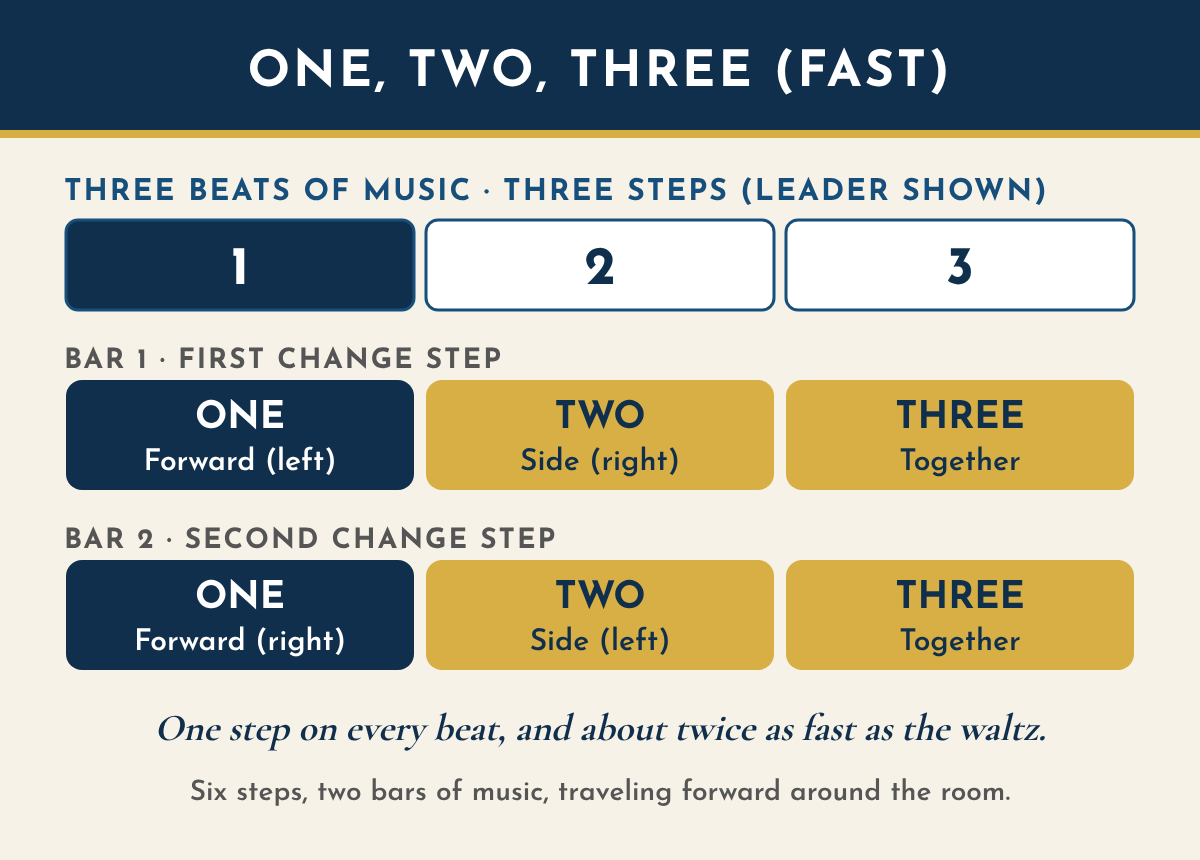
Viennese waltz or regular waltz?
Same three-beat music, very different feel. The regular waltz is slower and built on a box that stays in place. The Viennese waltz is fast and travels: in its classic form it’s made of just two things, turns and change steps, as its documented history puts it. This guide teaches the American (social) version, which allows more variety in positions and figures than International Standard, where couples stay in a closed hold. Choosing for a wedding? Read waltz or Viennese waltz for your first dance.
Step 2: Take a steady, closed hold
Start in a closed position, facing your partner, standing a little offset so each of you looks over the other’s right shoulder. At this speed, the hold is what lets two people move as one.
- Keep your arms toned, not stiff and not floppy, so a change in direction travels through the frame.
- Stand tall and look out, past your partner. Looking down at your feet pulls the whole couple off balance.
- Stay with your partner. In bronze-level American Smooth Viennese waltz, the hold isn’t released at all, according to the NDCA’s approved figures list.
Step 3: The leader’s change steps, step by step
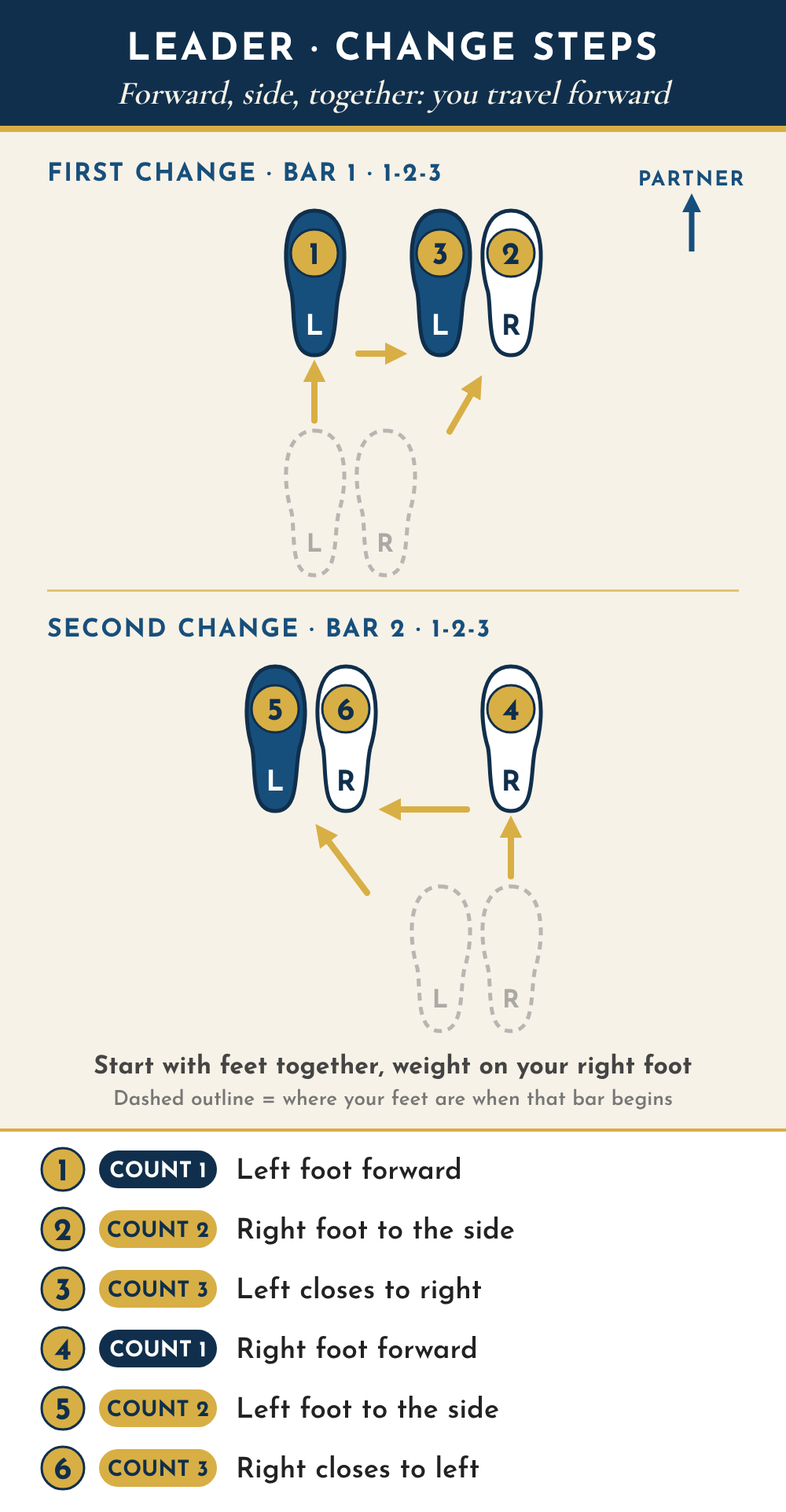
Start: feet together, facing your partner, weight on your right foot, so your left foot is free to move.
- One: step forward on your left foot.
- Two: step your right foot to the side, slightly forward.
- Three: close your left foot to your right and change weight.
- One: step forward on your right foot.
- Two: step your left foot to the side, slightly forward.
- Three: close your right foot to your left and change weight. You’ve traveled forward two bars, ready to go again.
Say it out loud: “Forward, side, together. Forward, side, together.” The pattern matches the forward change in the Round Dancing Viennese waltz figures and the closed change described on Wikipedia’s change step page.
Step 4: The follower’s change steps, step by step
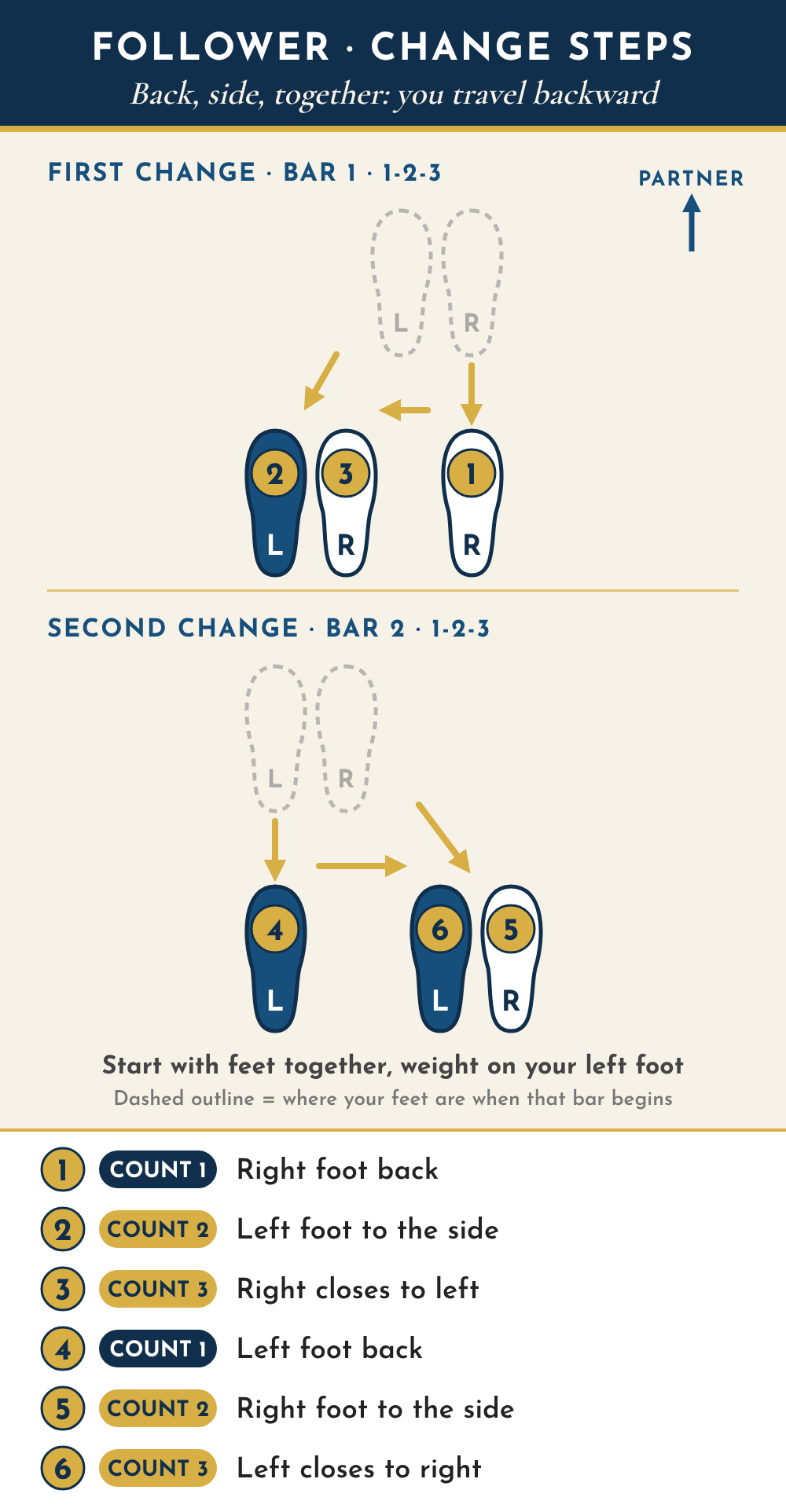
Start: feet together, facing your partner, weight on your left foot, so your right foot is free to move.
- One: step back on your right foot.
- Two: step your left foot to the side, slightly back.
- Three: close your right foot to your left and change weight.
- One: step back on your left foot.
- Two: step your right foot to the side, slightly back.
- Three: close your left foot to your right and change weight.
Your part is the mirror image of the leader’s: as the leader travels forward, you travel backward. Keep your steps a little smaller than feels natural.
Step 5: Put it together and travel
Take your hold and dance the change steps together: the leader moves forward, the follower moves back, and the couple travels. Start slowly and keep going until it feels automatic, at least eight change steps in a row.
On a real dance floor, everyone travels counterclockwise around the room, a path dancers call the line of dance. You’ll also meet backward change steps: the same pattern with the roles swapped, so the leader goes back, side, together and the follower comes forward, as the Round Dancing figure notes describe. Change steps are also how dancers switch between right and left turns, according to Wikipedia, so they’re the step you’ll use most.
Watch the count-along lesson (under 3 minutes)
This short video walks both parts step by step, then counts along with you at a slow practice tempo and again at Viennese waltz tempo. Press play and dance along; captions are available.
Read the video transcript
Let’s learn the Viennese waltz. It’s the fast, turning waltz, and it’s a showstopper at weddings and galas. You can start practicing it right where you are.
The Viennese waltz is counted one, two, three, just like the waltz, but about twice as fast. Each step takes one beat, and the one is the strong beat. Count it with me: one, two, three. One, two, three.
Your first step is the change step. It goes forward, side, together, then forward, side, together again on the other foot. Instead of drawing a box, it travels around the room.
Leaders, start with your feet together and your weight on your right foot. On one, step forward on your left foot. On two, step your right foot to the side. On three, close your left foot to your right.
Then do the same on the other foot. Forward on your right, side on your left, and close your right foot to your left. You’ve just traveled forward two bars.
Followers, you dance the mirror image, moving backward. Start with your weight on your left foot. One, back on your right. Two, side on your left. Three, close. Then back on your left, side on your right, and close.
Now let’s practice with the count. Listen for a deep tone on each one, and two lighter tones for two, three. Here we go, nice and slow.
[Practice tones at 120 beats per minute: a deep tone on each one, a lighter tone on two and on three.]
Now faster, at Viennese waltz tempo. Keep your steps small and let the music carry you.
[Practice tones at 159 beats per minute.]
Two quick reminders. At this speed, small steps are your friend. And always travel counterclockwise around the room, the same way everyone else on the dance floor is moving.
Want to dance it with an instructor? Ballroom by Amy teaches private lessons and group classes across the Twin Cities. Visit BallroomByAmy.com.
Instructor tip
Shrink your steps before you speed up. At Viennese waltz tempo, small steps keep you on the beat; big ones leave you a step behind.
General beginner advice, not a quote from Amy.
Hear the counts: two practice tracks
These original practice tracks (no music, just tones) play the Viennese waltz count for you. After three soft count-in clicks, a deep tone marks every one and a lighter tone marks two and three. Start with the slow track, then try dance tempo. Neither track plays automatically.
Slow practice · 120 beats per minute
Dance tempo · 159 beats per minute
What you’ll hear (text version)
Each track has no words or music. It opens with three quiet clicks to count you in. Then the pattern repeats every three beats: a deep tone on beat one, then a lighter, brighter tone on beat two and another on beat three. Each pattern is one change step. The slow track plays 32 bars in about 53 seconds, and the dance-tempo track plays 44 bars in about 52 seconds, matching the American Smooth competition tempo.
Beyond the change step: the turns
The turns are what make the Viennese waltz look like a Viennese waltz. They use the same three-step rhythm, but the couple rotates as it travels. They’re best learned with a teacher, slowly at first, but here’s what to look forward to:
Reverse turn (turning left)
The partner moving forward steps forward, side and crosses the free foot in front; the partner moving back steps back, side and closes. You swap roles each bar, turning about half a turn to the left every three steps, as BallroomDancers.com describes. Beginners often find it the harder turn.
Natural turn (turning right)
The same idea turning to the right, usually entered from a change step. The Round Dancing notes describe it as forward, side and back, close.
Hesitations and balance steps
Ways to pause or steady the couple without stopping the music. Balance steps and hesitations are on the bronze American Smooth list in the NDCA approved figures.
Start any turn with very little rotation, an eighth of a turn or less, and add more only when the change step feels easy at full speed.
Common mistakes and quick fixes
Taking big steps
Fix: keep every step small and close to the floor. Big steps make you late for the next one.
Looking at your feet
Fix: look out over your partner’s shoulder. Your feet will follow the frame.
Going against traffic
Fix: travel counterclockwise around the room, the same way as every other couple.
Dancing it to a slow song
Fix: if the song counts a slow, lilting “one, two, three,” it’s probably a regular waltz. Save the Viennese waltz for the fast ones.
Your five-minute practice
- Minute 1: play the count-along video above and count “one, two, three” out loud with it.
- Minutes 2-3: dance your own part alone, no music, traveling across the room and saying “forward, side, together” (or “back, side, together” for followers).
- Minute 4: play the slow practice track above and dance along with it.
- Minute 5: try the dance-tempo track. If it falls apart, go back to the slow one. That’s how everyone learns.
If finding the beat is the hard part, read why some songs make the beat hard to find.
|
Print the one-page Viennese waltz practice sheet |
Music, clothes and where you’ll dance it
The steps are only half the picture. Here’s what to play, what to wear, and where the Viennese waltz will actually come in handy.
What music works for the Viennese waltz?
Look for a fast song in 3/4 time with a clear, steady “one” at the start of each bar. Ballroom Pages’ Viennese waltz music guide suggests a quick test: clap only on the one. If you can keep clapping without losing it, the song will work. It also suggests beginners practice a little slower than competition speed, around 48 to 53 bars per minute. Classical favorites like Johann Strauss II’s The Blue Danube are the traditional choice, and plenty of modern songs work too.
Songs to try
- Iris, Goo Goo Dolls
- Breakaway, Kelly Clarkson
- Keep Holding On, Avril Lavigne
- I’ll Be, Edwin McCain
- Hero, Chad Kroeger
From the Viennese waltz titles on the RPI Ballroom Team’s music list. Tempos vary by recording, so test yours with the clap test before you plan around it. The practice tracks above are a good warm-up first.
What should you wear?
For lessons and practice
Clothes you can move in. Skip pencil skirts, scarves and long jewelry. Shoes matter most: smooth suede or leather soles that glide, with straps or laces that keep them on through the turns.
For a wedding or gala
A full skirt looks wonderful when it swirls, but check the hem clears your feet when you step back. Practice a few turns in your real shoes before the big night.
For competitions
Rules vary by event and level. Some newcomer and bronze events don’t allow costumes at all, so read the dress rules before you buy.
Avoid rubber soles, flip-flops and chunky or loose heels, which stick, slip or twist. Advice drawn from Supadance’s guide to dressing for ballroom; the costume example is from the Berkeley Classic’s competition rules.
Where will you dance the Viennese waltz?
- Wedding first dances. A Viennese waltz can be spectacular when your song is a fast 3/4, you have room to travel and time to practice, as Ballroom Pages notes; it isn’t the easiest first dance, so plan ahead. See wedding dance lessons and our guide to waltz or Viennese waltz for your first dance.
- Galas and formal balls. The fast waltz is a ballroom tradition at formal events, and the change step lets you join in. Here’s how to get ready for a gala dance floor.
- Ballroom socials. Ballroom variety nights can include a Viennese waltz among the other dances. Find nights on Where to Go Dancing in the Twin Cities.
- Competitions. The Viennese waltz is one of the American Smooth dances and one of the International Standard dances.
Because it travels, the Viennese waltz needs floor space and awareness of the couples around you. On a crowded floor, keep your steps small and follow the flow.
A little history
Where did the Viennese waltz come from?
The fast, turning waltz grew out of the German dance and the Ländler in Austria in the second half of the 18th century. Vienna opened huge dance halls for it, the Sperl in 1807 and the Apollo in 1808, and it reached England before 1812. The Congress of Vienna and the music of Josef Lanner, Johann Strauss I and Johann Strauss II spread it across Europe, and it became known as the Viennese waltz to tell it apart from the slower waltz, according to its documented history.
Next steps
Choose
Waltz or Viennese waltz for your first dance?
Learn
How to dance the foxtrot: the beginner basic
Learn
How to do the hustle: a party dance with Amy
|
Learn with Amy Want to whirl through a Viennese waltz at your wedding or next gala? Ballroom by Amy offers private lessons and group classes for dancers across the Twin Cities. Beginners are welcome, and no partner is needed. See private lessons Or call or text 612-308-7708. Amy typically replies within one business day. |
About Amy
Amy Hanson is the three-time defending Dancer’s Cup Tour Top Teacher. She has danced professionally and internationally and built friendships with dancers many people recognize from Dancing with the Stars. People who believe they’re not coordinated, confident, or good enough are exactly the beginners Amy loves to teach, and she also helps experienced dancers keep improving. No experience or partner is required.
Sources & Further Reading
- Ballroom Pages: Viennese Waltz Dance Guide. Character, American vs. International, natural and reverse turns, change steps, and first-dance advice.
- Ballroom Pages: Ballroom Dance Tempo Chart. NDCA tempos: American Smooth Viennese waltz 53 bars (159 beats) per minute; International 58 bars (174 beats).
- Ballroom Pages: Viennese Waltz Music. Choosing fast 3/4 songs, the clap-on-one test, beginner practice tempos and classical examples.
- Wikipedia: Viennese Waltz. History from the 18th century to the Strausses, about 180 beats per minute, turns and change steps, American vs. International.
- Wikipedia: Change Step. The closed change, one step per beat, and its role in switching between right and left turns.
- Round Dancing: Viennese Waltz Figures. Forward and backward change footwork, reverse turn and natural turn.
- BallroomDancers.com: Viennese Waltz Reverse Turn. Reverse turn footwork for the forward and backward partner and the amount of turn.
- NDCA: Approved Figures, Elements and Holds. Bronze American Smooth Viennese waltz figures and the rule that the hold isn’t released at bronze.
- RPI Ballroom Team: Music. Viennese waltz song titles.
- Supadance: How to Dress for Ballroom Dancing and Berkeley Classic: Competition Rules. Lesson clothes, shoes and a competition dress-rule example.
AI-Assisted Content Disclaimer
This educational guide was created with assistance from artificial intelligence (AI), including portions of the written content and visual materials. While we strive to provide accurate and helpful ballroom dance information, AI-generated content and illustrations may contain errors or inaccuracies, including in dance positions, footwork, timing, and technique.
Please independently verify important information and use your own judgment when practicing. Images are intended to support learning and may not always represent technically precise movements. For personalized guidance and instruction, consider learning directly with a qualified ballroom dance instructor.
Some images are AI-generated illustrations and do not show real people or places. The narration in the count-along lesson is an AI-generated voice. The footwork diagrams and practice tones were created for this guide.