
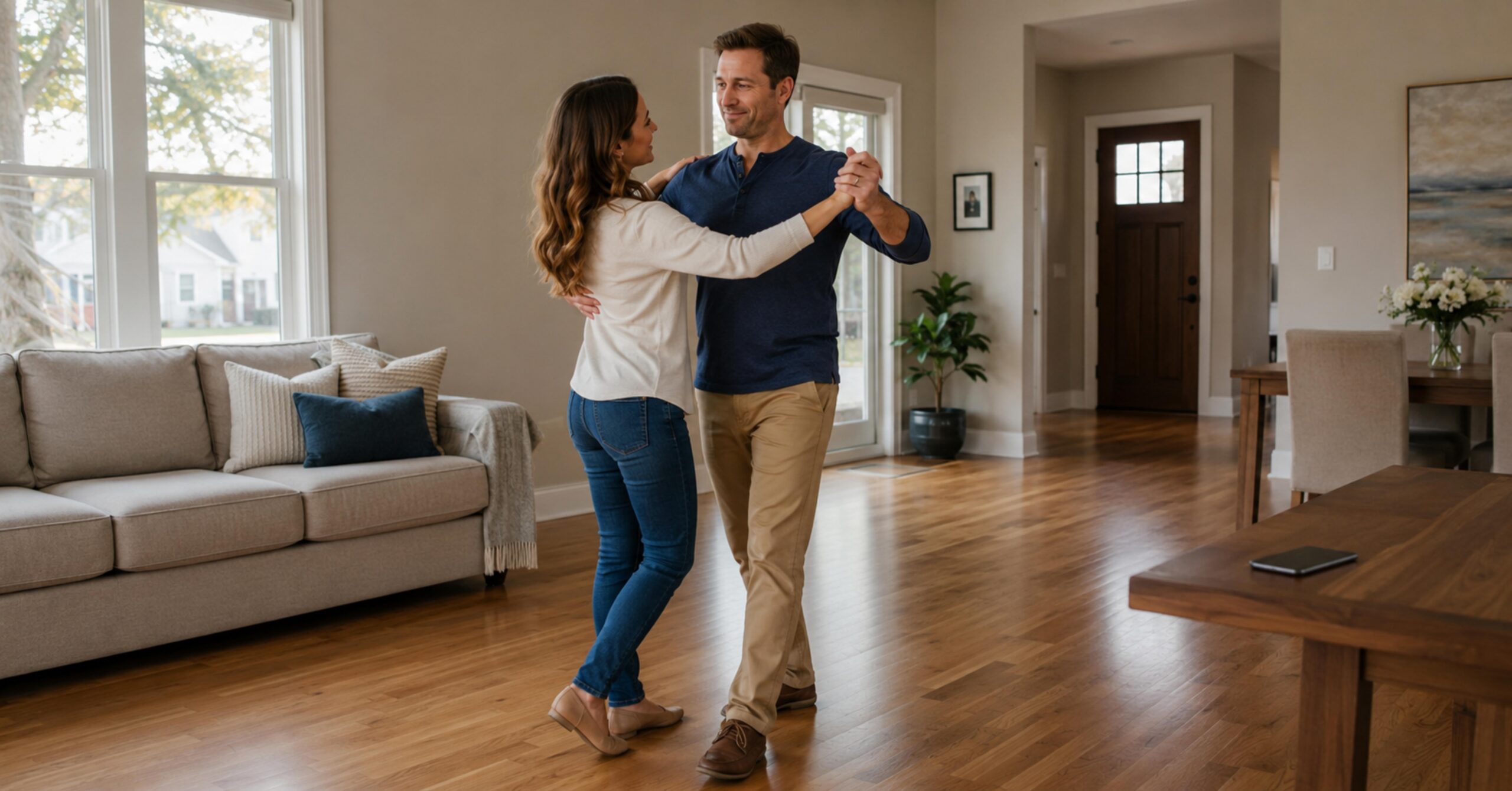
You finish a wedding dance lesson feeling surprisingly confident. The music starts, the steps make sense and you can finally picture yourselves enjoying the moment at your reception.
Then you try the dance at home the next evening—and suddenly neither of you can remember what comes after the first turn.
I want couples to know that this is completely normal. It does not mean you have no rhythm, that you were not paying attention or that you are incapable of learning to dance. It usually means the movement is still new and has not yet become automatic.
Ballroom dancing involves motor learning: the process of developing a movement skill through practice and experience. Early in that process, you may still need to think consciously about every count, foot placement and direction.
Why Can You Do the Dance During a Lesson but Not at Home?
During a lesson, you have more help than you may realize.
The studio, the instructor’s voice, the exact version of your song and even where you are standing can become cues that help you remember what happens next. Your instructor may also be giving small prompts—a count, a gesture or a change in expression—without interrupting the dance.
Once you get home, those cues disappear. You may be in a smaller room, using a different speaker, beginning in a different direction or trying to remember the dance without anyone providing the first count.
Research on context-dependent motor skills suggests that changing contextual cues can temporarily affect performance when a movement sequence has received only limited practice. That sensitivity can decrease as the skill receives more practice.
In everyday terms, the dance is not gone. Your brain may simply be learning how to retrieve it without the original set of hints.
Do Not Begin Every Practice With the Music
One of the most common mistakes I see is starting the song immediately and attempting to perform the entire dance from beginning to end.
If the couple gets lost, they restart the song. Then they get lost in the same place and restart it again. After several attempts, both people are frustrated and one person may begin correcting the other.
Instead, begin without the music.
- Stand in your starting position.
- Say the first two or three actions aloud.
- Walk through that small section slowly.
- Repeat it until you can begin without prompting each other.
- Add the next small section.
- Use the music only after the movement order feels familiar.
This separates two challenges: remembering the movement and matching it to the music. Beginners often struggle when they try to solve both at exactly the same time.
Practice the Beginning More Than Anything Else
The beginning deserves extra attention because it is your doorway into the rest of the dance.
If you know exactly where to stand, how to hold one another, when to begin and what the first movement feels like, you are much more likely to settle into the dance calmly.
Practice this short sequence several times:
- Walk into your starting position.
- Take your dance hold.
- Listen for your musical cue.
- Complete the first eight counts.
- Stop and reset.
The goal is not to exhaust yourselves. It is to make the opening feel familiar enough that you do not have to negotiate it on your wedding day.
Use Short Practices Instead of One Long Rehearsal
A focused practice of five to ten minutes can be more useful than a stressful 45-minute session once a week.
Guidance from the Cornell Learning Strategies Center explains that spaced practice—spreading learning across multiple sessions—generally supports stronger retention than cramming. Although its guidance is written for academic learning, the principle can also be useful when approaching a new dance sequence.
The National Institutes of Health has also reported research suggesting that short periods of rest may play an important role while the brain learns a new skill.
For most couples, a realistic schedule could look like this:
- Practice for five to ten minutes.
- Work on only one or two sections.
- Stop before either person becomes irritated.
- Return to it the next day or two days later.
Stopping while the practice still feels productive is often better than continuing until the dance becomes an argument.
Try the Dance Without Looking at Each Other for Answers
Couples sometimes develop a practice habit in which each person waits for the other to remember the next step. You may see the hesitation, exchange a worried look and then begin discussing whose foot was supposed to move.
Try walking through your own role independently for a moment. The leader can practice the direction and timing without a partner. The follower can do the same.
Then reconnect and try the section together.
This is not intended to remove the partnership from partner dancing. It simply helps each person take responsibility for remembering enough of their own movement that the other person does not have to carry them through the sequence.
Use a Video as a Reminder, Not as a Substitute for Practice
A short reference video can be helpful, especially when it shows your actual choreography from the angle you normally see it.
However, repeatedly watching the video is not the same as physically recalling the movement. Watch the section once, put the phone down and attempt it from memory.
This type of active recall is more useful than following the screen through every repetition. The effort required to retrieve the next action is part of the learning process.
If you record yourselves, keep the camera stationary and make sure your practice area is clear of furniture, loose rugs, pets, cords and other tripping hazards. Do not attempt lifts, drops or unsupported dips at home unless they have been specifically taught and approved for your abilities and practice environment.
Practice in More Than One Direction
A couple may unknowingly memorize the dance based on the room rather than the movement. For example, you may remember that the turn happens “toward the window” or that the traveling section goes “toward the mirror.”
That can create confusion when the reception space is arranged differently.
Once the choreography is reasonably comfortable, rotate your starting position and try the same small section facing another direction. You do not need to redesign the routine. The purpose is to make sure you understand the movement rather than relying entirely on a wall, mirror or piece of furniture as your cue.
This can be especially helpful for couples whose reception venue in Plymouth, Minneapolis, St. Paul or elsewhere in the Twin Cities has a different floor shape or orientation than the place where they normally practice.
Give Your Brain Time to Keep Learning
Sometimes a section that felt impossible at night feels more manageable the next day. That does not necessarily mean you were imagining the earlier difficulty.
Learning continues after the practice itself. Information from Harvard Health Publishing describes the relationship between sleep, learning and memory. Studies involving motor sequences have also found performance improvements after sleep, although the size and explanation of those improvements can vary.
This is another reason not to panic when a new step does not feel secure immediately. Practice it briefly, rest and return to it later.
What Should You Do When You Completely Forget a Section?
Do not invent five new versions of the step. That often makes the original choreography even harder to retrieve.
Instead:
- Stop the music.
- Return to the last position you remember confidently.
- Identify the single transition that is missing.
- Check your lesson notes or reference video.
- Practice only that transition a few times.
- Reconnect it to the section immediately before it.
If you are still unsure, make a note and ask about it at your next lesson. A quick clarification is usually more productive than repeatedly practicing a guess.
When Should You Ask Your Instructor for Help?
Ask for help when you repeatedly lose the dance in the same place, when the space at home makes a movement difficult or when you and your partner remember two different versions.
A good instructor can often simplify a transition, change the orientation, add a clearer cue or adjust the choreography to fit how you naturally move together.
If you are looking for wedding or ballroom dance guidance in Plymouth, St. Paul, Minneapolis or elsewhere in the Twin Cities, you can learn more at ballroombyamy.com. My goal is not to make your dance unnecessarily complicated. It is to help you feel comfortable, connected and prepared for the moment you actually want to enjoy.
The Most Important Thing to Remember
Forgetting part of your wedding dance at home does not erase the progress you made during your lesson.
Your dance is moving from something you consciously piece together into something your body can perform with less deliberate thought. That transition takes repetition, rest and patience.
Keep the practices brief. Work in small sections. Let yourselves make mistakes without assigning blame. The goal is not to produce a flawless performance in your living room. The goal is to make the dance familiar enough that you can be present with each other when the real music begins.
Sources and Further Reading
- Motor Learning — American Psychological Association Dictionary of Psychology
- Want to Learn a New Skill? Take Some Short Breaks — National Institutes of Health
- Effective Learning Strategies — Cornell University Learning Strategies Center
- Context-Dependent Motor Skill and the Role of Practice — PubMed
- Sleep Helps Learning and Memory — Harvard Health Publishing
- Minnesota Dancer, April 2026 — USA Dance Minnesota
This article was created with the assistance of artificial intelligence. Please verify important details independently. Some images may also be AI-assisted and are intended as general illustrations, not exact representations of any person, place, event, class or condition.