
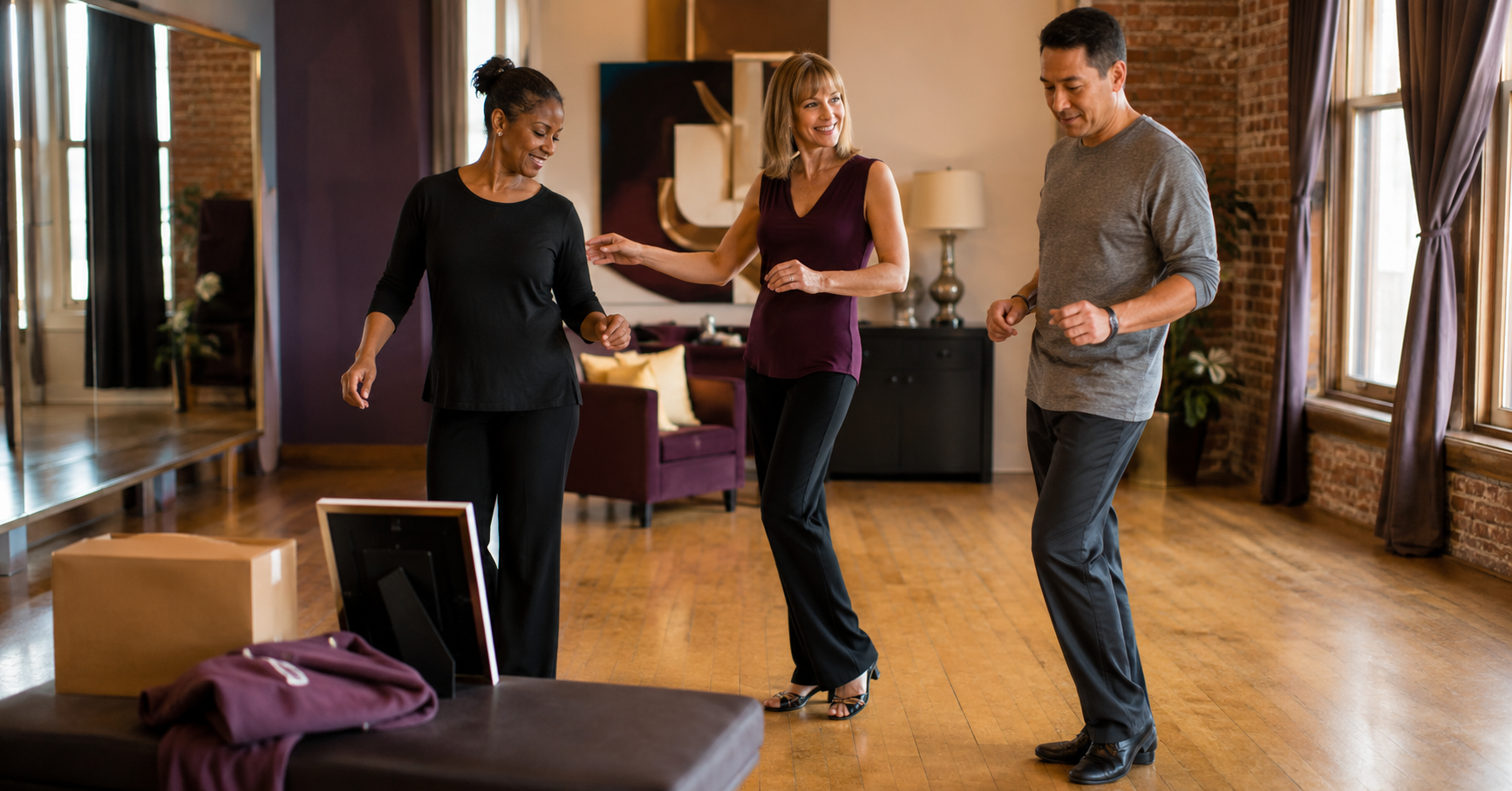
Empty nest dance lessons can give Twin Cities parents something enjoyable and genuinely new to anticipate after a child leaves for college, moves into an apartment or begins an independent life. That transition can feel exciting, emotional and strangely quiet at the same time. Ballroom dancing will not replace the role your children have played in your life, but it can help you build a routine centered on movement, connection, confidence and your own interests.
I meet many adults who have spent years organizing life around school calendars, practices, games, carpools, appointments and family obligations. When those responsibilities suddenly change, the open space on the calendar can feel liberating. It can also feel unfamiliar.
This is one reason late summer can be a wonderful time to begin dancing. You do not need a performance goal, previous experience or a grand plan. You simply need permission to try something that belongs to you.
Why Empty Nest Dance Lessons Feel Timely
Parents often prepare their children carefully for a departure while giving much less thought to their own transition. The dorm supplies are purchased. The moving date is scheduled. Transportation is planned. Then the child leaves, the house becomes quieter and the parent discovers that everyday life has changed too.
The American Psychological Association defines an empty nest as the family home after children have reached maturity and left. Mayo Clinic experts emphasize that this is a normal life stage rather than an illness, although some parents experience feelings of loss, fear, loneliness or uncertainty about their identity.
Not everyone reacts the same way. Some parents immediately enjoy the additional freedom. Some miss the noise and activity. Many experience both responses within the same afternoon.
I do not believe you need to label the experience before doing something positive with it. Empty nest dance lessons can become one new point on your weekly calendar: a place to move, laugh, concentrate and engage with another person instead of sitting at home wondering why the refrigerator is suddenly still full.
Ballroom Dancing Gives the Week Structure
One underrated benefit of a regular lesson is that it creates a dependable rhythm in the week.
When children live at home, family routines often develop automatically. There are pickup times, dinners, activities and places everyone needs to be. After those obligations disappear, couples and single parents may discover that evenings drift by without much intention.
A dance lesson is not simply another appointment. It is active time with a purpose. You arrive, learn something specific, practice it and leave with a small sense of progress.
That progress matters. Learning a basic turn, recognizing a rhythm or completing an entire song can remind you that growth does not stop when your children become adults. You still get to be a beginner. You still get to surprise yourself.
Empty Nest Dance Lessons Can Help Couples Reconnect
Parenting can turn a couple into an exceptionally efficient management team. You become good at calendars, meals, transportation, bills and solving the emergency directly in front of you.
That teamwork is valuable, but it can gradually replace more playful forms of connection. When the children leave, couples sometimes look at each other and realize they have not shared a new hobby in years.
Partner dancing provides a different kind of interaction. You have to pay attention to one another. You communicate through timing, posture, pressure and movement. You make mistakes together. You often laugh together.
You also have something to discuss besides the house, the children and what needs to be done next.
The goal is not to transform date night into a competition. In my lessons, I can adjust the pace so both partners feel successful. If one person learns more quickly, I do not let that person take over the lesson or turn into the other partner’s instructor. Each person has a role, and both roles matter.
You Do Not Need Equal Experience
Many couples delay lessons because one partner has danced before and the other has not. That difference is normal.
One person may hear music easily while the other focuses more on the mechanics. One may enjoy being watched while the other would prefer that no one notice them for at least six months. Those differences do not disqualify you. They simply help me understand how to teach you.
If rhythm is the concern, my article about why some songs make the beat difficult to hear explains why struggling with music does not mean you are incapable of dancing.
You Can Take Empty Nest Dance Lessons Alone
You do not need a spouse, date or permanent dance partner to begin.
This is especially important for single parents, divorced adults, widowed adults and people whose partners simply are not interested in dancing. Your opportunity to learn should not depend on persuading someone else.
In a private lesson, I can dance with you while teaching both the movement and the communication involved in partner dancing. You can build skills before deciding whether you want to attend a social event, dance with friends or invite someone else to join you later.
Beginning alone can actually remove pressure. You are free to learn at your own pace without comparing your progress with another beginner.
Public dance discussions frequently contain versions of the same concern: “Will everyone else already know what they are doing?” The answer is that every confident dancer once walked into a first lesson without knowing the vocabulary, etiquette or basic step.
You are not arriving late. You are arriving at the beginning.
Dancing Combines Movement With Mental Engagement
Adults are generally advised to build regular physical activity into their week. The Centers for Disease Control and Prevention recommends at least 150 minutes of moderate-intensity aerobic activity each week, while also emphasizing that some activity is better than none and that movement can be divided into smaller portions.
Dance can contribute to an active lifestyle, but I never present one lesson as a substitute for a complete fitness or medical plan. The intensity varies by dance, lesson and individual. Anyone with health concerns should seek appropriate medical guidance.
What makes ballroom dancing interesting is that your mind remains involved while your body moves. You are listening to music, remembering a pattern, responding to a partner and adjusting your position in the room.
Research involving partnered dancers has found that participants commonly report perceived physical, cognitive, emotional and social benefits. Those findings do not prove that dance produces identical results for everyone, but they help explain why many adults remain engaged longer than they do with repetitive exercise they do not enjoy.
You can read more about the learning side of dancing in my article on why ballroom dancing feels like a mental challenge.
Empty Nest Dance Lessons Create Real Interaction
There is a difference between having an occupied calendar and feeling connected.
Social isolation describes a lack of regular social contact, while loneliness refers to the distressing feeling of being separated or disconnected. A person can live alone without feeling lonely, and someone can feel lonely while surrounded by people.
National Institute on Aging guidance encourages adults to take part in meaningful activities and find ways to maintain social connections. A recent cross-sectional study of adults ages 45 to 70 found that ballroom dance participation was associated with stronger social connection, less loneliness and more positive attitudes toward aging. Because the study observed people at one point in time, it cannot show that ballroom dancing caused those outcomes. It does, however, support further study of ballroom dancing as a socially engaging activity.
The interaction in partner dancing is immediate. You are not sitting beside someone while both of you look at separate screens. You are sharing timing, space and attention.
That does not mean you must become an extrovert. Private lessons can provide a comfortable first step for someone who wants connection without entering a large social setting right away.
You Are Allowed to Do Something Just Because It Is Fun
Parents are accustomed to justifying activities by explaining how those activities benefit someone else.
You attend the game because your child is playing. You volunteer because the team needs help. You drive because someone needs transportation. You sacrifice because that is part of loving a family.
After years of that thinking, it can feel surprisingly uncomfortable to spend time and money on something simply because you enjoy it.
Enjoyment is a legitimate reason.
You may want to dance because you love music. You may want a date-night activity. You may want to feel more comfortable at weddings, parties or community events. You may want exercise that does not feel like staring at a machine. You may just be curious.
Empty nest dance lessons do not need to solve a crisis to be worthwhile. Sometimes a healthy new chapter begins with an activity that makes Tuesday evening more interesting.
What Your First Lesson Will Actually Be Like
Your first lesson should not feel like an audition.
I will want to understand what brought you in, what music you enjoy, whether you have any previous experience and what would make dancing feel valuable to you.
We may begin with a simple weight change, walking movement or basic rhythm. I will pay attention to how you learn. Some students want to see a demonstration. Some need a verbal explanation. Others understand the movement only after trying it several times.
You will not be expected to memorize an entire routine. You do not need special clothing. Comfortable attire that allows movement is enough, along with secure shoes that will stay on your feet.
You also do not need a large practice area at home. My guide to practicing ballroom dancing in a small space explains how useful work can happen with only a few feet of clear floor.
You Will Not Be Judged for Starting From Zero
Some of my favorite students begin by warning me that they have no rhythm, no coordination and no business being in a dance lesson.
Those statements are not proof that someone cannot learn. They usually mean the person feels vulnerable doing something unfamiliar.
My job is to make the movement understandable, adjust it to the student and create enough early success that embarrassment stops controlling the experience.
Choosing a Dance That Fits Your New Chapter
You do not need to choose a dance before contacting me. We can start with your music and goals.
Different dances create different experiences:
- Rumba can feel relaxed, connected and adaptable to many familiar songs.
- Single-time swing can be playful and approachable for upbeat music.
- Hustle works well for many disco and contemporary party songs.
- Foxtrot offers smooth movement and a classic social-dance feeling.
- Waltz can provide a flowing challenge for students drawn to elegant music.
- Cha-cha brings sharper rhythm and lively personality.
The best starting dance is not necessarily the one that looks most impressive online. It is the one that gives you an understandable entry point and makes you want to return.
How to Make Empty Nest Dance Lessons Last
A common mistake with any new hobby is expecting immediate transformation.
You do not need to become “a dancer” after one lesson. Begin with a smaller commitment:
- Schedule the first lesson.
- Choose one dance or one usable skill.
- Practice for a few minutes between lessons.
- Notice one improvement at a time.
- Decide what you want to explore next.
A short, consistent practice is often more helpful than one exhausting session. Practice the starting position, a basic movement or the transition that feels least certain. Stop before frustration takes over.
For couples, I also recommend separating practice from correction. Agree that you are working together rather than evaluating each other. When something is not working, bring the question to me instead of arguing about who remembered it correctly.
There Is No Correct Way to Have an Empty Nest
Some parents feel grief. Some feel relief. Some rediscover their relationship. Others discover they need a broader community outside the relationship. Some children remain nearby. Others move across the country. Some come home again much sooner than expected.
Research on empty-nest transitions is mixed. Some studies associate the transition with emotional difficulty or isolation, while others report stable or improved well-being. That is an important reminder not to assume every parent will experience the same story.
Empty nest dance lessons are not based on the idea that something is wrong with you. They are based on the possibility that this transition has created room for something new.
A New Routine Can Begin in St. Paul
I teach adults from St. Paul, Minneapolis, Roseville, Shoreview, Woodbury, Maplewood, White Bear Lake, Plymouth and communities throughout the Twin Cities.
You may come as a couple looking for a shared activity. You may come alone because dancing has always interested you. You may feel confident. You may feel completely uncoordinated.
All of those starting points are welcome.
Empty nest dance lessons can become exercise, date night, personal development, social preparation or simply a source of fun. The lesson will be shaped around what you want from it—not around an assumption that every adult should have the same goal.
Visit Ballroom by Amy to learn more, or contact me at 612-308-7708 or Amy@BallroomByAmy.com to schedule a lesson and ask questions.
About Amy Hanson
Amy Hanson is the three-time defending Dancers Cup Tour Top Teacher. She has danced professionally and internationally and has built friendships with dancers many people recognize from Dancing with the Stars.
People who think they are not coordinated, confident or good enough are exactly the beginners Amy loves to teach. No experience or partner is required.
Website: ballroombyamy.com
Phone: 612-308-7708
Email: Amy@BallroomByAmy.com
Sources
- Mayo Clinic Press: Empty Nest Syndrome and Adjusting After Children Leave Home
- American Psychological Association: Empty Nest Definition
- National Institute on Aging: Loneliness, Social Isolation and Staying Connected
- Centers for Disease Control and Prevention: Physical Activity Guidelines for Adults
- Frontiers in Psychology: Ballroom Dance, Social Connection, Loneliness and Positive Aging
- PubMed: Perceived Benefits of Modern Partnered Dancing
- National Library of Medicine: Empty-Nest Transitions and Subjective Well-Being
This article includes content supported by AI. While we strive for accuracy, please use your own judgment and double-check details as needed. Photos may use AI-generated or AI-assisted imagery when applicable.