
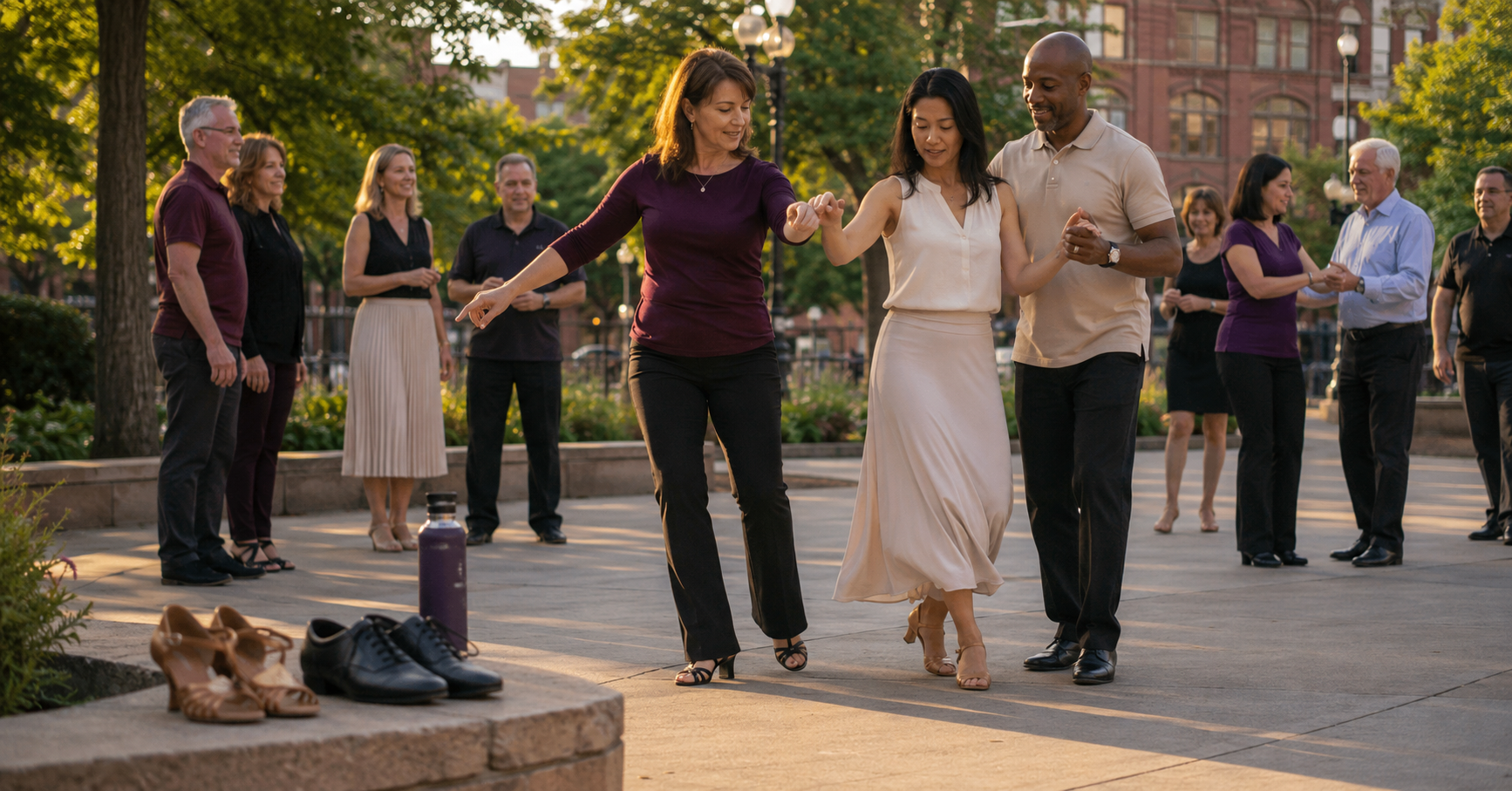
Outdoor Ballroom Dancing: How to Enjoy Twin Cities Summer Events Without Fighting the Floor
Outdoor ballroom dancing gives Twin Cities adults a fun way to enjoy music, movement and community during Minnesota’s short outdoor season. It can also feel surprisingly different from dancing in a studio. Concrete resists your turns, humid air changes your energy, wind competes with the music and a perfectly flat-looking plaza may contain cracks, slopes or damp patches. The answer is not to avoid outdoor dancing. It is to adjust your shoes, steps and expectations to the setting.
Summer dance opportunities are appearing throughout the metro. Ballroom in the Park in downtown St. Paul offers free beginner-friendly classes with no experience or partner required. The regional dance community is also gathering for events such as Dancing in the Park at Harriet Island, which includes several participatory dance traditions and live music.
These events can be a welcoming bridge between private lessons and social dancing. However, dancing outside is not simply indoor dancing with a prettier background. The floor, footwear, weather and available space all affect how comfortably you can move.
Why Outdoor Ballroom Dancing Feels Different
In a ballroom studio, the floor is usually smooth, level and designed—or at least maintained—for dancing. You can predict how your shoes will grip and how easily your feet will rotate.
Outdoor surfaces are built primarily for walking, drainage and durability. A public plaza may be concrete, stone, brick, composite decking or painted pavement. Those materials can create more friction than a traditional dance floor. Even when the surface looks smooth, it may not allow the foot to rotate freely.
A review of dance-injury prevention research notes that dancers generally prefer sprung floors over unyielding surfaces such as concrete. The authors explain that flooring characteristics influence the forces absorbed by a dancer’s body. That research addresses dance broadly rather than casual ballroom events specifically, but it supports a practical point: the floor beneath you matters. Read the review of dance-injury prevention and flooring considerations.
This does not mean one relaxed evening on a plaza will automatically cause an injury. It means you should respect the surface rather than trying to force your normal studio movement onto it.
Choose Shoes for the Surface
Traditional ballroom shoes often have suede soles. Suede provides a useful balance of grip and glide on a clean indoor dance floor, but it is generally a poor choice for pavement, damp ground or rough concrete.
An outdoor surface can quickly damage suede. Dirt and moisture can also affect how the shoes behave when you return indoors. I recommend keeping your indoor dance shoes separate from anything worn outside.
For outdoor ballroom dancing, look for secure shoes with:
- A sole that can tolerate concrete or pavement.
- Enough flexibility to let the foot move naturally.
- A secure heel that does not lift out of the shoe.
- Good support without an extremely sticky tread.
- A closed or protected toe when the surface is uneven.
- A heel height you can manage on slopes and cracks.
A clean, lightweight sneaker may be a practical choice for a beginner. The challenge is finding a sole that is not so sticky that it stops the foot abruptly during a turn. You do not need to buy specialized shoes before attending one community event, but you should test your footwear before dancing for an hour.
Perform a Small Turn Test
Stand near a stable support and gently rotate the ball of one foot a small amount. Do not attempt a full spin.
If the shoe grips so strongly that your foot cannot rotate without twisting your knee, avoid repeated pivots in that shoe. If the shoe slides unpredictably, it is also not a good choice.
The goal is not maximum slipperiness. The goal is controlled movement.
Make Your Steps Smaller on Concrete
Outdoor events are not the place to prove how large you can make every step. Smaller movement is usually more useful.
Reducing your stride can help you:
- Maintain balance on an unfamiliar surface.
- Avoid cracks, seams and other dancers.
- Reduce the force of each landing.
- Respond more quickly when space changes.
- Keep your partnership compact in a crowd.
Many beginners assume that a dance will look better if they travel farther. In reality, clear timing and connected movement usually look more confident than oversized steps.
During outdoor ballroom dancing, think about placing each foot rather than throwing it. Keep your knees relaxed, allow your body weight to settle and avoid pounding into the ground.
Replace Sharp Pivots With Gentle Rotations
A turn that feels easy on hardwood may feel stuck on concrete. Trying to force it can send the turning pressure into the ankle or knee.
I may adapt a student’s outdoor movement by:
- Dividing one large rotation into two smaller actions.
- Using walking turns instead of planted pivots.
- Reducing the number of consecutive spins.
- Keeping the feet closer together.
- Changing the direction of travel.
- Replacing a turn with a simple underarm pass.
This is not “watering down” the dancing. It is making the movement fit the environment.
A good social dancer does not execute the same pattern in exactly the same way everywhere. A good social dancer notices the floor, available space and partner before choosing how much movement to use.
Outdoor Ballroom Dancing Requires Better Floor Awareness
Before the music starts, walk across the area where people will dance.
Look for:
- Cracks or raised seams.
- Loose gravel and sand.
- Damp spots or spilled drinks.
- Drain covers.
- Changes in slope.
- Cords running to speakers or lights.
- Furniture extending into the dance space.
- Areas where people frequently walk through.
Do not assume the center is automatically the safest area. Sometimes the edge provides a smoother surface and more predictable traffic.
When dancing with a partner, the person moving forward generally has a better view of the space ahead. That person should help protect the partner who is moving backward. Both dancers still share responsibility for keeping the movement controlled.
My article about adapting ballroom movement on a crowded floor offers additional strategies that also apply to busy outdoor events.
Do Not Compete With the Wind
Wind affects more than hair and clothing. It can make music harder to hear, especially when speakers are pointed away from you or surrounding conversations become loud.
Move closer to the music source without standing directly in front of a speaker. Listen for a repeating pulse rather than trying to hear every instrument or lyric.
If the music becomes difficult to follow, simplify. Return to a basic pattern and let your partner feel the timing through your body movement.
People sometimes interpret losing the beat outdoors as a failure of rhythm. The setting may simply be hiding the musical information you normally rely on. My guide to hearing the beat in difficult songs explains how to find a steadier musical reference.
Heat and Humidity Change the Experience
Even gentle dancing creates body heat. Warm temperatures, direct sun and high humidity can make an outdoor event feel more physically demanding than an indoor lesson.
The Centers for Disease Control and Prevention’s heat guidance for physical activity notes that people exercising on hot days face greater risks of dehydration and heat-related illness. It recommends limiting activity during the hottest part of the day when possible and stopping if you feel faint or weak.
The National Weather Service’s outdoor heat-safety guidance also emphasizes hydration and stopping activity when heat causes concerning physical symptoms.
For outdoor ballroom dancing in warm weather:
- Bring water rather than assuming it will be available.
- Take breaks before you feel exhausted.
- Use shade whenever possible.
- Choose breathable clothing.
- Reduce the intensity of fast dances.
- Avoid treating dizziness or unusual weakness as something to “push through.”
Muscle cramping, headache, nausea, dizziness, confusion and unusual weakness can be warning signs of heat-related illness. Stop dancing, move to a cooler place and seek appropriate help when symptoms are concerning.
Anyone with medical conditions or symptoms that may affect exercise tolerance should consult an appropriate healthcare professional. A social dance event is supposed to be enjoyable, not a test of endurance.
Dress for Movement, Not Just the Photograph
Outdoor social dancing often attracts people who are also attending a concert, festival, dinner or neighborhood event. You do not need formal ballroom clothing.
Choose clothing that lets you move without requiring constant adjustment. Consider:
- Lightweight fabrics that breathe.
- A layer that can be removed as you warm up.
- A secure neckline and waistband.
- Sleeves that allow comfortable arm movement.
- A skirt length that will not catch under your shoes.
- Pockets or a secure place for essential belongings.
Loose accessories, oversized bags and long straps can interfere with a partner or another dancer. Place belongings away from the dance area rather than leaving them at the edge where someone may trip.
Start With Dances That Adapt Well
Almost any ballroom style can be adjusted for an outdoor setting, but some movements are easier to compact than others.
Beginner-friendly possibilities include:
- Rumba: Compact, controlled and adaptable to many familiar songs.
- Single-time swing: Playful and easy to simplify when space is limited.
- Hustle: Useful for party music when turns are adjusted to the surface.
- Cha-cha: Energetic, but manageable with smaller steps.
- Foxtrot: Enjoyable when there is enough smooth space for controlled travel.
Fast jive, large traveling patterns and repeated spins may require more modification on hard pavement.
The best dance is not the one with the most impressive name. It is the dance that fits the music, surface, available space and comfort of both partners.
What Beginners Should Expect at a Public Outdoor Lesson
Many Twin Cities community events explicitly welcome beginners and people without partners. The St. Paul outdoor ballroom series, for example, describes its classes as open to all levels and says no partner or experience is required.
At a public lesson, you may encounter:
- A wide range of experience levels.
- Partner rotation or optional partner changes.
- Music that is harder to hear than studio music.
- Limited individual correction.
- People joining after the lesson has begun.
- A social-dance period after the instruction.
You are not expected to master everything. Choose one useful idea and enjoy the experience.
A private lesson beforehand can make the public event feel less intimidating. We can practice the likely dance, talk about etiquette and create a simple home-base movement you can use whenever you become uncertain.
You Do Not Need a Partner
Public dance listings often emphasize that participants may attend alone. That is important because many adults postpone dancing while waiting for a spouse, friend or date to become interested.
You can begin privately with me, learn the roles involved in partner dancing and arrive at a community event with a clearer sense of what to expect.
Attending alone also does not require you to dance with everyone who asks. You may accept or decline an invitation politely. Your boundaries remain valid in every dance setting.
Keep an Indoor Backup Plan
Minnesota summer weather can change quickly. Rain can make brick, wood and pavement unsafe even after the storm has passed. High heat, poor air quality or severe weather may also cause an event to be moved or canceled.
Check the organizer’s official page before leaving home. Bring an extra pair of shoes and a light layer. Know where you can take shelter, and do not continue dancing when the event organizer has paused activities because of weather.
A wet surface is not improved by dancing more cautiously. When traction is unpredictable, stop.
Use Outdoor Events as Practice, Not a Final Exam
Outdoor ballroom dancing can reveal useful skills that are harder to develop in a controlled studio:
- Adjusting to unfamiliar music.
- Keeping steps compact.
- Communicating in a distracting environment.
- Recovering without stopping.
- Watching the space around you.
- Dancing with different levels of energy.
You may not dance as smoothly outside as you do in a lesson. That is normal. The environment is asking more of your attention.
Notice what becomes difficult. Did your shoes grip? Did you lose the beat? Did your steps become too large? Did you become tired more quickly than expected? Those observations give us useful material for your next lesson.
Practice Outdoor Ballroom Dancing Before the Event
You do not need to rehearse on a public sidewalk. We can simulate many of the challenges indoors by practicing:
- Smaller steps.
- Walking turns instead of sharp pivots.
- A simple recovery pattern.
- Movement in a compact area.
- Dancing to quieter or less familiar music.
- Changing direction when space disappears.
You can also use my guide to practicing ballroom dancing in a small space to develop control without needing a studio-sized room.
Enjoy the Setting Without Forcing the Dancing
One of the best parts of an outdoor dance event is that it does not need to be perfect. You are outside, music is playing and people are gathering around a shared activity.
Dance one song and sit out the next. Watch other dancers. Try a beginner lesson. Ask questions. Leave before you are exhausted. The goal is not to prove that you can reproduce your studio dancing on concrete.
The goal is to enjoy the experience while taking care of yourself and your partner.
Outdoor ballroom dancing works best when you choose practical shoes, use smaller steps, reduce forced pivots, monitor the weather and remain willing to simplify. Those adjustments do not make you less of a dancer. They show that you understand social dancing is about adapting to the real room—or park—in front of you.
I teach adults from St. Paul, Minneapolis, Roseville, Shoreview, Woodbury, Maplewood, White Bear Lake, Plymouth and communities throughout the Twin Cities. You may begin alone or with a partner, and no previous experience is required.
Visit Ballroom by Amy, call 612-308-7708 or email Amy@BallroomByAmy.com to schedule a lesson and ask questions.
About Amy Hanson
Amy Hanson is the three-time defending Dancers Cup Tour Top Teacher. She has danced professionally and internationally and has built friendships with dancers many people recognize from Dancing with the Stars.
People who think they are not coordinated, confident or good enough are exactly the beginners Amy loves to teach. No experience or partner is required.
Website: ballroombyamy.com
Phone: 612-308-7708
Email: Amy@BallroomByAmy.com
Sources
- Visit Saint Paul: Ballroom in the Park
- DanceMN: Dancing in the Park at Harriet Island
- National Library of Medicine: Preventing Dance Injuries—Current Perspectives
- Centers for Disease Control and Prevention: Heat and Physical Activity
- National Weather Service: Outdoor Heat Safety and Preparedness
- University of Minnesota Ballroom Dance Club
This article includes content supported by AI. While we strive for accuracy, please use your own judgment and double-check details as needed. Photos may use AI-generated or AI-assisted imagery when applicable.