
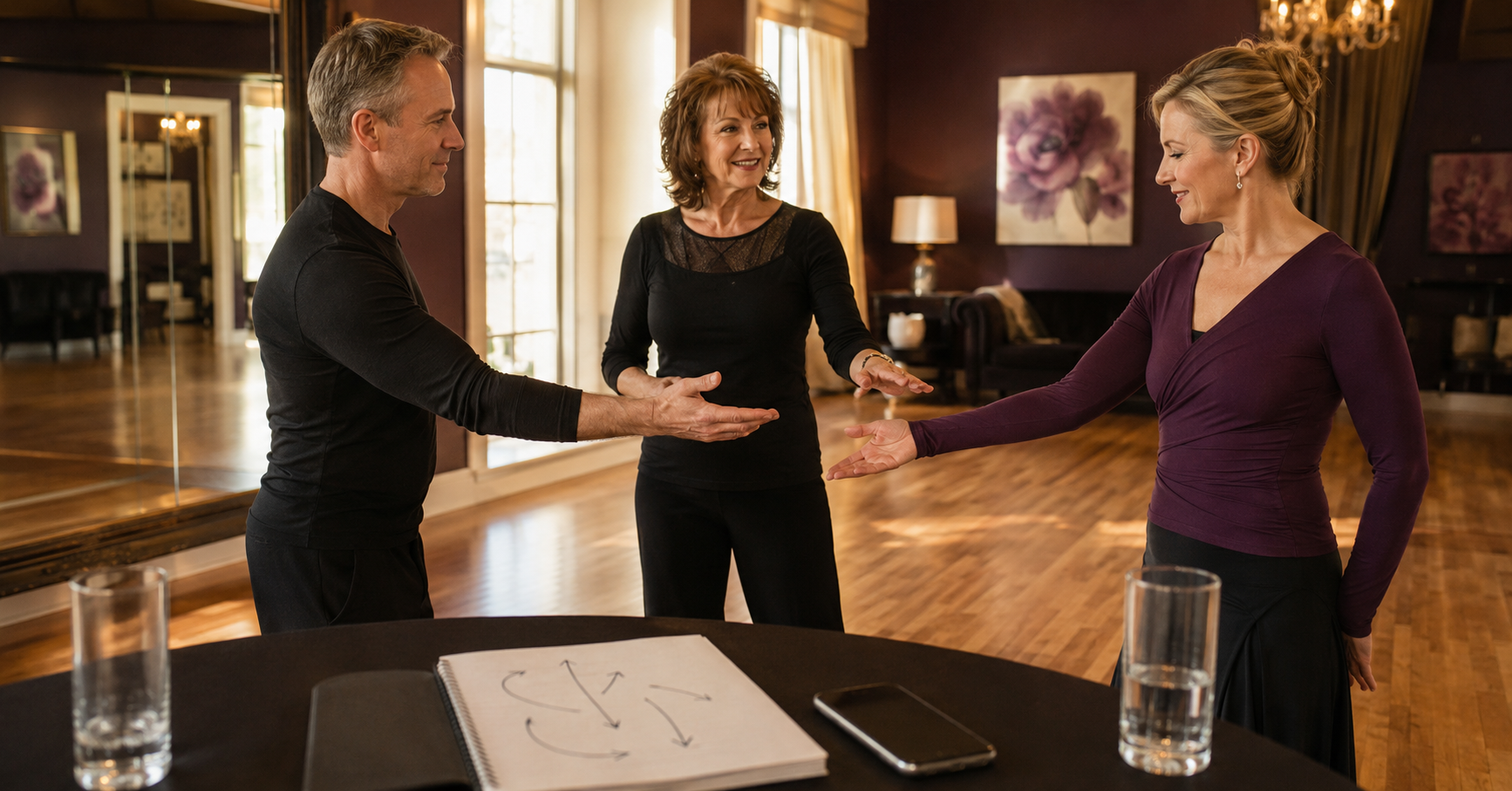
Learning to practice dancing without arguing may be more important for a couple’s progress than squeezing one more turn into a routine. Many couples enjoy their lessons, leave feeling optimistic and then become frustrated at home because one person starts correcting, coaching or blaming the other. A practice session that was supposed to be fun quickly becomes a debate about who missed the step, who lost the beat and whose version of the instructor’s explanation was correct.
I understand why this happens. Partner dancing requires two people to coordinate movement, timing and communication while learning different responsibilities. When something goes wrong, each person feels a different part of the problem. Both may sincerely believe the other person caused it.
The solution is not to stop practicing together. It is to stop treating home practice like an unsupervised private lesson.
Why Couples Struggle to Practice Dancing Without Arguing
In a lesson, I am responsible for diagnosing the problem. I can watch both partners, identify where the movement begins to break down and decide what each person needs to change.
At home, neither partner has that neutral view. The leader may feel that a signal was clearly given. The follower may feel no usable signal at all. The follower may anticipate a familiar pattern, causing the leader to feel ignored. The leader may change the timing while believing the follower fell behind.
Partner dancing is built on interaction rather than two separate people performing independent steps. Research involving partner dancers has found meaningful relationships between nonverbal communication and dancers’ engagement in the activity. The study does not tell us how any individual couple should practice, but it reinforces how central physical communication is to partner dancing. You can review the research on nonverbal communication in partner dance.
When the connection fails, the problem may not belong entirely to either person. It may exist in the communication between them.
Rule One: Do Not Become Your Partner’s Instructor
The fastest way to make practice unpleasant is for one student to assume the role of teacher.
That can sound like:
- “You are stepping on the wrong foot.”
- “You are supposed to turn now.”
- “That is not what Amy said.”
- “You keep doing the same thing wrong.”
- “Just let me show you how to do it.”
The person speaking may genuinely be trying to help. The person receiving the correction may hear criticism, impatience or superiority.
A long-standing piece of informal ballroom culture warns dancers against constantly correcting their partners. An entry in the USC Digital Folklore Archives documents this advice as a commonly shared partnership rule. It is not a scientific study or universal law, but it captures something many dancers learn through experience: constant partner correction can damage trust faster than it improves technique.
During home practice, your partner is your teammate—not your substitute instructor.
Practice Dancing Without Arguing by Agreeing on the Goal
Before the music starts, decide what you are practicing.
“Let’s practice dancing” is too broad. It leaves both people free to evaluate every step, turn, arm position and timing issue they notice.
Choose one narrow goal:
- Starting on the correct musical count.
- Completing one basic pattern without stopping.
- Making one transition feel more comfortable.
- Keeping the steps small.
- Practicing the entrance to a wedding dance.
- Recovering when either person forgets what comes next.
Everything else is temporarily outside the assignment.
If you are practicing the beginning of the dance, do not interrupt the session to debate hand styling. If you are working on timing, do not turn it into a discussion about posture, shoe placement and facial expression.
A narrow goal gives the practice session a finish line.
Ask Before Giving Dance Feedback
A simple question can completely change the tone of practice:
“Would you like feedback, or should we try it again?”
That question gives your partner a degree of control. They may already know what went wrong. They may need another attempt before hearing an explanation. They may want to describe what they felt first.
Motor-learning research has found potential benefits when learners have some control over when and how they receive feedback. The evidence comes from many kinds of movement tasks rather than married couples practicing ballroom dancing, so it should not be stretched into a guarantee. Still, it supports the practical value of giving the learner some agency. A recent review describes how autonomy, expectations and social context can affect motor learning. Read the socially embedded motor-learning framework.
You can also agree on a feedback rule before practicing:
- Feedback only when requested.
- One observation after three attempts.
- Questions instead of instructions.
- No corrections while the music is playing.
- Save unresolved issues for the next lesson.
Describe What You Felt, Not What Your Partner Did
Compare these two statements:
“You did not lead the turn.”
“I did not feel where the turn was beginning.”
The first statement declares fault. The second describes an experience.
Or compare:
“You keep going too fast.”
“I am having trouble staying balanced at this speed.”
Describing your experience creates room for both people to investigate. Declaring what your partner did wrong invites a defense.
The Gottman Institute describes how criticism can trigger defensiveness and create a repeating conflict cycle. Its guidance is about relationships generally, not ballroom technique, but it is highly relevant when dance feedback starts sounding like a character judgment. The institute recommends replacing personal criticism with a gentler explanation of the situation, feeling and need. Read its discussion of the criticism-defensiveness cycle.
Remove “Always” and “Never” From Practice
Statements such as “You always rush” or “You never listen” are much larger than the movement you are practicing.
Talk about the current attempt:
- “That one felt faster to me.”
- “I lost the connection before the turn.”
- “Could we make the next step smaller?”
- “Can we try that without music?”
Keep the conversation attached to an observable moment rather than turning it into an assessment of your partner.
Use Questions to Practice Dancing Without Arguing
Questions are often more productive than corrections.
Try:
- “Where did that start feeling uncertain?”
- “Would a smaller step help?”
- “Should we try it once without the turn?”
- “What did you feel from me?”
- “Do we remember the same ending?”
- “Should we record this and ask Amy?”
A question does not guarantee agreement. It does signal that both perspectives matter.
A qualitative dissertation involving five couples explored partner dancing within a couples-therapy context and identified themes including communication, synchronization, attunement, negotiating space and interpersonal dynamics. That small study should not be treated as proof that dance lessons are therapy, and I do not provide couples therapy. It does illustrate how partner movement can reveal communication patterns. The full abstract is available through Lesley University’s digital repository.
Do Not Argue About What the Instructor Said
Couples often remember the same lesson differently.
One person remembers the instructor saying to rotate earlier. The other remembers being told to finish the weight change first. Both memories may contain part of the explanation because the partners received different instructions.
When that happens, do not hold a courtroom hearing in the living room.
Write down the question:
- When does the turn begin?
- Which foot should carry the weight?
- How much rotation should we use?
- Is the follower expected to know the pattern?
- What should the leader communicate?
Bring the question to the next lesson. A short video can also help me see exactly where the disagreement begins.
Saying “Let’s ask Amy” is not giving up. It is recognizing that you hired an instructor so neither partner would have to become one.
Separate a Memory Problem From a Partnership Problem
Sometimes neither partner clearly remembers the pattern.
That is a memory problem—not evidence that one person is refusing to cooperate.
Stop and rebuild the movement:
- Say the name of the pattern.
- Walk each role separately.
- Reconnect without music.
- Try only the first half.
- Add the second half.
- Use slow music before returning to full speed.
If the movement still does not work, mark it for the next lesson. Repeating a confused version twenty times usually makes both people more frustrated.
Practice the Recovery, Not Just the Correct Version
Couples often believe successful practice means completing the entire sequence exactly as planned.
Social dancing requires a different skill: recovering together.
Choose a home-base movement that both people understand. This might be a simple side-to-side action, a basic box, a slow walking pattern or a comfortable sway with controlled timing.
When something goes wrong:
- Stop forcing the pattern.
- Return to the home-base movement.
- Reestablish the rhythm.
- Make eye contact.
- Continue with something familiar.
Recovery practice can be especially valuable for wedding couples and social dancers because guests do not know the planned choreography. They are far more likely to notice an argument, grimace or complete stop than a skipped turn.
Anyone who struggles to recover because the music becomes confusing can use my article about why the beat can be difficult to hear.
Keep Home Practice Short
You do not need to practice until the movement is perfect.
Try ten focused minutes:
- Two minutes reviewing the goal.
- Five minutes practicing one skill.
- Two minutes dancing without stopping.
- One minute identifying a success and a question.
Stop while the session still feels useful.
Fatigue can make timing, patience and coordination worse. Continuing after both people are irritated rarely creates the breakthrough they were hoping to achieve.
You also do not need a large room. My guide to practicing ballroom dancing in a small space explains how to work on timing, balance and weight changes with only a few feet of clear floor.
End With Something You Can Already Do
Do not let the final attempt be the one that caused the argument.
Finish with a basic movement, familiar turn or favorite song. The goal is to leave practice remembering that you can dance together—not just remembering the problem you have not solved yet.
A supportive learning environment matters. Current motor-learning research emphasizes that social connection and a learner’s sense of autonomy may influence engagement and skill development. It does not mean every practice session must be cheerful, but it does mean the relationship surrounding the learning process is not irrelevant. :contentReference[oaicite:1]{index=1}
What to Do When One Partner Wants More Practice
Couples do not always have equal enthusiasm.
One person may want to practice every evening. The other may enjoy lessons but have little interest in drilling steps at home. That difference does not necessarily mean the less enthusiastic partner does not care.
Agree on a realistic minimum:
- One ten-minute practice each week.
- One complete dance after dinner.
- Listening to the song together in the car.
- Reviewing only the entrance and ending.
- Practicing during the lesson rather than at home.
You may also practice individual skills separately. Leaders can work on timing and foot placement. Followers can practice balance, weight changes and turns. Then you can reconnect for one short shared attempt.
When to Stop the Practice Session
Stop when:
- Corrections become personal.
- Either person raises their voice.
- You repeat the same disagreement without new information.
- One partner feels embarrassed or belittled.
- Fatigue is clearly affecting coordination.
- You no longer remember what you were trying to improve.
A useful repair phrase is:
“We are on the same team. Let’s save this for our lesson.”
The Gottman Institute notes that healthy couples still fall into negative cycles but benefit from making and accepting repair attempts before conflict escalates. Read more about recognizing defensiveness and taking responsibility.
Private Lessons Can Protect the Partnership
One advantage of working with an instructor is that couples do not have to solve every technical disagreement alone.
I can:
- Explain each partner’s responsibility separately.
- Identify where the communication breaks down.
- Give the partners different exercises.
- Adjust a pattern to fit your current ability.
- Set a narrow home-practice assignment.
- Help each person understand what the other is feeling.
Couples are also not required to learn at identical speeds. One partner may process movement visually while the other needs verbal counts. One may understand the feet quickly but struggle with timing. The other may feel the music naturally but need more repetition to remember the pattern.
Different learning speeds are not a partnership failure.
You Can Also Learn Without a Partner
If practicing together repeatedly creates tension, one or both partners can take occasional individual lessons.
That allows each person to focus without monitoring the other. It can also reduce the temptation to blame the partnership for an individual skill that still needs development.
The Twin Cities ballroom community includes opportunities where beginners may attend without bringing partners. The University of Minnesota Ballroom Dance Club, for example, describes its community as welcoming to people without previous experience or partners.
You do not need to wait until your spouse, date or friend is ready before improving your own dancing.
My Best Rule for Couples
Here is the rule I want couples to remember:
Practice the dancing. Protect the relationship.
The step can be fixed during the next lesson. A cutting comment may stay with your partner much longer.
Learning to practice dancing without arguing does not mean avoiding every disagreement. It means keeping the disagreement focused, respectful and temporary. Choose one goal. Ask before giving feedback. Describe what you feel. Stop before frustration takes over. Bring unresolved technical questions to me.
Most importantly, remember why you started. You may be preparing for a wedding, trying a shared hobby, becoming more comfortable at social events or simply looking for a reason to laugh together.
The dancing should serve that goal—not replace it with a weekly argument about whose foot moved first.
I teach adults from St. Paul, Minneapolis, Roseville, Shoreview, Woodbury, Maplewood, White Bear Lake, Plymouth and communities throughout the Twin Cities. No previous experience is required, and couples do not need to arrive with equal confidence or ability.
Visit Ballroom by Amy, call 612-308-7708 or email Amy@BallroomByAmy.com to schedule a lesson and ask questions.
About Amy Hanson
Amy Hanson is the three-time defending Dancers Cup Tour Top Teacher. She has danced professionally and internationally and has built friendships with dancers many people recognize from Dancing with the Stars.
People who think they are not coordinated, confident or good enough are exactly the beginners Amy loves to teach. No experience or partner is required.
Website: ballroombyamy.com
Phone: 612-308-7708
Email: Amy@BallroomByAmy.com
Sources
- The Gottman Institute: The Criticism-Defensiveness Cycle
- The Gottman Institute: Recognizing Defensiveness
- Frontiers in Psychology: Socially Embedded Motor Learning
- Korean Citation Index: Nonverbal Communication in Partner Dance
- Lesley University: Partner Dancing and Couples’ Communication
- USC Digital Folklore Archives: Correcting a Ballroom Partner
- University of Minnesota Ballroom Dance Club
This article includes content supported by AI. While we strive for accuracy, please use your own judgment and double-check details as needed. Photos may use AI-generated or AI-assisted imagery when applicable.