
Why Can’t I Find the Beat? The Song May Be Harder Than the Dance
You know the steps. You can do them while your instructor counts. Then a different song begins, and suddenly everything feels uncertain. If you are trying to find the beat in ballroom dancing, the problem may not be your coordination. Some songs simply make their pulse much easier to hear than others.
The beat is the steady pulse that makes you want to tap your foot, nod your head or shift your weight. Researchers describe beat perception as the ability to detect a recurring pulse in complex music and use it to coordinate movement. That connection between listening and movement is one of the foundations of dancing. Read the research on finding the beatNIH/PMC
That does not mean every recording presents the pulse in the same way. A song with a strong drum pattern and predictable phrasing may feel almost effortless. Another may emphasize vocals, melody, syncopation or changing instrumental layers, making the underlying pulse harder for a beginner to identify.
Important: Losing the timing when the song changes does not mean you have forgotten the dance. It often means you are still learning how to connect a familiar movement to unfamiliar music.
Knowing the Steps Is Not the Same as Hearing the Music
Dance steps and musical timing are related skills, but they are not identical. You can memorize a pattern without yet being able to place it confidently inside every song.
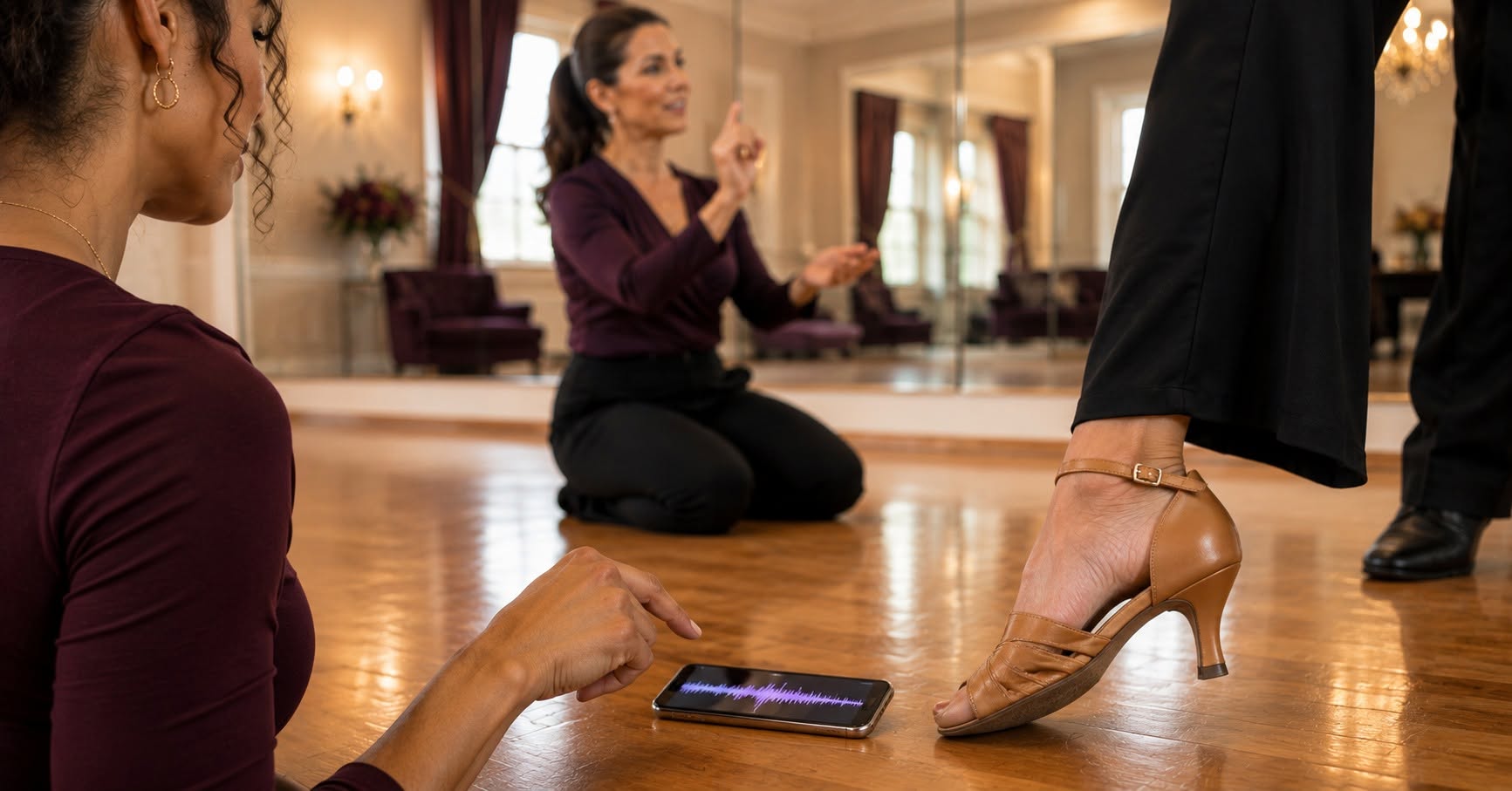
When Amy counts “one, two, three” or “slow, quick, quick,” the timing is being made clear for you. The count acts like a road map. When the count disappears and only the music remains, your ears and body must identify that structure on their own.
Research on rhythm describes this as a partnership between auditory and motor systems. Even when people are only listening, areas involved in movement can participate in predicting when the next beat will occur. Explore auditory-motor beat predictionNeuroscience Review
That is why finding the beat can improve when you move instead of standing perfectly still. A light foot tap, a small sway or a simple weight change gives your body a way to test where it believes the pulse is.
Why Some Songs Make the Beat Easy to Find
Beginner-friendly practice music often has several helpful characteristics:
- A clear and steady drumbeat
- A noticeable bass line
- A consistent tempo
- Predictable musical phrases
- Fewer competing rhythmic layers
- A clear start to each measure or phrase
These qualities give your attention something reliable to follow. You do not have to separate the pulse from a crowded mix of sounds before you begin moving.
This is one reason Amy may start a new dancer with music that feels especially clear rather than immediately using the student’s favorite recording. The goal is not to limit anyone’s musical taste. It is to help the brain recognize a pattern under easier conditions before adding complexity.
Why Other Songs Hide the Beat
In some songs, the melody or vocals command most of your attention. The drums may drop out for a section. The singer may enter before or after the main pulse. Syncopation may place strong sounds between the beats you are trying to follow.
Those choices can make music interesting and expressive, but they can also make a song harder for a beginning dancer. Music-perception research shows that listeners build internal expectations about timing rather than merely reacting to isolated sounds. See how the brain maintains a musical pulseNIH/PMC
In other words, the beat does not always have to be loudly struck for an experienced listener to feel where it belongs. A newer dancer may not yet have built that same internal prediction.
Listen for the Pulse, Not Every Sound
One of the most useful changes a beginner can make is to stop trying to follow everything. A song may contain vocals, drums, bass, piano, guitar, strings and decorative percussion. You do not need to understand each part.
Instead, listen for the sound or feeling that repeats most steadily. It may be a bass drum, a snare, a bass note or a subtle recurring accent. Once you locate that pulse, let the rest of the song exist around it.
Try the foot-tap test
Before dancing, sit or stand comfortably and tap one foot at an even pace. Do not worry about dance steps yet. Ask yourself whether the tap continues to feel supported by the music.
If you repeatedly need to speed up, slow down or restart, the recording may be too complex for that stage of practice. Choosing a clearer song is not cheating. It is a practical way to train the skill.
Start With a Simple Weight Change
A full dance pattern may create too many decisions at once. A simple side-to-side or forward-and-back weight change reduces the task to one question: “Can I arrive on the next foot when the next beat occurs?”
Listeners commonly express the pulse through body movement such as tapping, swaying or dancing. Research on beat perception specifically uses synchronized movement to study how people hear and maintain musical timing. Learn about movement and auditory predictionCerebral Cortex
Once the weight change feels steady, add the simplest version of the dance step. Keep the arms relaxed and avoid adding styling until the feet and timing feel more secure.
Count Before You Dance
Counting is not just for beginners. It is a way of turning an invisible musical structure into something concrete.
Listen through part of the song before moving. Count the repeating pulse aloud. Then begin the weight change while continuing the count. If you lose the timing, stop, listen and restart rather than rushing to catch up.
Use a three-step progression
- Listen and count: Find the recurring pulse without moving.
- Count and shift: Add a basic weight change.
- Shift and dance: Replace the weight change with the dance pattern.
This progression lets your brain solve one problem at a time.
Recognize Repeating Musical Patterns
The pulse is only one level of musical timing. Beats are also grouped into measures and larger phrases. Dancers often hear one beat as a stronger beginning point and the following beats as part of a repeating group.
Research distinguishes between perceiving a basic pulse and perceiving meter—the way beats are organized into stronger and weaker groupings. Read about pulse and musical meterRoyal Society
You do not need formal music training to recognize these patterns. Amy may have you listen for a repeated lyric, a drum accent or a musical “reset” that helps identify the beginning of a phrase.
Why Familiar Steps Feel Different With a New Song
A pattern can feel comfortable with one recording and completely different with another. Several factors can change the experience:
- Tempo: The same step may feel rushed or unusually slow.
- Instrumentation: The beat may be emphasized by different sounds.
- Syncopation: Important accents may occur between the main beats.
- Dynamics: Some sections may become quieter or more intense.
- Phrasing: Musical ideas may begin in unexpected places.
A 2025 study examining movement synchronization found that tempo and rhythmic structure can affect how accurately and consistently people coordinate movement with music. See the study on rhythm and movement synchronizationFrontiers 2025
This helps explain why changing songs can temporarily make a known step feel new. Your body is not only repeating a movement; it is adapting that movement to a different timing environment.
Finding the Beat Is a Skill You Can Build
People sometimes talk about rhythm as though everyone is born with a fixed amount. Individual differences are real, but timing is also something people can practice.
Modern rhythm research examines perception, attention, movement coordination and learning as connected processes. Review current models of rhythm learningMusic Perception
For a beginning dancer, improvement may look like hearing the pulse sooner, staying with it longer or recovering more calmly after losing it. You do not need perfect timing before you are allowed to enjoy dancing.
What to Do When You Lose the Beat
Even experienced social dancers occasionally lose their place. The useful skill is not never making a mistake; it is knowing how to reconnect.
- Simplify the movement.
- Return to a weight change or basic step.
- Listen for the strongest recurring sound.
- Wait for a clear musical beginning.
- Restart without apologizing or panicking.
A calm recovery often looks more natural than trying to force several rushed steps into the music.
How Private Lessons Make Rhythm Easier
In a private lesson, Amy can select music that matches your current level and gradually introduce songs with less obvious timing. She can also identify whether the difficulty is coming from the music, the step pattern, the tempo or the way the movement has been explained.
One student may need to hear a drum. Another may respond to counting, a lyric pattern or a physical weight change. Personalized instruction makes it possible to try different approaches without the pressure of keeping up with a room full of people.
No partner is required. Amy works with individuals and couples from Roseville, St. Paul, Minneapolis and communities throughout the Twin Cities.
Why This Matters Now
Summer weddings, outdoor concerts, community events and social gatherings create more opportunities to hear unfamiliar music and step onto a dance floor. You may not get the exact practice song you used during a lesson.
Learning how to find the beat gives you a skill that travels from one song to another. Instead of depending on a memorized recording, you begin listening for structure, adjusting to tempo and recovering when the music surprises you.
That confidence can make dancing feel far less intimidating—whether you are preparing for a wedding, joining a social dance or simply learning something new for yourself.
The Song May Be the Problem—and That Is Good News
If you know the steps but lose them when the song changes, do not assume you lack rhythm. The recording may be asking you to hear the pulse in a less obvious way.
Start with clear music. Listen before moving. Tap or shift your weight. Count aloud. Add the full pattern only after the pulse feels steady.
With patient practice, you can learn to find the beat more quickly, stay connected to it longer and recover without feeling defeated. Rhythm does not have to be a mysterious talent. It can become a familiar skill.
Want Help Finding the Beat?
Having trouble hearing the rhythm does not mean you are uncoordinated or incapable of learning. Amy Hanson offers personalized ballroom dance lessons that break timing, music and movement into manageable steps.
No experience or partner is required.
Call or text: 612-308-7708
Email: Amy@BallroomByAmy.com
About Amy Hanson
Amy Hanson is the three-time defending Dancers Cup Tour Top Teacher. She has danced professionally and internationally and built friendships with dancers many people recognize from Dancing with the Stars.
People who think they are not coordinated, confident or good enough are exactly the beginners Amy loves to teach. No experience or partner is required.
Sources and Further Reading
- Merchant et al.: Finding the Beat—A Neural Perspective Across Humans and Non-Human Primates
- Proksch, Comstock and Médé: Motor and Predictive Processes in Auditory Beat and Rhythm Perception
- Tal et al.: Neural Entrainment to the Beat and the “Missing-Pulse” Phenomenon
- Patel and Iversen: The Action Simulation for Auditory Prediction Hypothesis
- Fitch: Rhythmic Cognition in Humans and Animals
- Bayd et al.: Influence of Rhythm Features on Beat and Movement Synchronization
- Large, Herrera and Velasco: Dynamic Models for Musical Rhythm Perception and Coordination
This article is for general educational and informational purposes. Images associated with this article may be created or enhanced using artificial intelligence.