
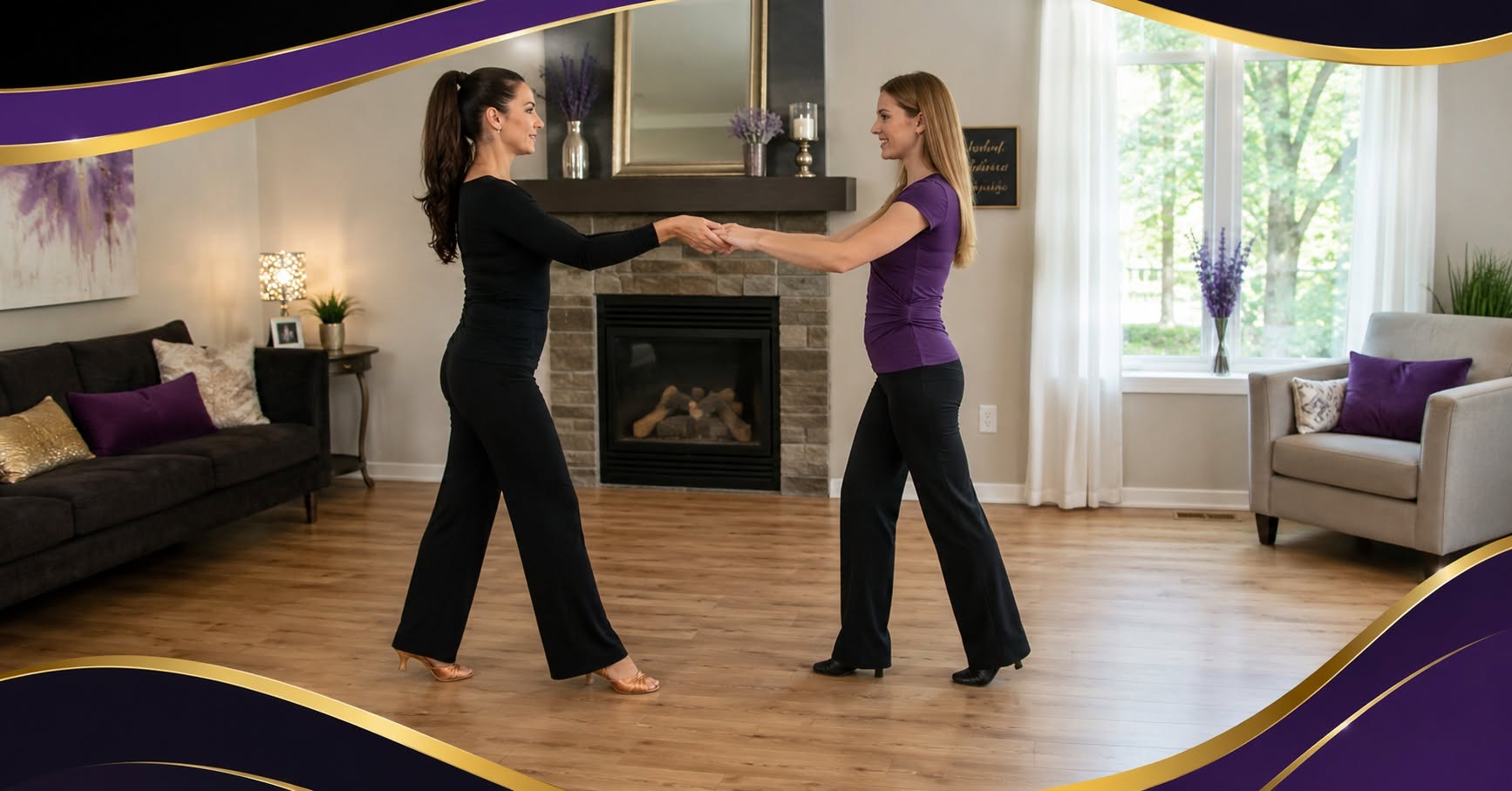
Many people assume they cannot practice ballroom dancing at home because their living room, kitchen or bedroom does not offer enough open floor space. But meaningful dance practice does not always require traveling from one side of a studio to the other. A few feet of safe, uncluttered space may be enough to strengthen some of the most important parts of your dancing.
Small-space practice is especially useful for working on timing, weight changes, posture, balance and individual sections of a dance pattern. It can help complete beginners become more comfortable moving to music, and it can help experienced dancers refine details that are easy to overlook when concentrating on an entire routine.
The goal is not to turn your living room into a ballroom. The goal is to use the space you have with purpose.
Why Small-Space Dance Practice Works
Ballroom dancing may look as though it is primarily about memorizing steps, but good dancing begins with what happens between those steps: hearing the rhythm, transferring your weight, maintaining balance, controlling your movement and preparing for what comes next.
Those foundational skills can often be practiced without traveling very far. A dancer can mark a rhythm almost in place, repeat a weight change, check posture in a mirror or isolate one challenging transition from a larger pattern.
This type of practice also challenges physical skills that matter well beyond dancing. The
Centers for Disease Control and Prevention
includes balance activities as an important part of a well-rounded physical-activity routine for older adults. Ballroom practice is not a substitute for medical care or a complete exercise program, but controlled dance movement can encourage dancers to become more aware of balance, coordination and body position.
Start With a Safe Practice Area
Before you begin, take a minute to make the area safe. You do not need to move every piece of furniture, but you should have enough room to shift your weight and take a few controlled steps without bumping into a coffee table, lamp or chair.
A Quick Safety Check
- Move loose rugs, cords and small objects out of the way.
- Choose a surface that is stable and not unusually slippery.
- Wear shoes that remain secure on your feet and suit the flooring.
- Make sure pets and children will not suddenly cross your path.
- Keep a wall, counter or sturdy chair nearby when balance is a concern.
Johns Hopkins Medicine advises dancers to warm up, wear appropriate shoes, avoid overtraining and pay attention when pain or an injury occurs. Those principles are just as important when practicing at home as they are in a studio.
Read Johns Hopkins Medicine’s dance-injury prevention guidance.
Practice only movements that feel comfortable and appropriate for your abilities. Stop if you experience pain, dizziness, unusual shortness of breath or instability. Home practice should support your dancing, not become a test of how much you can push yourself.
Practice Ballroom Timing Without Traveling
Timing is one of the best things to practice in a small area because you can work on rhythm without performing a complete pattern. Begin by playing a familiar song and listening before you move.
Try clapping the beat, tapping one foot or counting the rhythm aloud. Once the beat feels clear, add a simple side-to-side or forward-and-back weight change. Keep the movement small enough that you remain comfortable and balanced.
Depending on the dance, you might practice a basic rhythm such as:
- Slow, slow, quick, quick
- Quick, quick, slow
- One, two, three
- One, two, three, four
The specific count changes from one dance to another, but the exercise remains the same: hear the music, say the count and allow your movement to match it. When the rhythm begins to feel more natural, it becomes easier to concentrate on your partner, technique and surroundings.
Anyone who struggles to recognize the rhythm may also find Amy’s article
Why Can’t I Find the Beat?
helpful.
Build Better Weight Changes
One of the most valuable things you can do when you practice ballroom dancing at home is work on fully transferring your weight from one foot to the other.
Beginners sometimes place a foot on the floor without moving their body weight completely onto it. This can make the next step feel rushed, unstable or confusing. It may also leave both feet partially weighted when one foot needs to be free.
Try This Simple Weight-Change Exercise
- Stand comfortably with your feet underneath you.
- Shift your weight slowly onto your left foot.
- Notice when your right foot becomes light enough to move.
- Return to the center and shift onto your right foot.
- Repeat the movement slowly before trying it with music.
The movement does not need to be large. Pay attention to whether you feel stable over the standing leg and whether the unweighted foot is genuinely free.
The
Mayo Clinic’s balance-exercise guidance
also begins with controlled side-to-side weight shifts. The purpose of Amy’s dance exercise is different—it is designed to improve ballroom movement—but the same basic awareness of where your weight is located matters.
Improve Posture Without Becoming Stiff
Good ballroom posture does not mean pulling your shoulders back as far as possible or holding your body rigidly. It means creating an aligned, balanced position that allows you to move comfortably and respond to a partner.
Stand naturally and imagine your head floating upward while your shoulders remain relaxed. Keep your rib cage comfortably over your hips rather than leaning forward or backward. Your knees should remain available for movement rather than locked.
A mirror or short phone recording can help you notice habits such as raised shoulders, a tilted head or a tendency to lean. Look for one detail at a time. Trying to correct everything at once usually makes dancing feel less natural.
Cleveland Clinic notes that balance involves communication among several parts of the body and that lower-body strength can contribute to stability.
Explore Cleveland Clinic’s balance and stability overview.
During ballroom practice, the goal is not to recreate a clinical balance program. It is to become more aware of alignment, control and how your body is organized over your feet.
Practice Balance Through Controlled Movement
Balance becomes easier when your movements are deliberate and your weight is organized over the supporting foot. Instead of rushing through a familiar pattern, slow it down and notice where your weight is after every step.
The National Institute on Aging includes activities such as standing on one foot, heel-to-toe walking, moving sideways and carefully shifting the body as examples of movements that challenge balance.
See the National Institute on Aging’s balance-activity examples.
Ballroom dancing uses different movement patterns, but it frequently asks dancers to manage similar ideas: moving in more than one direction, placing weight with control and remaining organized while the feet change position.
Make Your Steps Smaller
Many dancers believe larger steps automatically look better. In reality, steps should fit the dance, the music, the partnership and the available floor.
Practicing in a small space encourages you to control the size of your movement. That skill becomes useful at weddings, restaurants, cruises and social dances where the floor may be crowded.
Try performing a familiar basic pattern at half its usual size. Keep the rhythm and weight changes clear while reducing how far each foot travels. The goal is not to make the dancing timid. It is to make the movement intentional.
Small steps can reveal big details. When you are not concentrating on covering the floor, you may notice your timing, balance and weight placement more clearly.
Break Larger Patterns Into Pieces
You do not have to perform an entire dance pattern every time you practice. Often, the most productive approach is to isolate the part that feels uncertain.
Practice the first two or three steps. Then practice the ending. Work on the transition between two figures without continuing through the rest of the routine. Repeat the entrance to a turn before worrying about its exit.
Dividing a pattern into smaller sections reduces the amount of information you are asking your brain and body to process at once. Once each section feels more comfortable, the pieces can be reconnected during a lesson or in a larger practice area.
Use Music With a Clear Beat
Home practice is easier when the music has a beat you can hear clearly. Save complicated or unfamiliar songs until the rhythm begins to feel comfortable.
Start with the music at a moderate volume. Listen for the repeating pulse and begin with the simplest movement you know. You do not have to perform a recognizable routine immediately. One well-timed weight change is more valuable than a complicated pattern that repeatedly falls out of rhythm.
If the music feels too fast, practice the movement without music first. Count slowly, establish the order of the steps and then return to the song.
Use Mirrors and Video Carefully
A mirror or phone recording can provide useful feedback, but it should have a specific purpose. Before recording, decide what you want to observe. You might check your posture, step size, balance or whether your feet are closing when they should.
Record only a few seconds and review one detail. Watching a long video while searching for every possible mistake can become discouraging and unproductive.
Video also has limits. A movement may look correct while feeling unstable, or it may appear unusual because the recording angle is unhelpful. Personalized instruction allows a teacher to see what is happening, explain why it is happening and help you make the correct adjustment.
Avoid Practicing Mistakes Repeatedly
Repetition is helpful only when you have a reasonably clear understanding of what you are repeating. If you are unsure about the footwork, timing or technique, repeatedly guessing may make an incorrect movement begin to feel familiar.
Concentrate on movements you have already learned and understand. Write down questions about anything that remains confusing and bring those questions to your next lesson.
It is perfectly acceptable for home practice to be simple. Practicing one accurate rhythm or weight change can be more productive than attempting an entire routine incorrectly.
How Long Should You Practice?
A useful practice session does not have to last an hour. Five to fifteen focused minutes may be enough to reinforce something from your lesson, reconnect with the rhythm or keep a pattern fresh in your memory.
Choose one clear objective for each session:
- Find and count the beat in two songs.
- Repeat controlled side-to-side weight changes.
- Practice one difficult transition.
- Review your posture and relax your shoulders.
- Perform a familiar basic pattern with smaller steps.
Stop before your concentration disappears. A short session with a clear purpose is usually more valuable than continuing to move without paying attention.
What Should Not Be Practiced Alone?
Some parts of ballroom dancing genuinely require another person. Lead-and-follow connection, partnership, frame, shared balance and floor navigation are difficult to reproduce accurately without a partner or instructor.
Advanced turns, unfamiliar footwork and movements that challenge your joints or balance should also be approached carefully. When you are uncertain, ask your instructor what is appropriate to practice independently.
Home practice is most effective when it reinforces your lessons rather than attempting to replace personalized instruction.
Why This Matters Right Now
Busy schedules, summer travel, weddings, family commitments and changing routines can make it difficult to find a large block of practice time. Waiting for the perfect room, the perfect schedule or the perfect partner may mean not practicing at all.
Learning how to practice ballroom dancing at home gives you another option. A few focused minutes can help you remain connected to what you learned and make your next lesson more productive.
Your small practice space can also help you develop movement that works in real life. Wedding receptions, community events, restaurants, cruises and social dances rarely provide unlimited floor space. Learning to adjust your step size without losing your timing is a practical ballroom skill—not merely a compromise you make at home.
Small Space. Big Progress.
You do not need a huge dance floor to improve. You need a safe area, a clear purpose and an exercise that fits what you currently understand.
Practice hearing the rhythm. Make complete weight changes. Check your posture. Reduce the size of your steps. Work on one small section instead of attempting everything at once.
Most importantly, do not let the size of your home convince you that progress has to stop between lessons. When you practice ballroom dancing at home with intention, even a small amount of space can help you build better timing, balance and confidence.
Sources and Further Reading
-
Centers for Disease Control and Prevention:
Older Adult Activity: An Overview
-
National Institute on Aging:
Exercise Activities That Support Health and Balance
-
Mayo Clinic:
Balance Exercises
-
Johns Hopkins Medicine:
Common Dance Injuries and Prevention
-
Cleveland Clinic:
Balance Exercises to Improve Stability
Important health and safety notice: This article contains general educational information only. It is not medical, physical-therapy, fitness, legal or other professional advice. Readers should consider their own health, abilities and surroundings, independently verify information that may affect their decisions and consult an appropriate qualified professional regarding pain, dizziness, balance concerns, injuries or whether an activity is safe for them.
AI and graphics disclosure: This article was written with the assistance of artificial intelligence and was reviewed and edited before publication. Graphics accompanying this article were also created with artificial intelligence. Although care was taken to consult reputable sources and present useful, accurate information, AI-generated content can contain mistakes, omit important context or become outdated. Readers should double-check important facts, review the original sources linked in this article and seek personalized advice from qualified professionals when appropriate.