
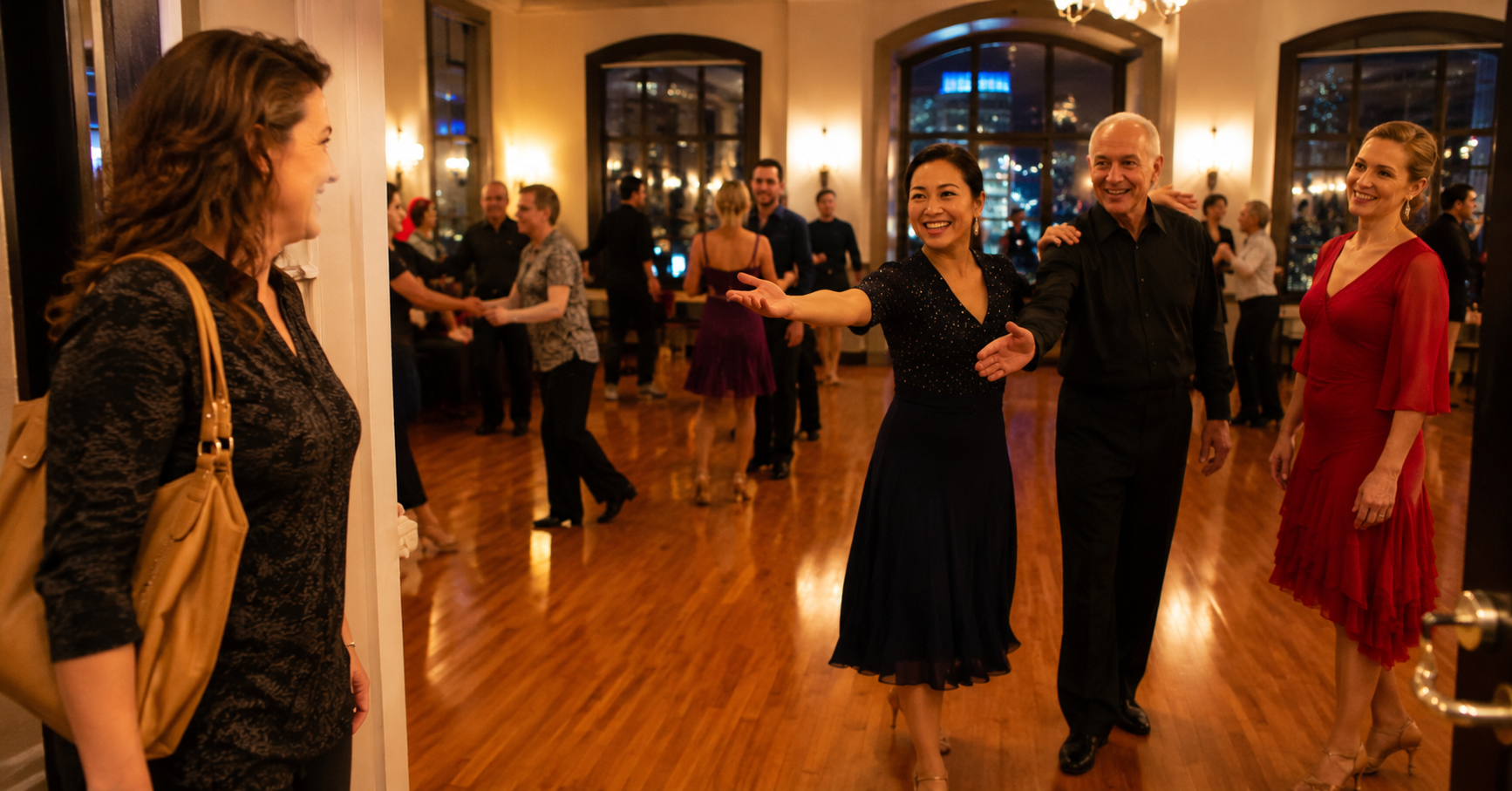
Going to your first ballroom social alone may feel intimidating, but you do not need a partner, perfect coordination or years of experience to belong on the dance floor.
Going to your first ballroom social alone may feel like walking into a room where everyone else already knows the steps, the people and a collection of unwritten rules. From the doorway, it can appear that everyone arrived with a partner and has been dancing for years.
Usually, that is not what is actually happening.
Some dancers came with friends. Others arrived alone. A few are experienced, while several may be quietly hoping nobody notices they are beginners. Social dancing brings all of those people into the same room.
I have worked with many adults who wanted to attend a social but kept waiting until they felt coordinated, confident or accomplished enough. My advice is simple: you do not have to become a social dancer before attending a social dance. Attending is one of the ways you become one.
Here is what I would want you to know before your first evening out in Minneapolis, St. Paul or elsewhere in the Twin Cities.
Is It Normal to Attend Your First Ballroom Social Alone?
Yes. Although the customs vary by event, many ballroom and partner-dance communities welcome people who arrive without partners. Local organizations such as USA Dance Minnesota organize social dances and instruction, while other Twin Cities communities offer lessons and events for dancers at different experience levels.
You may see couples enter together, but that does not necessarily mean they will dance exclusively with one another. At many socials, people change partners throughout the evening. Therefore, arriving alone does not automatically leave you on the sidelines.
Still, every event has its own personality. A ballroom studio party, swing dance, Latin night and formal ball may follow different traditions. Read the event description before attending.
Look for These Helpful Phrases
If the listing is unclear, contact the organizer and ask one direct question: “Is this event comfortable for a beginner attending alone?” A welcoming organizer should be able to answer without making you feel embarrassed for asking.
Why a First Ballroom Social Alone Feels Intimidating
The hardest part often happens before the music starts. Your mind tries to protect you by inventing every possible awkward moment.
- What if nobody asks me to dance?
- What if I ask and the person says no?
- What if I forget the steps?
- What if everyone can tell I am new?
- What if I do not recognize the dance?
Those worries are understandable because partner dancing combines movement, music and social interaction. You are not merely learning where to put your feet. You are also entering a new community and communicating with another person in real time.
However, you are not required to solve the entire experience at once. Your first goal does not need to be dancing every song.
A Better First-Night Goal
These goals are small enough to be realistic and meaningful enough to make the evening worthwhile.
How to Choose the Right Twin Cities Ballroom Social
Your first experience will depend partly on the event you choose. A crowded specialty dance can be fun, but it may not provide the easiest introduction for someone who has never social danced.
I recommend looking for an event that includes a beginner lesson immediately before the social. The lesson gives you a reason to arrive early, introduces at least one usable basic pattern and helps you meet other newcomers before the experienced dancers fill the floor.
For example, local organizations and dance communities maintain calendars for lessons and socials. TC Swing offers classes and dancing opportunities for different experience levels, while the Twin Cities Rebels publishes information about scheduled social dances.
These examples also show why you should check current event details rather than assuming every dance happens weekly or follows the same format.
Signs an Event May Be Beginner-Friendly
Look for a clearly advertised introductory lesson, straightforward information about admission and language that explicitly welcomes new dancers. Photos or event descriptions may also reveal whether the atmosphere is casual, formal or competition-oriented.
A beginner-friendly event should not require you to decode a maze of unexplained abbreviations. Moreover, it should tell you enough about the music or dance style to prepare.
Questions to Ask the Organizer
- What dance will the beginner lesson cover?
- Do people rotate partners during the lesson?
- Are clean street shoes acceptable?
- Is there a dress code?
- Are beginners encouraged to stay for the social?
Do Not Judge the Event Only by Its Photos
Promotional photos usually show polished moments: advanced dancers, dramatic movement and a full floor. They rarely show the new dancer standing near the refreshment table, the experienced dancer reviewing a basic step or the person who just introduced themselves to someone for the first time.
Consequently, a beautiful dance photograph can make the event look more intimidating than it feels in person.
What to Wear to Your First Ballroom Social Alone
You do not need a ballroom costume. Unless the event advertises a formal dress code, choose clothing that lets you move comfortably and makes you feel presentable.
A Simple Clothing Checklist
- A comfortable shirt, blouse, dress or top that stays in place while turning
- Trousers, a skirt or clothing that allows a natural stride
- Minimal jewelry that will not catch on your partner
- Light layers if the room becomes warm
- Fresh socks or hosiery if your shoes require them
Your shoes matter more than the label on your outfit. Avoid footwear that grips the floor so aggressively that your knees twist when you turn. At the same time, very slippery shoes can feel unstable.
Dedicated ballroom shoes can be helpful later, but beginners do not always need to buy them before attending one social. Clean, secure shoes with a manageable sole are often enough when the venue permits them. Avoid flip-flops, loose backless shoes and extremely high heels that you cannot comfortably walk in.
Remember: Dance floors and venue rules differ, so confirm the footwear policy before attending.
When to Arrive at Your First Ballroom Social Alone
Arrive before the introductory lesson rather than entering after the social is already underway. Coming early gives you time to find parking, check in, change shoes and understand the room.
More importantly, the people present before a beginner lesson are easier to approach. They are standing rather than dancing, and many are also waiting for instructions.
Try saying:
“Hi, this is my first time here, and I came by myself. Is there anything I should know?”
That sentence does three useful things. It tells the organizer you are new, gives them a chance to explain the format and signals that a friendly introduction could help you.
You are not admitting a weakness. Instead, you are giving the host the information needed to welcome you properly.
What to Do During the Beginner Lesson
Stand where you can see the teacher, but do not hide in the farthest corner. If the class rotates partners, introduce yourself each time with your first name and a smile.
You do not have to apologize for being new. In fact, repeated apologies can make both dancers more tense.
If hearing the beat is one of your concerns, read my related guide, Why Can’t I Find the Beat in Ballroom Dancing? You do not need perfect musical timing before attending a social, but understanding a few listening strategies can reduce the mental overload.
During the lesson, concentrate on the basic rhythm and one repeatable pattern. You do not need to memorize every variation the teacher demonstrates. One comfortable basic is more valuable socially than five patterns you cannot yet lead or follow safely.
How to Ask Someone to Dance
Once the social dancing begins, remember that almost everyone was new at some point. The experienced dancers who seem comfortable today once stood exactly where you are standing now.
Keep your invitation simple and friendly.
“Would you like to dance?”
“Would you care to dance this one?”
“Hi, I’m Amy. Would you like to dance?”
That is all you need.
You do not need a clever introduction or a long explanation that you are new. If the dance becomes challenging, let your partner know you are keeping things simple.
Most social dancers appreciate someone who is polite, attentive and willing to learn far more than someone who knows dozens of complicated patterns.
What If Someone Says No?
This is one of the biggest fears beginners have, but it is usually much less personal than people imagine.
Someone may decline because they are sitting out that dance, taking a break, getting a drink, recovering from an injury, waiting for a promised dance or simply tired.
One declined invitation does not define your evening.
Smile and reply, “No problem. Maybe another time.” Then move on.
Do not ask for an explanation or pressure the person to reconsider. A polite invitation should always allow for a polite decline.
Ballroom Social Etiquette Everyone Appreciates
You do not need to memorize a long list of rules. Following a few simple habits will immediately help you fit comfortably into almost any ballroom social.
Be Kind
Thank your partner after every dance.
Be Safe
Watch the couples around you and keep your movements comfortable.
Be Flexible
If you lose your place, return to the basic step and keep smiling.
Be Comfortable
Wear clean, secure shoes and clothing that lets you move naturally.
Be Fresh
Fresh breath, clean clothing and considerate hygiene help everyone feel at ease.
Be Encouraging
Remember that everyone, including advanced dancers, is still learning.
How Many Dances Should You Expect?
Do not measure success by the number of dances.
If you dance three songs, meet two new people and leave feeling more comfortable than when you arrived, your first ballroom social was successful.
The confidence you build by attending one social can make the second experience dramatically easier.
How to Leave Feeling Successful
Many people judge themselves far too harshly after their first social.
Instead of asking, “Did I dance well enough?” ask yourself a better set of questions.
Your First-Social Success Checklist
If you answered yes to most of those questions, you succeeded.
Every experienced ballroom dancer has memories of a first social. The difference between people who eventually become comfortable social dancers and those who never do often comes down to one simple decision:
They came back.
My Final Advice for Your First Ballroom Social Alone
If you are waiting until you feel coordinated enough, confident enough or experienced enough before attending your first ballroom social alone, you will probably wait much longer than necessary.
Confidence usually does not arrive before the experience. It grows because of the experience.
Come to learn. Come to smile. Come expecting to make a few mistakes.
That is how ballroom communities grow, and it is how lifelong dancers begin.
Ready to Feel More Comfortable Before Your First Social?
I help Twin Cities beginners learn the steps, timing and social-dance skills that make walking onto the floor feel much easier. No partner or previous experience is required.
|
Schedule a Lesson |
Call 612-308-7708
or email
Amy@BallroomByAmy.com
About Amy Hanson
Amy Hanson is the three-time defending Dancers Cup Tour Top Teacher. She has danced professionally and internationally and built friendships with dancers many people recognize from Dancing with the Stars.
People who think they are not coordinated, confident or good enough are exactly the beginners Amy loves to teach. No experience or partner is required.
Ballroom by Amy
ballroombyamy.com
612-308-7708
Amy@BallroomByAmy.com
Sources and Further Reading
- USA Dance Minnesota
- TC Swing
- Twin Cities Rebels
- National Dance Council of America
- Dance/USA
- Ballroom by Amy: Why Can’t I Find the Beat in Ballroom Dancing?
This article includes content supported by AI. Please use your own judgment, double-check important details and seek appropriate professional guidance when relevant. Accompanying graphics may include AI-generated or AI-assisted imagery.
first ballroom social alone • ballroom dance social • beginner ballroom dancing • Twin Cities ballroom dancing • Minneapolis dance lessons • St. Paul dance lessons • dancing without a partner • ballroom dance etiquette • adult dance lessons • social dance confidence