
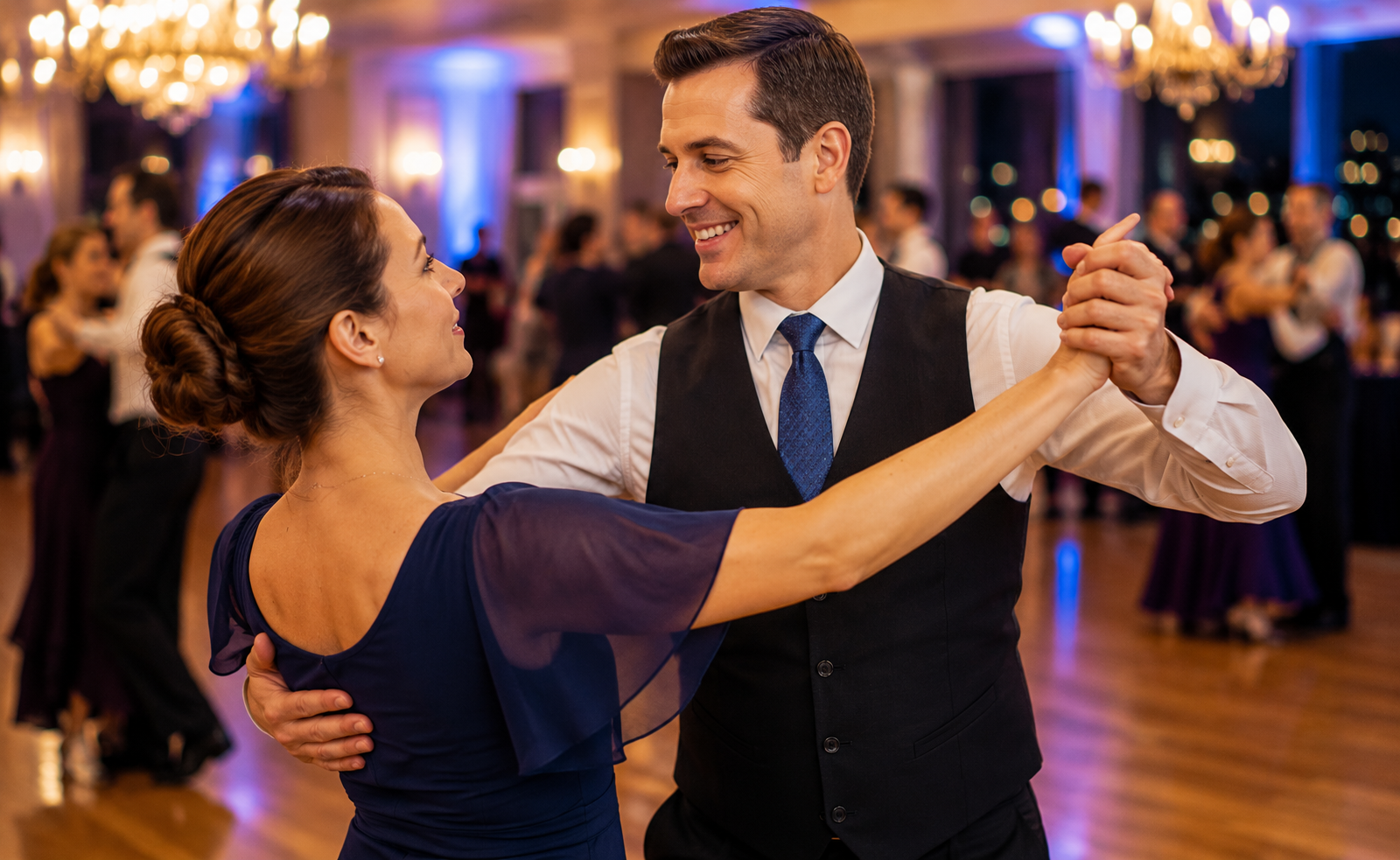
Learning how to dance with experienced ballroom dancers can feel intimidating, but your partner is probably not expecting perfection. A comfortable connection, a positive attitude and a willingness to keep the dance simple matter far more than knowing every step.
Walking onto a ballroom floor with someone who has years more experience than you can make every small uncertainty feel enormous. You may wonder whether you will miss the lead, forget the rhythm or somehow ruin the dance for your partner.
I hear those concerns from beginners all the time.
However, experienced ballroom dancers usually understand something that beginners have not learned yet: a good social dance is not measured by the number of patterns completed. It is measured by whether two people can share the music, communicate comfortably and enjoy a few minutes together.
You do not have to pretend that you are more experienced than you are. You also do not have to decline every invitation from someone who appears more advanced. Instead, you can approach the dance with honesty, awareness and a few simple skills that make the experience better for both of you.
The Fear Almost Every Beginner Has
When beginners imagine dancing with someone much more experienced, their thoughts often sound like this:
Those thoughts are understandable. Partner dancing combines movement, timing, touch, musical awareness and social interaction. A beginner is trying to process all of those things at once.
Still, the pressure you are feeling is often coming from assumptions rather than from anything your partner has said. Experienced social dancers generally know how to simplify their dancing, adjust their movement and respond to the person in front of them.
USA Dance’s ballroom etiquette guidance encourages dancers to welcome people of every ability level, keep the dance simple when someone is new and remember that everyone was once a beginner.
Experienced dancers are usually not looking for a perfect partner. They are looking for an enjoyable one.
Why Experienced Dancers Often Enjoy Dancing With Beginners
Many advanced dancers remember exactly what it felt like to attend their first lesson or social. They remember watching the room, questioning whether they belonged and hoping someone friendly would ask them to dance.
For that reason, dancing with a beginner can be genuinely rewarding. An experienced dancer may enjoy helping someone relax, discover the rhythm or realize that social dancing is less frightening than expected.
Good social dancers also learn to adapt. They are not simply repeating memorized patterns. They are listening through movement, changing the size of their steps and choosing figures that fit the partner they have.
What an Experienced Partner May Bring to the Dance
They can simplify patterns and adjust to your comfort level.
Their steadiness may help you hear and feel the rhythm.
They may be less rattled when a step does not go as planned.
They may enjoy helping a newer dancer have a positive experience.
Of course, every dancer is different. Experience does not automatically make someone patient or considerate. Nevertheless, many skilled social dancers understand that the goal is to make the dance work for both partners, not to display everything they know.
The broader dance community also recognizes movement as communication. The American Dance Therapy Association describes movement as a form of nonverbal communication. Social ballroom dancing is not therapy, but the same basic idea applies: your body is listening and responding before either person says a word.
How to Tell Your Partner You Are New
You do not need to deliver a speech before the music begins. A brief, confident sentence gives your partner useful information without turning your experience level into an apology.
Simple Things You Can Say
Notice what is missing: “I am sorry.”
You do not need to apologize for being a beginner. Everyone starts somewhere. Repeatedly saying that you are terrible may also make you more tense and may put your partner in the position of constantly reassuring you.
Confidence does not mean pretending to be experienced. It means being comfortable admitting that you are still learning.
What Experienced Ballroom Dancers Actually Appreciate
Beginners often assume that advanced dancers are evaluating every foot placement. Most social dancers are paying attention to the overall experience instead.
They notice whether you are considerate. They feel whether your body is extremely tense. They appreciate a partner who listens, responds and keeps a sense of humor when something goes wrong.
A Positive Attitude
A relaxed smile and willingness to enjoy the music make a dance more pleasant.
Listening
Responding to your partner is more useful than trying to anticipate every movement.
A Comfortable Connection
Gentle, attentive contact works better than gripping, pulling or forcing a movement.
Kindness
Courtesy, patience and a sincere thank-you matter at every experience level.
USA Dance also advises social dancers not to correct or teach their partners during a dance unless safety or personal boundaries are involved. Social dancing is supposed to feel welcoming, not like an unexpected private lesson.
Beginner Mistakes That Usually Do Not Matter
You are going to make mistakes. Experienced dancers make them too.
Missing a step, forgetting a pattern or briefly losing the rhythm does not automatically ruin the dance. In many cases, your partner can simply return to the basic step and continue.
Things You Can Stop Worrying About
What matters is how you respond. If something goes wrong, avoid freezing, blaming your partner or repeatedly stopping the dance. Take a breath, find the basic rhythm and continue.
If finding the beat is one of your concerns, my article Why Can’t I Find the Beat in Ballroom Dancing? offers practical listening strategies that can help.
What to Do When Your Body Feels Nervous
Sometimes the fear is not just a thought. Your shoulders rise, your hands tighten and your breathing becomes shallow. That tension makes it harder to feel your partner and harder for your partner to communicate clearly with you.
Before the dance begins, quietly lower your shoulders and take one slow breath. You do not need a dramatic relaxation routine in the middle of the ballroom. A single pause can help you stop bracing for a mistake.
Mayo Clinic’s relaxation guidance explains that breathing, body awareness and releasing muscle tension can help reduce the physical effects of stress. Those same simple ideas can be useful when nerves make your ballroom frame feel rigid.
A Quick Reset Before the Music Starts
Feeling nervous at one social does not mean you have an anxiety disorder. However, if fear of social situations is intense, persistent or keeps you from participating in normal activities, the Cleveland Clinic’s overview of social anxiety explains when professional help may be appropriate.
The Few Things That Really Do Matter
Perfection is not required, but safety and consideration are important. These habits help dancers at every level feel comfortable.
Watch the Floor
Stay aware of nearby couples and avoid movements that could cause a collision.
Avoid Gripping
A secure connection should not feel like squeezing, pulling or pushing.
Respect Boundaries
Everyone has the right to decline a dance or request a more comfortable hold.
Say Thank You
A sincere thank-you creates a positive ending, regardless of how the dance went.
People may forget which steps you danced. They are less likely to forget how you made them feel.
Advice for Experienced Dancers, Too
Experienced dancers play an important role in shaping whether a beginner returns.
If you are the more advanced partner, simplify without making the beginner feel incapable. Avoid testing them with increasingly difficult patterns. Do not teach or correct them during the dance unless they specifically request help and the setting is appropriate.
Instead, create a clear rhythm, use comfortable figures and respond to what your partner can do. The goal is not to prove how much you know. The goal is to create a dance that works for both people.
The National Dance Council of America serves the organized ballroom and dancesport community, while Dance/USA supports a broad range of dance organizations and professionals. Formal dance structures matter, but the welcoming culture of a local social is ultimately created by the people sharing the floor.
Why One Comfortable Dance Can Change Everything
A beginner may remember a kind, patient partner for years. One enjoyable dance can change the way someone sees the entire ballroom community.
Dance can also offer a meaningful sense of social connection. Harvard Health notes that dance can support social connection while also providing physical and mental stimulation.
That does not mean every dance will be magical. It means that each respectful interaction gives a newer dancer another reason to feel that they belong.
If you are preparing for your first social without a partner, you may also find my guide to going to your first ballroom social alone helpful.
My Perspective as a Ballroom Instructor
One of my favorite moments as an instructor is watching a new student realize they can comfortably dance with someone who has been dancing for years.
That moment changes how the beginner sees ballroom dancing. Instead of viewing the floor as a place where they might be judged, they begin to see it as a place where people communicate, adapt and enjoy music together.
I teach beginners and experienced dancers, and I can tell you that enjoyable partnering does not come from one person knowing everything. It comes from both people paying attention to each other.
If you are kind, willing to listen and open to enjoying the experience, you are already bringing something valuable to the dance.
If you would feel more comfortable practicing this before your next social, visit Ballroom by Amy and ask me about lessons designed for complete beginners, returning dancers, singles and couples throughout the Twin Cities.
Feel More Comfortable With Any Dance Partner
I help Twin Cities beginners build the timing, connection and confidence needed to enjoy ballroom dancing with partners at every experience level. No partner or previous dance experience is required.
|
Schedule a Lesson |
Call 612-308-7708
or email
Amy@BallroomByAmy.com
About Amy Hanson
Amy Hanson is the three-time defending Dancers Cup Tour Top Teacher. She has danced professionally and internationally and built friendships with dancers many people recognize from Dancing with the Stars.
People who think they are not coordinated, confident or good enough are exactly the beginners Amy loves to teach. No experience or partner is required.
Ballroom by Amy
ballroombyamy.com
612-308-7708
Amy@BallroomByAmy.com
Sources and Further Reading
- USA Dance: Dance Etiquette Frequently Asked Questions
- Mayo Clinic: Relaxation Techniques
- Cleveland Clinic: Social Anxiety
- Harvard Health: Dance, Movement and Social Connection
- American Dance Therapy Association: Movement and Nonverbal Communication
- National Dance Council of America
- Dance/USA
This article includes content supported by AI. Please use your own judgment, double-check important details and seek appropriate professional guidance when relevant. Accompanying graphics may include AI-generated or AI-assisted imagery.
dance with experienced ballroom dancers • ballroom dancing • beginner ballroom dancing • ballroom dance etiquette • social dancing • Twin Cities ballroom dancing • Minneapolis dance lessons • St. Paul dance lessons • adult dance lessons • dance confidence