
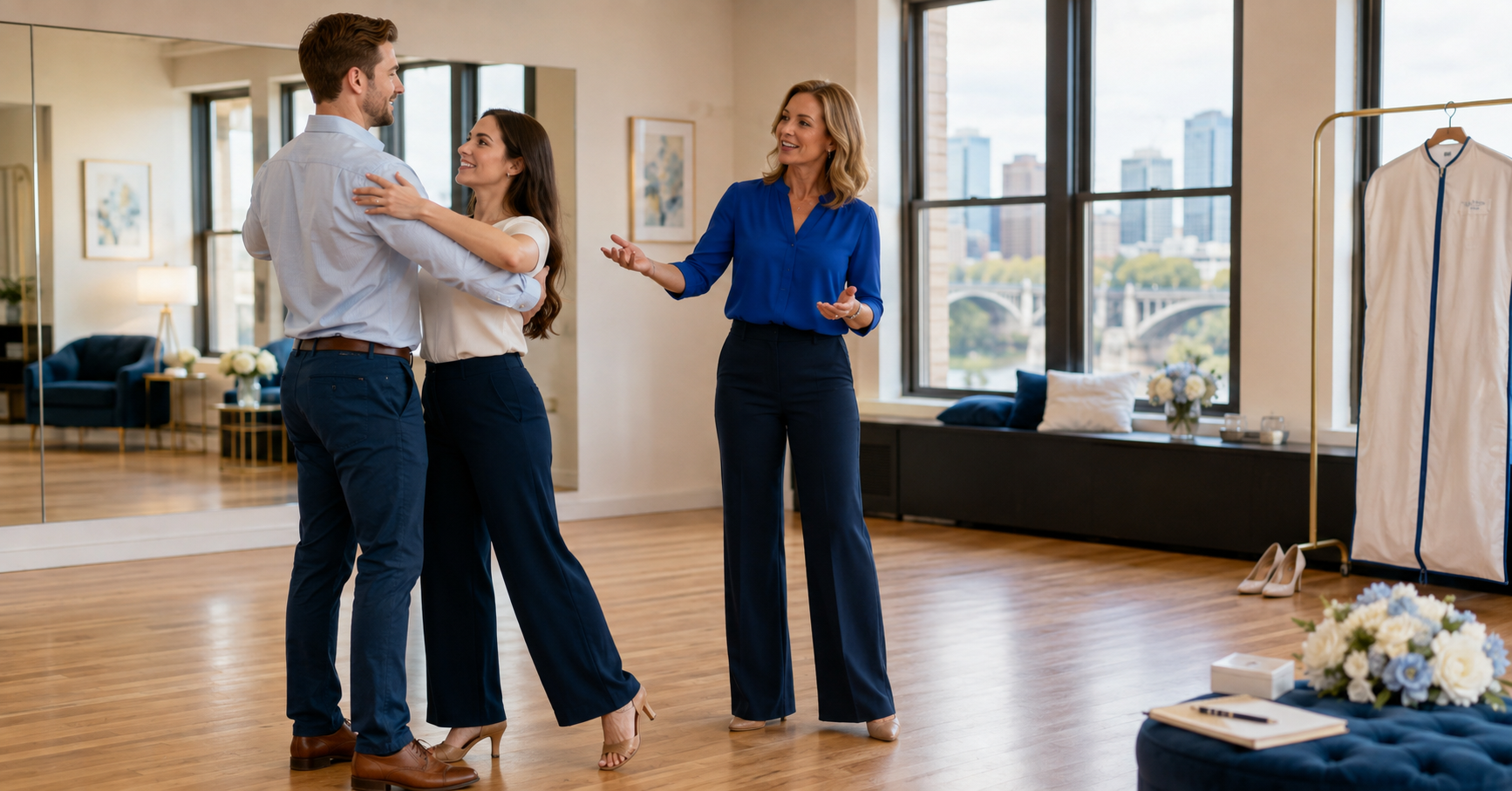
Your first dance should feel comfortable, personal and unmistakably yours. It does not need to be complicated, theatrical or perfectly performed to become one of the most meaningful moments of your wedding.
For many engaged couples, the first dance starts as a romantic idea and gradually becomes another source of wedding stress.
You may love your song but have no idea how to move to it. One person may be excited to dance while the other is nervous about being watched. You might also wonder whether you are supposed to memorize an elaborate three-minute routine filled with turns, dips and dramatic choreography.
The reassuring answer is no.
Effective wedding dance lessons in the Twin Cities are not about turning complete beginners into professional performers. They are about giving you a comfortable plan, helping you move naturally together and making sure you know how to begin, what to do during the song and how to finish.
At Ballroom by Amy, wedding lessons are personally taught by Amy Hanson, the three-time defending Dancer’s Cup Tour Top Teacher.
That award reflects high-level teaching and dance expertise, but Amy’s wedding lessons are not intended only for experienced dancers. One of her greatest strengths is using that knowledge to help ordinary couples, including people who do not consider themselves coordinated, confident or naturally comfortable on a dance floor.
Your First Dance Does Not Need to Be Complicated
Couples sometimes assume that professional choreography means filling every second of a song with a different step. That approach can create more pressure than enjoyment, especially when both people are learning to dance for the first time.
Wedding professionals frequently recommend keeping an individual spotlight dance relatively brief. Many suggest approximately 60 to 90 seconds, while others consider a minute and a half to two minutes an ideal range.
That is enough time for your guests to enjoy the moment and for your photographer to capture beautiful images without making the dance feel unnecessarily long.
A memorable first dance is not measured by how many steps you perform. It is measured by how comfortable, connected and present you feel while sharing it.
For many beginner couples, a successful first dance may include:
- A confident entrance onto the dance floor
- A comfortable foundational movement
- Several repeatable patterns or transitions
- One or more turns or directional changes
- A memorable dip, pose or special moment when appropriate
- A polished ending that does not feel abrupt or uncertain
Amy generally helps beginner couples develop approximately 90 seconds to two minutes of comfortable choreography. Those movements can then be naturally repeated, rearranged or adapted through the remainder of the song.
Your DJ may also be able to shorten or fade the song at a natural point. A shorter dance is not incomplete. In many cases, it creates a stronger and more enjoyable wedding moment.
Why Personalized Wedding Choreography Is Different
It is possible to find dance steps and wedding routines online. However, a prerecorded routine cannot evaluate how you and your partner actually move together.
It cannot see that one person takes smaller steps, that a turn feels uncomfortable, that a particular movement does not fit the dress or that the reception floor will be much smaller than the studio shown in the video.
Personalized choreography begins with the couple, not with a predetermined routine. And it does not have to be ballroom: custom choreography can be in any style, from a classic waltz to country, line dancing or hip hop.
Your Song
Amy listens for the rhythm, phrasing, emotional changes and natural moments where turns, transitions or an ending might fit.
Your Abilities
Movements are chosen according to what both partners can perform comfortably and confidently.
Your Personalities
Your dance can be romantic, relaxed, playful, elegant or energetic rather than looking like someone else’s routine.
Your Wedding
Clothing, shoes, floor size and the overall atmosphere of your reception can all influence the final plan.
What Are You Really Paying for?
The value of personalized wedding dance instruction extends beyond the number of minutes spent learning steps.
Couples are also receiving Amy’s preparation, judgment, choreography and ability to recognize which movements will look polished, which ones will feel natural and which ones should be adjusted before they cause unnecessary frustration.
- Evaluation of your song and its rhythm
- A dance plan created around your goals
- Custom selection and arrangement of movements
- Adjustments as Amy sees how you learn together
- Coaching on timing, posture, leading, following and connection
- Preparation for clothing, shoes and reception-floor limitations
- A reliable entrance and ending
- Guidance for practicing effectively between appointments
That is the difference between simply being shown a sequence of steps and having an experienced teacher choreograph a wedding dance specifically for you.
Why Amy’s Top Teacher Experience Matters
Awards alone do not create a meaningful wedding dance. What matters is how the knowledge behind those awards benefits the couple.
As the three-time defending Dancer’s Cup Tour Top Teacher, Amy has demonstrated an ability to develop dancers, communicate clearly and adapt her instruction to different personalities and experience levels.
For wedding couples, that means Amy can:
- Quickly identify movements that suit both partners
- Recognize when choreography should be simplified
- Help a nervous dancer feel less exposed or overwhelmed
- Challenge a more experienced partner without leaving the beginner behind
- Make adjustments when something does not feel comfortable
- Teach technique without making the lesson feel overly technical
- Create a routine that looks polished without looking forced
The objective is not to make your first dance resemble a ballroom competition. Amy uses competition-level knowledge to make your wedding dance more achievable, comfortable and personal.
Premium Instruction Should Make Dancing Feel Easier
Expertise is not valuable because it produces the most complicated routine. It is valuable because an experienced instructor knows what to include, what to leave out and how to help you achieve a stronger result in the time available.
What Can You Accomplish in Four Wedding Dance Lessons?
Both Ballroom by Amy wedding packages include four private lessons. Four focused lessons can provide a strong roadmap for beginner couples who want a natural, polished first dance without creating a complex performance.
During those lessons, Amy can help you establish:
- Your foundation: how to stand, connect and move together comfortably.
- Your main patterns: repeatable movements that fit the song and do not require constant memorization.
- Your special moments: turns, poses, transitions or a dip when appropriate.
- Your finished presentation: an intentional entrance, natural progression and polished ending.
Four lessons will not usually create three minutes of entirely unique, highly detailed choreography for complete beginners. That is not necessarily the best goal.
Most couples will benefit more from a shorter amount of reliable material that they can perform naturally than from a long routine they are worried about forgetting. If you want more time, a Bonus Dance Lesson can be added.
How to Get More From Every Lesson
Progress does not depend only on the number of appointments you schedule. What you do between lessons also matters.
Short, focused practice sessions can be more productive than one exhausting rehearsal. Research on motor-skill learning has also found that rest periods between practice blocks can contribute to learning and memory.
A Manageable Practice Plan
- Practice for approximately 10 to 15 minutes at a time.
- Review the movement slowly before adding music.
- Practice the entrance and ending every time.
- Record a quick phone video at the end of each lesson so you can review the details at home.
- Focus on one section instead of repeatedly running the entire dance.
- Stop before either person becomes tired or frustrated.
Practice should help the dance become more familiar. It should not become another wedding-planning argument.
Put on your song, work on one manageable section and allow yourselves to laugh when something goes wrong. Those moments are part of learning together.
Practice for the Wedding You Are Actually Having
Comfortable clothing and supportive shoes are generally appropriate when you begin learning. Once the choreography becomes familiar, however, you should practice in footwear similar to what you will wear at the wedding.
Amy should also know about:
- The style and approximate size of the wedding dress or other formal clothing
- A train, fitted skirt, restrictive sleeves or other movement considerations
- Wedding shoes and heel height
- The size and shape of the reception dance floor
- Any injuries, balance issues or physical limitations
- Any movements you especially want, or do not want, to perform
A movement that works beautifully in comfortable clothing on a large studio floor may need to be changed for formal clothing and a smaller reception space. Personalized instruction allows those changes to happen before the wedding day.
Ballroom by Amy Wedding Dance Packages
Ballroom by Amy offers two first dance packages, two add-ons and one complete bundle. Every option is personally taught by Amy Hanson, the three-time defending Dancer’s Cup Tour Top Teacher, and lessons are scheduled around your calendar.
Classic First Dance
Four private lessons to learn a classic wedding dance: timeless, elegant and comfortable for beginners.
- A classic first dance that looks graceful without a complicated routine.
- Help with timing, leading, following, posture and connection so you move together confidently.
- A polished entrance and ending so you know exactly how to begin and finish.
- A turn or dip when appropriate for a moment that looks great without feeling forced.
- At-home practice guidance so your rehearsal time stays productive and manageable.
Ideal for couples who want a beautiful, traditional first dance.
Signature First Dance
Four private lessons with custom choreography created for your song, in any style: ballroom or something completely different, from country and line dancing to hip hop.
- Song and vision consultation so Amy understands how you want the dance to feel.
- Custom choreography designed specifically for the two of you and your song.
- Comfortable, repeatable movements that feel natural rather than overly staged.
- Special moments such as turns, dips or poses, placed where they fit your music.
- Adjustments for attire, shoes and floor space so the choreography works at your actual reception.
- A polished entrance and memorable ending so the dance finishes intentionally.
Ideal for couples who want a first dance that could only belong to them.
Add-Ons
Bonus Dance Lesson: $99
One additional private session. Use it for extra first-dance practice, or to learn a father-daughter, mother-daughter or other special two-person dance.
Personalized First Dance Video: $399
A keepsake video combining your practice footage with the two of you sharing why you chose your song and the story behind it, ready to play for your guests right before your first dance.
Complete First Dance Bundle: $999
Signature First Dance + Bonus Dance Lesson + Personalized First Dance Video. That’s $1,097 separately, so you save $98.
A Meaningful Wedding Dance Can Include Anyone
Special wedding dances do not have to be limited to traditional pairings.
A meaningful dance may be shared by a father and daughter, mother and son, father and son, mother and daughter, two parents, siblings, grandparents, close friends or any two people who want to recognize an important relationship.
The people involved do not need to learn an elaborate routine. A simple beginning, several comfortable movements and a clear ending can provide enough structure to help both people feel prepared while preserving the emotion of the moment. A Bonus Dance Lesson is a simple way to prepare for it.
What If We Are Nervous About Dancing?
Nervousness is one of the most common reasons couples consider wedding dance lessons.
It makes sense. You are learning a new physical skill while imagining family members, friends, photographers and videographers watching you.
Lessons reduce that pressure by replacing uncertainty with familiarity. You will know how to stand, how to connect, what your first movement will be and where the dance is going next.
You are not expected to become flawless. The goal is to practice enough that you can pay less attention to remembering steps and more attention to the person dancing with you.
Remember Who Is Watching
Your guests are not judging a dance competition. They are watching two people they care about share an important moment.
When Should You Begin Wedding Dance Lessons?
Beginning several weeks or months before the wedding gives you more flexibility and allows time for the dance to become familiar.
Amy schedules your lessons around your calendar, leaving time to practice in between. Couples with a shorter timeline can still make meaningful progress, but the choreography may need to remain especially focused and streamlined.
Before Your First Appointment
- Choose your song or narrow your choices to two or three.
- Discuss whether you want the dance to feel romantic, relaxed, playful or energetic.
- Estimate the size of your reception dance floor.
- Tell Amy about physical concerns or clothing limitations.
- Bring comfortable shoes and be prepared to learn together.
Create a First Dance That Feels Like You
Work directly with three-time defending Dancer’s Cup Tour Top Teacher Amy Hanson to create a wedding dance that fits your song, your abilities and your relationship.
About Amy Hanson
Amy Hanson is the three-time defending Dancer’s Cup Tour Top Teacher. She has danced professionally and internationally and built friendships with dancers many people recognize from Dancing with the Stars.
People who believe they are not coordinated, confident or “good enough” are exactly the beginners Amy loves to teach, but she also helps experienced dancers take their skills to the next level. No experience or partner is required.
Visit BallroomByAmy.com, call or text 612-308-7708 or email amy@ballroombyamy.com.
Sources and Further Reading
- The Knot: Reasons to Take Wedding Dance Lessons
- The Knot: How Long a Wedding First Dance Should Last
- Brides: What to Know About Pre-Wedding Dance Lessons
- Brides: Wedding Dance Timing and Common Mistakes
- WeddingWire: Managing Wedding First-Dance Nerves
- Harvard Health: Practice, Rest and Learning
- National Institutes of Health: How Short Breaks Help the Brain Learn Skills
AI disclosure: AI helped create portions of this article and its visuals. Images may not depict actual people, places or events. Please verify important information before relying on it.