
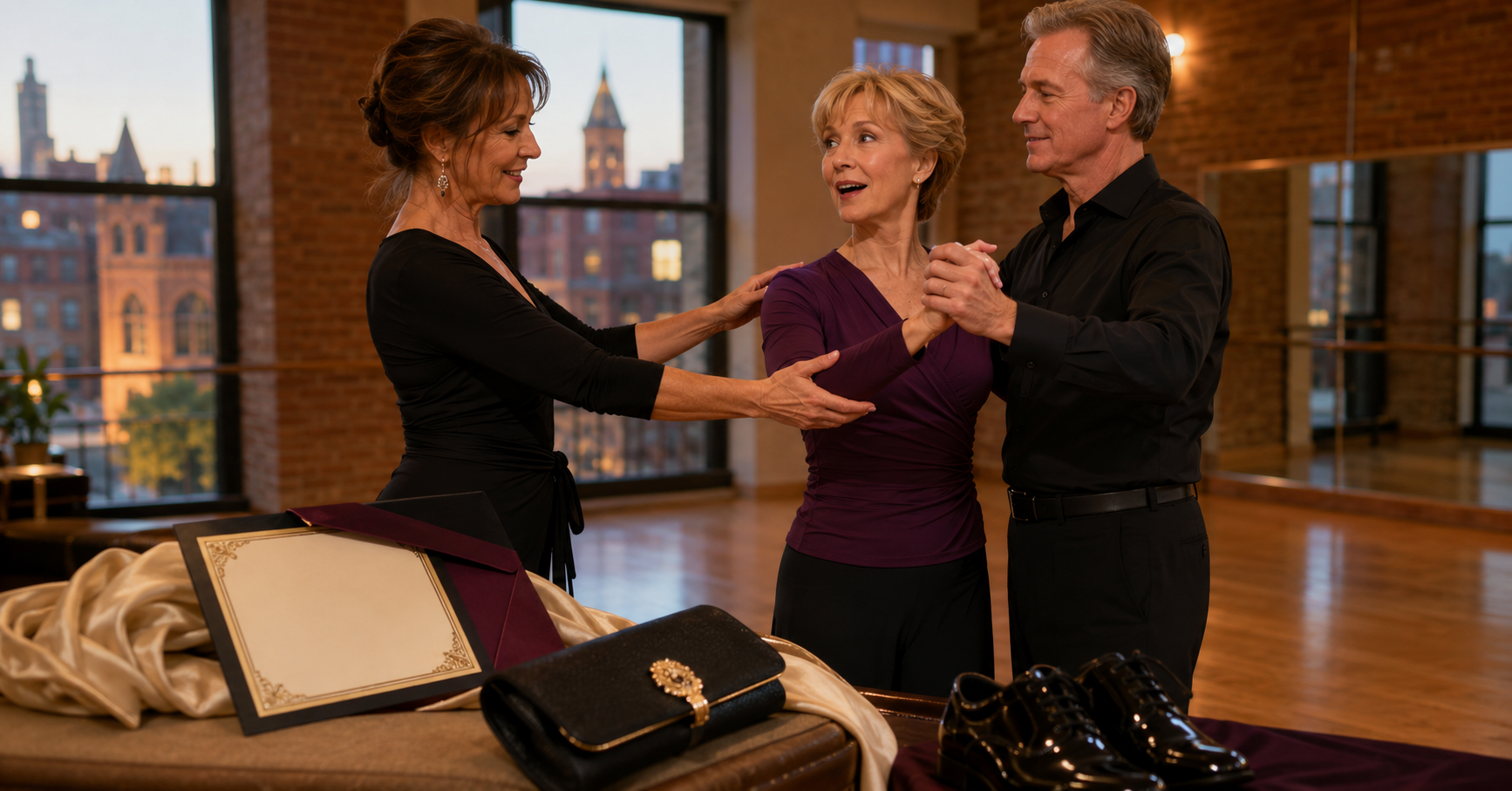
Fall gala dance lessons can help Twin Cities adults prepare for the part of a formal evening that often creates the most uncertainty: the moment the music starts and people begin moving toward the dance floor. You do not need a memorized routine, competition experience or a closet full of ballroom clothing. Instead, you need a few practical skills that help you recognize the music, move comfortably with another person and recover when you are unsure what comes next.
September and October bring charity galas, museum benefits, fundraising dinners, formal celebrations and opening-night events throughout Minneapolis and St. Paul. Some evenings end after the program. Others transition into live music, an after-party or an energetic dance floor.
Because you may not know exactly what the band or DJ will play, gala preparation should be different from preparing one choreographed wedding dance. The goal is flexibility rather than perfection.
Why Fall Gala Dance Lessons Matter Now
Several major Twin Cities organizations have already announced 2026 fall events. The Masonic Cancer Center’s Illuminate Gala will be held September 24 at Union Depot in St. Paul and includes live music. Meanwhile, the NMDP Gala in Minneapolis concludes with an after-party celebration on September 25.
The Stonewall Sports anniversary gala advertises an evening dance party on September 26. In addition, the Walker Art Center says its September 19 Avant Garden benefit will move from dinner into a rave-inspired dance hall.
Later in the season, the Minnesota Opera World Premiere Gala will bring guests from a black-tie-optional dinner at the Saint Paul Hotel to a performance and after-party at the Ordway.
These events are different from one another. However, they share a useful lesson: a formal evening may include more movement and social interaction than the dinner invitation initially suggests.
You Do Not Need a Gala Routine
When people hear “dance lessons,” they sometimes imagine learning a complete routine from beginning to end. That approach can work for a wedding performance or showcase. Nevertheless, it is rarely the most useful way to prepare for a gala.
You probably will not know the complete playlist. The size of the dance floor may change throughout the evening, and other guests will move unpredictably. Furthermore, the music may shift from a slow romantic song to Motown, disco, contemporary pop or live-band standards.
Therefore, I would rather help you learn a small set of adaptable skills:
- How to begin moving without hesitating.
- How to hear a usable pulse in unfamiliar music.
- How to maintain one comfortable basic action.
- How to guide or follow a simple turn.
- How to keep movement compact around other guests.
- How to end naturally when the song finishes.
Those skills can carry you through far more music than one impressive but inflexible sequence.
Fall Gala Dance Lessons Start With the Music
The first question is not, “Which ballroom dance looks best?” It is, “What kind of music are you likely to hear?”
A live band may play familiar standards, classic soul, swing, contemporary songs or a mixture of styles. A DJ may move rapidly among decades. Consequently, you need to recognize broad musical categories rather than memorize choreography for one recording.
I may begin by helping you distinguish between:
- Slow, even music that works with a relaxed rumba-style action.
- Upbeat music that supports single-time swing.
- Disco or party music that can work with hustle.
- Smooth standards that may suit compact foxtrot movement.
- Latin-influenced music that invites cha-cha, salsa or merengue-inspired movement.
If unfamiliar songs make the beat difficult to locate, read my direct guide to hearing the beat in ballroom dancing. Struggling to identify the pulse does not mean you lack rhythm. Sometimes the recording simply hides the musical information you are trying to follow.
Learn One Home-Base Movement
Every beginner should have a movement that feels safe enough to use while deciding what to do next.
Your home base might be a compact side-to-side action, a basic box, a relaxed walking pattern or a controlled sway with clearer timing and posture. It should be simple enough that you can continue it while paying attention to the music, your partner and the people around you.
When a turn becomes confusing, return to the home base. If the band changes the arrangement, use it while finding the pulse again. Likewise, when another couple moves into your space, the home base allows you to reduce your movement without stopping completely.
Simple does not look bad. In fact, a comfortable basic frequently looks more confident than complicated material performed with tension.
Prepare for a Crowded Gala Floor
Formal-event dance floors often become busiest during the most familiar songs. Friends gather in groups, guests carry drinks near the edges and couples may stop unexpectedly to talk or take photographs.
For that reason, fall gala dance lessons should include floor awareness. You need to understand how to make your movement smaller, redirect a pattern and protect a partner who is moving backward.
Useful crowded-floor habits include:
- Keeping steps beneath your body rather than reaching outward.
- Using walking turns instead of large pivots.
- Avoiding long backward travel when you cannot see the space.
- Leaving room for another couple to pass.
- Stopping a pattern before it becomes unsafe.
My direct article about dancing comfortably on a crowded floor explains how to adapt without feeling as though the dance has fallen apart.
What to Wear During Fall Gala Dance Lessons
You do not need to wear formal clothing to every lesson. However, your final preparation should account for the outfit and shoes you expect to wear.
A fitted jacket may restrict arm movement. Long skirts can alter step size, while narrow dresses may limit how comfortably someone can move backward. In addition, slick leather shoes behave differently from sneakers, and high heels change balance and posture.
Before the event, practice in clothing that creates similar restrictions. Bring the formal shoes to a lesson or wear shoes with a comparable heel and sole. That allows us to adjust turns, stride length and partner position before the gala.
Comfort also matters. If a shoe becomes painful after twenty minutes, you may stop dancing regardless of how well prepared you are. Therefore, break shoes in gradually and bring a secure backup pair when appropriate.
How to Invite Someone to Dance
You do not need a clever line. A simple “Would you like to dance?” is enough.
The other person may accept or decline, and both responses should be treated comfortably. If someone says no, smile and continue enjoying the evening. A declined invitation is not necessarily a judgment about you; the person may be tired, occupied, uncomfortable in their shoes or simply uninterested in that song.
Likewise, you may decline an invitation. “Thank you, but I’m going to sit this one out” is polite and complete.
Once you are dancing, avoid turning the floor into an impromptu lesson. General social-dance etiquette emphasizes enjoying the song rather than correcting a partner. The guidance published by Dance With Me Studios similarly advises dancers to save technical instruction for an actual lesson.
What If You Feel Watched?
Formal events can create the impression that everyone is evaluating everyone else. In reality, most guests are paying attention to their own conversations, clothing, friends and comfort level.
Still, fear of being judged can feel very real. The National Institute of Mental Health explains that anxiety can become especially strong in situations where someone expects scrutiny or evaluation. Feeling nervous at one event does not necessarily mean a person has an anxiety disorder, and dance instruction is not mental-health treatment. Nevertheless, the concern deserves respect rather than dismissal.
Preparation can reduce uncertainty. During a lesson, you can practice entering the floor, taking a comfortable hold, beginning with the music and finishing a song. As a result, the evening contains fewer unfamiliar moments.
Give Yourself a Small Goal
Do not make “dance confidently all night” your only measure of success.
Instead, choose one attainable goal:
- Dance one complete song.
- Invite your partner onto the floor without delaying.
- Use one comfortable turn.
- Return to your home base after losing the beat.
- Stay for part of the after-party rather than leaving immediately.
Once that goal is complete, anything additional becomes a bonus.
Fall Gala Dance Lessons for Couples
Couples sometimes arrive with different levels of interest. One partner may be excited, while the other mainly wants to avoid embarrassment.
That difference is manageable. I can build the lesson around the more cautious partner without allowing the more confident partner to dominate. Each person receives a clear role and a realistic assignment.
During home practice, avoid correcting one another. Agree on one goal, practice briefly and bring unresolved technical questions back to me. My article about how to practice dancing without arguing provides a structure that protects both the dancing and the relationship.
You Can Prepare Without a Partner
Many gala guests attend alone, with colleagues or as part of a larger table. You do not need a permanent partner before beginning lessons.
During private instruction, I can dance with you while helping you understand both the movement and the communication involved. You can learn how an invitation works, how to establish a comfortable connection and how to move with someone whose experience differs from yours.
Beginning alone may also reduce pressure because you can concentrate on your own timing and balance without comparing yourself with another beginner.
How Many Gala Dance Lessons Do You Need?
The answer depends on your starting point and goal. Someone who wants to move comfortably through one slow song may need less preparation than someone hoping to handle several musical styles.
Even so, a short series can focus on:
- Lesson one: music, home-base movement and comfort.
- Lesson two: one turn, partner communication and recovery.
- Lesson three: different songs, crowded-floor adjustments and formal shoes.
- Lesson four: a realistic gala-style practice session.
You may need fewer or more lessons. The point is not to sell you a fixed number. It is to identify the minimum preparation that lets you participate instead of worrying through the entire evening.
Enjoy the Gala Instead of Auditioning
A gala is not a ballroom competition. Guests are not expecting technical perfection, and the dance floor is not an examination.
Therefore, resist the urge to prove how many patterns you know. Listen to the music, remain connected to your partner and keep your movement suitable for the available space.
Fall gala dance lessons should help you feel more present at the event—not give you another performance to worry about.
I teach adults from St. Paul, Minneapolis, Roseville, Shoreview, Woodbury, Maplewood, White Bear Lake, Plymouth and communities throughout the Twin Cities. You may attend with a partner or begin on your own. No previous ballroom experience is required.
Feel Ready When Music Starts
Prepare for your fall gala with private lessons designed around your experience, outfit, event and comfort level.
612-308-7708 | Amy@BallroomByAmy.com
Amy Hanson is the three-time defending Dancers Cup Tour Top Teacher. She has danced professionally and internationally and has built friendships with dancers many people recognize from Dancing with the Stars.
People who think they are not coordinated, confident or good enough are exactly the beginners Amy loves to teach. No experience or partner is required.
Sources and Further Reading
- Masonic Cancer Center: Illuminate Gala 2026
- NMDP: 2026 Minneapolis Gala
- Twin Cities Pride: Stonewall Sports Anniversary Gala
- Walker Art Center: Avant Garden 2026
- Minnesota Opera: 2026 World Premiere Gala
- National Institute of Mental Health: Social Anxiety and Fear of Evaluation
- Dance With Me Studios: Social Dance Etiquette
AI disclosure: This article and its supporting graphics were created with assistance from artificial intelligence. Readers should confirm event details, seek qualified professional advice when appropriate and use their own judgment. AI-generated or AI-assisted images may not depict specific people, venues or events exactly.