
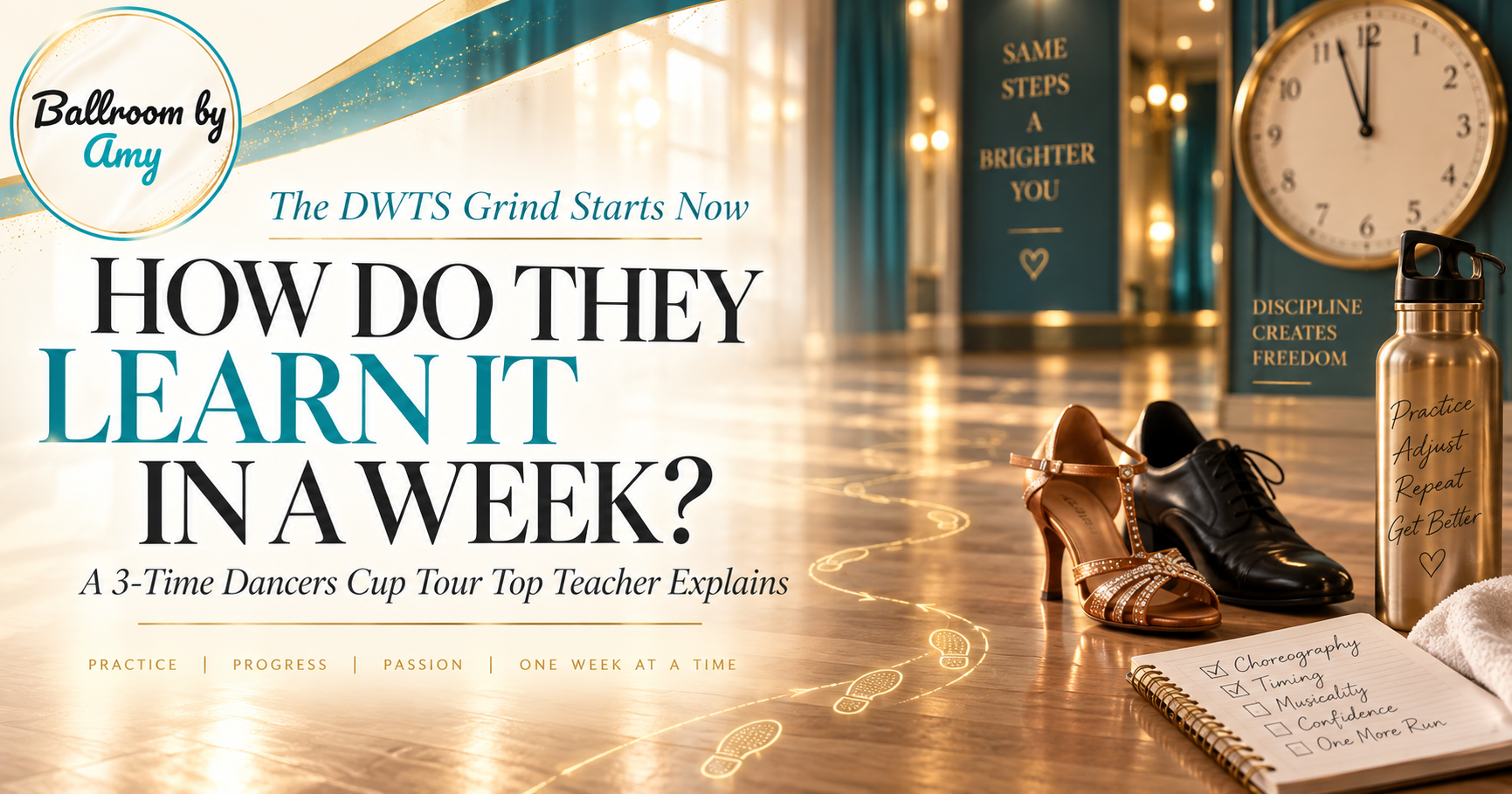
The first dances of Dancing with the Stars Season 35 come with all the pressure of opening night — but there is one luxury the celebrities will not have for very long:
Time.
The Season 35 couples had several weeks to get acquainted with their partners and prepare their first routines. Current pro Witney Carson told TV Insider that the couples began rehearsing weeks ahead of the September premiere — a very different situation from what happens once the competition settles into its normal weekly rhythm.
[1]
Now comes the part Amy Hanson finds especially impressive.
Amy is a professional ballroom dance instructor with Ballroom by Amy and a three-time Dancers Cup Tour Top Teacher. When she watches celebrities learn choreography, technique, timing, partnering and performance quality in a matter of days, she understands exactly how much information they are trying to put into their bodies at once.
Amy explains why even a routine that lasts only about a minute can demand an enormous amount of preparation.
Learning steps is only the beginning. The celebrity then has to remember the sequence, execute a dance style that may be completely unfamiliar, work with a partner, stay on time, perform for the cameras and make the whole thing look natural.
This is an important distinction when judging what we see during premiere week.
The first routine is not normally learned under the same timetable the contestants face later in the season. Carson says early-round Season 35 rehearsals are limited to approximately four studio hours per day, and the cast had multiple weeks before the premiere to work on Dance No. 1.
[1]
Once the regular schedule begins, the reset is brutal. Pro Rylee Arnold has described a typical cycle as rehearsing Wednesday through Sunday, camera blocking Monday and performing live Tuesday — then starting the process again.
[2]
And those four rehearsal hours do not necessarily represent the entire workload. Pros also develop choreography, meet with production, review music and video, handle camera blocking and work through costumes, staging and other creative details.
Former pro Lindsay Arnold once described a six-day turnaround as “cram time”, explaining that the goal is to get choreography into the celebrity’s head as quickly as possible so there is at least some time left to actually polish it.
[3]
Through more than three decades of competition, some of the show’s most memorable routines have come when the celebrity and pro had to solve a problem that seemed almost impossible on paper.
Paralympian Amy Purdy entered Season 18 as a double amputee, which meant she and Derek Hough could not simply teach conventional ballroom technique and expect her body and prosthetics to respond the same way.
During Disney Week, Purdy said the waltz forced her into positions that were especially difficult with her legs. Her frustration came from knowing what she wanted her body to do while discovering that her equipment sometimes would not allow it.
[4]
Their answer was not to lower the ambition. Purdy said those limitations forced them to become more creative. Hough kept finding alternate mechanics and solutions until the choreography worked for the dancer standing in front of him. The performance earned a 10 from one judge.
Nyle DiMarco’s Season 22 partnership with Peta Murgatroyd required a completely different teaching language because DiMarco is deaf.
DiMarco explained that trying to feel loud music through vibration actually threw him off. Instead, Murgatroyd demonstrated the movement visually and built subtle physical cues into the choreography so he could recognize transitions and timing.
[5]
Their Paso Doble to “Victorious” then turned that challenge into the centerpiece of the dance. The music disappeared for several seconds while DiMarco continued dancing, allowing the television audience to experience a small piece of his world.
[6]
The lesson: great teaching is not always about explaining something better. Sometimes it is about finding an entirely different way to communicate it.
Sometimes the challenge has nothing to do with the celebrity’s body.
During Season 23, Sharna Burgess and IndyCar driver James Hinchcliffe were preparing a Walking Dead-inspired Paso Doble when the music clearance changed. Burgess wrote that the team suddenly had to rethink the concept, music and choreography with only about a day and a half to put the performance together.
[7]
Hinchcliffe’s racing background helped. Burgess credited his attention to detail and work ethic, and the pair simply compressed the normal process: decide, teach, repeat and perform.
Iman Shumpert and Daniella Karagach’s Horror Night contemporary routine became one of Season 30’s signature performances — but Karagach later admitted that contemporary itself was outside much of her own competitive-dance background.
She built the piece from movement ideas and lifts she understood, then adapted them around Shumpert’s extraordinary size, strength and musical instincts. There was another complication: Karagach said the track essentially had no conventional beat to anchor the choreography.
[8]
Her solution was trust. Karagach described Shumpert as having remarkable instincts when catching and lifting her. The routine eventually helped earn her an Emmy nomination for choreography, and the pair went on to win the season.
Selma Blair’s Season 31 run was challenging from the beginning because she was competing while living with multiple sclerosis.
Sasha Farber said they adjusted the rehearsal process around her symptoms, including giving her additional rest and developing techniques to calm her body. At times Blair practiced with her eyes closed to slow her heart rate — an adaptation Farber eventually incorporated into a televised routine.
[9]
After scans revealed stress fractures and other physical damage, Blair made the difficult decision to withdraw. She and Farber performed one final gentle waltz and received perfect scores.
[10]
Her lesson was different but equally important: pushing yourself and protecting yourself are not opposites.
During Season 34, Dylan Efron struggled so much with a jive that he thought it could become one of his worst dances.
Instead, after a difficult rehearsal week with Daniella Karagach, he earned his first 10. Efron said the difference between the beginning and end of the week was essentially “night and day” and took pride in turning a potential disaster into one of their strongest routines.
[11]
That may be the purest example of what Amy is talking about: a dance does not gradually become easy. Sometimes it looks terrible until suddenly, after enough repetition, it doesn’t.
Season 34 champion Robert Irwin entered the finale dealing with significant rib pain that sometimes made breathing difficult.
Rather than simply demand that he push through everything, Witney Carson altered their freestyle. She removed a catch that was aggravating his ribs and later explained that Irwin’s health was her first priority.
[12]
They still performed three finale dances and won the Mirrorball — a reminder that adapting choreography is not necessarily making it easier. Sometimes it is the smartest way to preserve the performance.
From a ballroom teacher’s perspective, the celebrity is actually learning several things at the same time:
What step comes next?
How should the step actually be danced?
Exactly where does each movement belong in the music?
How do two people move as one?
Can you communicate character instead of looking like you’re counting?
Can you reproduce all of it live, once, with millions watching?
Amy looked at the Season 35 field, its dance backgrounds and the contestants she thought deserved an early look.
Winning predictions and personal favorites aren’t always the same. Amy explained who she is cheering for — and why.
Amy hasn’t simply watched Dancing with the Stars from her couch.
Tomorrow, Amy will share some of her personal connections to the show and explain why Dancing with the Stars has a special connection to her own ballroom-dance world.
On television, a routine can be over in little more than a minute.
What we don’t see is every forgotten step, every changed count, every awkward first attempt, every adjustment from the professional and every repetition required before a celebrity can finally stop thinking about the choreography and start actually dancing it.
And now that premiere week is ending, they have to do it all again.
[1]
TV Insider — Witney Carson on the current DWTS rehearsal schedule
[2]
E! News — Rylee Arnold on the weekly DWTS rehearsal cycle
[3]
Just Jared Jr. — Lindsay Arnold on the choreography timeline
[4]
Los Angeles Times — Amy Purdy on adapting ballroom movement to her prosthetics
[5]
TIME — Nyle DiMarco on learning choreography visually
[6]
Entertainment Tonight — DiMarco and Murgatroyd’s silent Paso Doble
[7]
TV Guide — Sharna Burgess on rebuilding James Hinchcliffe’s routine in a day and a half
[8]
ABC News — Daniella Karagach on choreographing Iman Shumpert’s Horror Night contemporary
[9]-[10]
SELF — Sasha Farber on adapting rehearsals for Selma Blair
;
Los Angeles Times — Blair’s final waltz and withdrawal
[11]
Us Weekly — Dylan Efron on turning a difficult jive week around
AI Disclosure:
This article was created with the assistance of artificial intelligence and reviewed, edited and approved for publication by Ballroom by Amy. AI-assisted tools were used to help research, organize and draft this article. More than 20 current and archival sources were reviewed during preparation, with key sources cited and linked within the article. AI-assisted tools may also have been used to create original accompanying graphic elements. Any such graphic is not official ABC, Disney or Dancing with the Stars promotional artwork and does not use celebrity photographs. Ballroom by Amy is not affiliated with or endorsed by ABC, Disney or Dancing with the Stars. Program names, trademarks and related intellectual property belong to their respective owners.