
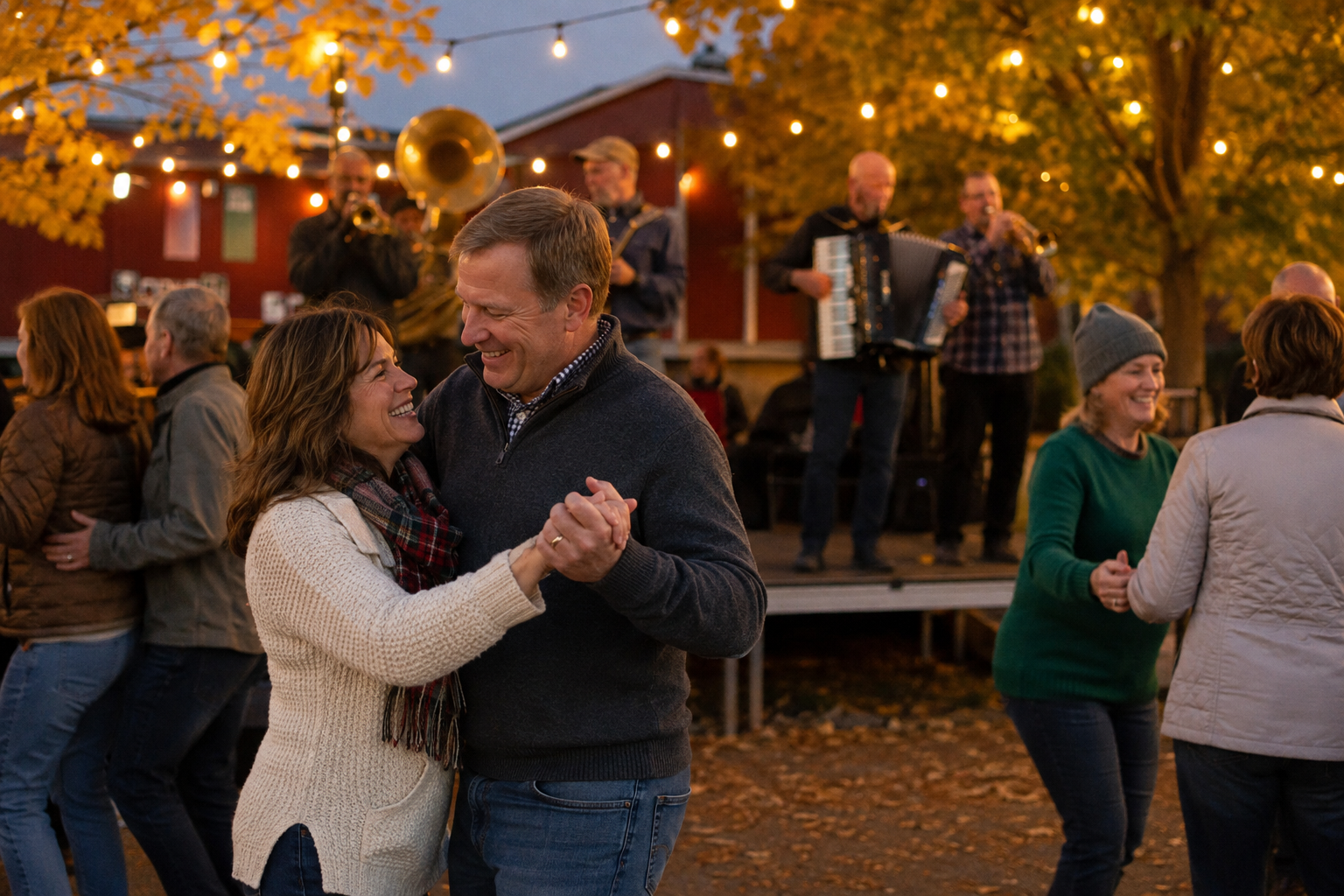
Minnesota has a funny relationship with polka.
You may not think about it very often.
Then September arrives.
Suddenly there are accordions. Bratwurst. Oktoberfest tents. People in lederhosen. Somebody starts playing a polka, and a dance floor that looked empty five minutes ago begins filling with people who somehow seem to know exactly what to do.
That is not an accident.
Polka is woven more deeply into Minnesota culture than many of us realize. And with Oktoberfest season about to begin across the state, it offers a surprisingly useful lesson about ballroom and social dancing:
The dances that survive are usually the dances people find a reason to use.
Minnesota’s German Connection Runs Deeper Than Many People Realize
Minnesota is frequently associated with Scandinavian heritage.
German influence is just as important.
The Minnesota Historical Society’s history of Germans in Minnesota notes that Germans became the largest single immigrant group in Minnesota history. German immigrants established communities throughout the state and brought traditions involving music, social gatherings and community life with them.
That history helps explain why names such as New Ulm, Stearns County and Oktoberfest feel so naturally Minnesotan.
But here is the first interesting twist:
Polka isn’t actually German.
The Dance Minnesotans Associate With Germany Started Somewhere Else
The Library of Congress traces polka to nineteenth-century Bohemia. By the 1840s, the dance had spread through Prague, Vienna and Paris before becoming enormously popular elsewhere in Europe and America. Dance manuals from the period routinely included instructions for polka alongside waltz and other fashionable social dances.
So how did a Bohemian dance become something that feels almost inseparable from German-American celebrations in Minnesota?
Because dance travels.
People adopt it. Change it. Attach their own music to it. Teach it to another generation. Eventually, the question of where a dance started becomes less important than what a community has done with it.
A Smithsonian Folklife Festival history of American polka describes exactly that process in the Midwest. Different regional and ethnic styles developed, and polka became something communities shared across ethnic lines. It also notes the influence of Minneapolis radio station WCCO, whose broadcasts of Whoopee John’s Dutchman music helped carry the sound across a large region.
A Minnesota Polka Myth Worth Busting
Myth: You need German heritage to have any connection to polka.
Reality: Polka itself came from Bohemia and became a shared social tradition across many Midwestern communities.
That may actually be part of the reason it lasted. The dance belonged to whoever showed up and danced it.
Minnesota Once Had Nearly One Hundred Ballrooms
If you want to understand how important social dancing once was in Minnesota, don’t just look at old photographs of dancers.
Look at the buildings.
The Minnesota Historical Society’s MNopedia history of the Minnesota Music Hall of Fame notes that Minnesota was home to nearly 100 ballrooms in the years following World War II.
Think about that for a moment.
Those weren’t 100 places primarily built so people could watch dancing.
They were places people went to dance.
One spectacular example was George’s Ballroom in New Ulm.
According to the City of New Ulm’s history of George’s Ballroom, the venue could accommodate thousands of people and featured an enormous hardwood dance floor. Its stage hosted performers ranging from Lawrence Welk and the Andrews Sisters to Glenn Miller, Whoopee John and the Six Fat Dutchmen. It became a center for both big-band and polka music.
That combination is worth noticing.
Big band.
Polka.
Ballroom.
Different music. Different styles.
Same basic social idea:
Put on music, make room on the floor and give people a reason to dance together.
Polka Wasn’t Something Minnesotans Only Watched
This is where the history becomes useful for someone thinking about ballroom dancing today.
Polka succeeded because it wasn’t treated primarily as a performance.
It was participatory.
People danced at weddings.
They danced at festivals.
They danced in ballrooms.
They danced at community celebrations.
They danced because a band was playing and dancing was simply part of what happened next.
New Ulm’s connection to that tradition became so significant that the city once promoted itself as the nation’s polka capital. The community’s famous Polka Days grew out of a 1953 downtown celebration that reportedly drew thousands of people for a parade and street dancing accompanied by multiple old-time bands.
And this is not entirely nostalgia.
Earlier this year, the New Ulm Journal reported on a new weekly Polka Tuesday series created with the stated goal of attracting generations both young and old.
Polka didn’t disappear.
It just stopped being something many Minnesotans encounter every Saturday night.
What Polka Understands About Social Dancing
Strip away the accordion, the traditional clothing and the Oktoberfest decorations for a moment.
What makes polka work socially?
It gives people something to do together.
There is music with a recognizable energy.
There is a repeatable structure.
There is another person.
There is a reason to move.
And perhaps most importantly, there is an environment in which dancing does not feel unusual.
That last part matters.
A person who says, “I don’t dance,” may suddenly become considerably more adventurous when everybody around them is dancing at a wedding, festival or Oktoberfest.
The environment gives them permission.
What Polka Can Teach a Beginning Ballroom Dancer
You don’t need a perfect dance floor.
You need music and enough room to move.
You don’t need to perform.
Social dancing exists primarily for the people doing it.
You don’t need ten dances.
Knowing enough to comfortably participate can completely change an evening.
You need a reason to use what you learn.
A wedding, Oktoberfest, vacation, concert or date night can be just as good a reason as simply deciding you want to learn ballroom dancing.
Minnesota’s Oktoberfest Season Is About to Put That Theory to the Test
This article publishes September 3.
That means Minnesota is about to enter one of the easiest times of the year to see this type of social dancing in action.
The Germanic-American Institute’s St. Paul Oktoberfest runs September 11–12, 2026, with German food, cultural performances, music and polka bands.
Farther south, New Ulm Oktoberfest takes place October 2–3 and October 9–10, with live German music, dancing and celebrations spread across several locations in a city where this tradition has unusually deep roots.
And Twin Cities Oktoberfest returns to the Minnesota State Fairgrounds October 9–10, 2026.
Three Minnesota Oktoberfest Dates to Know
September 11–12 — St. Paul Oktoberfest
Germanic-American Institute, St. Paul
See St. Paul Oktoberfest information
October 2–3 and October 9–10 — New Ulm Oktoberfest
Multiple locations in New Ulm
See New Ulm Oktoberfest information
October 9–10 — Twin Cities Oktoberfest
Minnesota State Fairgrounds, St. Paul
See Twin Cities Oktoberfest information
Please note: Ballroom by Amy is not affiliated with, compensated by or endorsing the events or organizations listed above. They are included as educational resources for people interested in Minnesota culture and social dancing. Schedules and event details can change, so confirm information with the organizer before attending.
What If You Go to Oktoberfest and Don’t Know How to Polka?
Watch.
Listen.
Notice what the people dancing seem to have in common.
You may discover that the floor is not populated exclusively by expert dancers executing perfect technique.
That’s the point.
Social dancing does not require every person on the floor to have the same amount of experience.
And you don’t necessarily have to become a dedicated polka dancer to benefit from learning how to move comfortably with another person.
Basic partner connection, rhythm, leading and following, awareness of the people around you, and confidence moving to music travel remarkably well from one social situation to another.
A wedding may play one kind of music.
An Oktoberfest may play another.
A cruise may give you something completely different.
The valuable skill is becoming a person who hears music and thinks:
“I might actually know what to do with this.”
You Can Build a Dance Lesson Around Real Minnesota Life
This may be the most practical connection between Minnesota’s dance history and ballroom lessons today.
You don’t have to walk into a lesson and say:
“I would like to become a ballroom dancer.”
You can say:
“I’m going to Oktoberfest.”
Or:
“We have three weddings this fall.”
Or:
“My spouse loves dancing and I always sit down.”
Or:
“I keep seeing people dance when there’s live music, and I’d like to be able to join them.”
Those are excellent reasons to learn.
At Ballroom by Amy, Amy can build private instruction around what you actually want to do with dancing.
Maybe that’s Waltz.
Maybe it’s Swing.
Maybe you’d like enough experience with Polka to feel more comfortable when an accordion starts playing.
The dance style is only part of the question.
Where do you want dancing to take you?
Have a Minnesota Dance Opportunity Coming Up?
A wedding, Oktoberfest, concert or fall event can be a perfectly good reason to learn a few dance basics.
Learn about private dance lessons with Ballroom by Amy
Call 612-308-7708 or email Amy@BallroomByAmy.com.
Minnesota Didn’t Keep Polka Alive by Putting It Behind Glass
That may be the real lesson.
Minnesota has museums full of history.
Polka survived differently.
People kept playing it.
People kept dancing it.
Communities kept building celebrations around it.
Grandparents danced with grandchildren. Bands learned the old songs. Festivals gave the music another weekend on a stage and another chance to fill a dance floor.
That is how social dance stays alive.
Not because everybody decides to become a serious dancer.
Because enough people keep finding moments when dancing makes life more fun.
Maybe that is the best thing Minnesota’s polka tradition can teach us about ballroom dancing.
You don’t always learn to dance because you need another hobby.
Sometimes you learn because the music is already playing.
Helpful Sources and Further Reading
Minnesota Historical Society — Germans in Minnesota
Minnesota Historical Society/MNopedia — Minnesota Music Hall of Fame
Library of Congress — Nineteenth-Century Social Dance
Smithsonian Folklife Festival — American Polka Tradition
City of New Ulm — George’s Ballroom History
Germanic-American Institute — St. Paul Oktoberfest
Twin Cities Oktoberfest — Event Information
This article includes content supported by AI. While we strive for accuracy, please use your own judgment and double-check details as needed. Photos or graphics may include AI-assisted elements.