
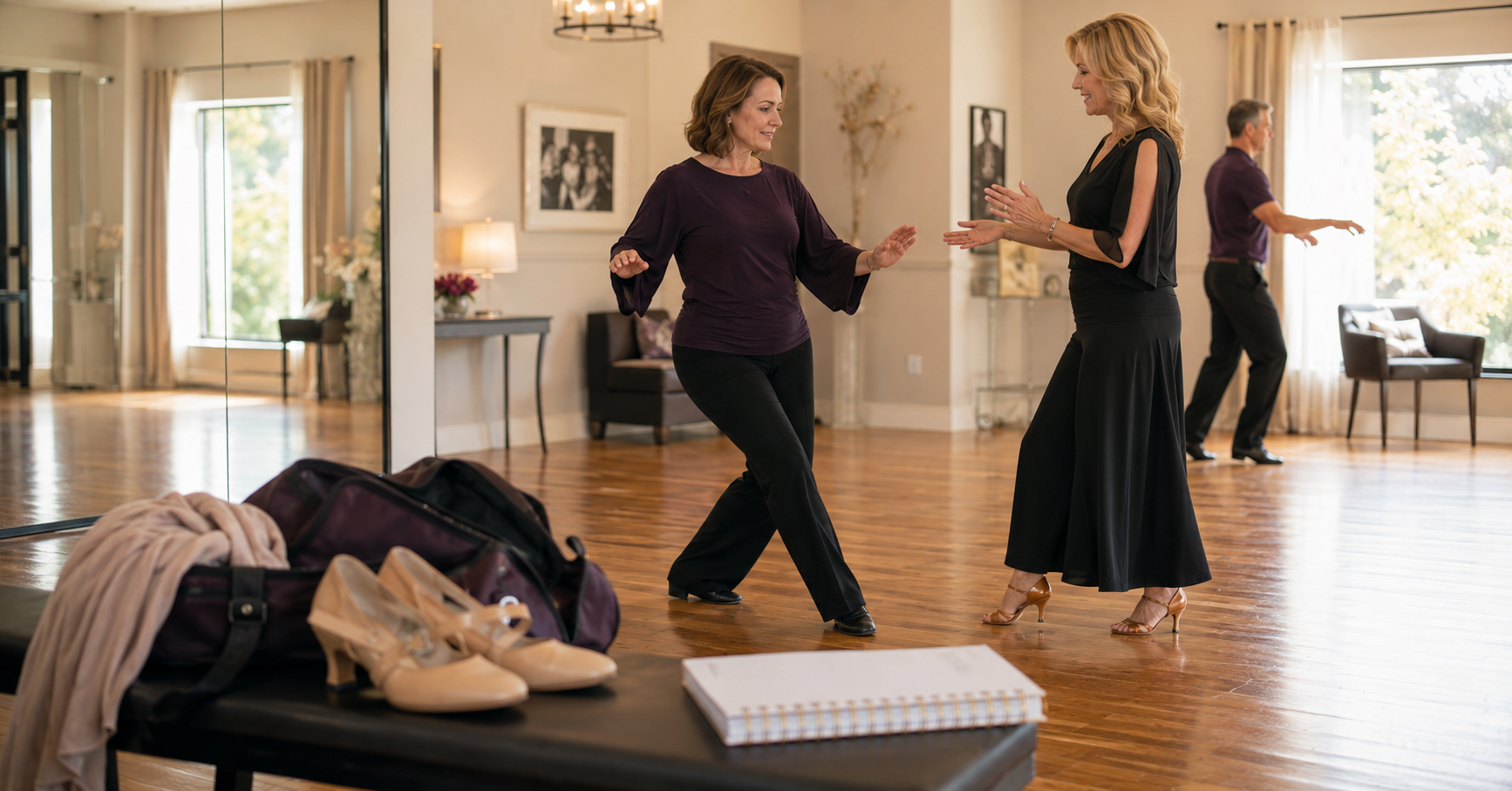
Returning to ballroom dancing after several months or years away can feel more intimidating than taking your first lesson. You remember enough to notice what has disappeared, yet you may not remember enough to feel comfortable. Timing that once felt automatic may require concentration. Familiar turns can seem surprisingly complicated, and your balance or stamina may not feel the way it did before the break. None of that means you have lost your ability to dance.
Instead, think of your return as a reintroduction. You are not starting from zero, but you are also not required to resume at the exact level where you stopped.
Late summer and early fall are natural times to return. Vacations end, family schedules become more predictable and adults throughout the Twin Cities begin deciding what they want their own routines to include. If ballroom dancing was once important to you—or if you have continued thinking about it—the next step does not need to be dramatic. It can simply be one lesson.
Returning to Ballroom Dancing Is Not Starting Over
A long break can affect both memory and physical comfort. However, forgetting a sequence is not the same as losing everything you learned.
Research on procedural skills shows that performance can decline when a skill is not used. Nevertheless, the degree of decline varies substantially. A recent meta-analysis of procedural-skill retention found that accuracy, speed and combined performance do not all decline at the same rate.
Other motor-learning research has found that some detailed features of a well-practiced skill can remain after long delays. In one controlled task, participants retained aspects of a learned motor skill after six months and, in limited cases, after several years. That study did not involve ballroom dancers, so it cannot predict exactly what any returning student will remember. Still, it supports a reassuring idea: stored movement may reappear once the right cues are restored. You can read the long-term motor-memory study.
In practical terms, you may forget the name of a figure while your body recognizes part of its rhythm. Perhaps you cannot explain the correct dance hold, but your posture begins returning after a few guided attempts. You might also remember one role more clearly than another.
Therefore, I do not assume that a returning student is either a complete beginner or an experienced dancer ready to continue without review. We begin by finding out what is still available.
Why Returning Dancers Often Feel More Self-Conscious
True beginners do not expect themselves to know anything. Returning dancers often expect themselves to remember everything.
That expectation creates pressure. You may compare today’s movement with your best dancing from years ago rather than with your first lesson from that period. Furthermore, you may remember how a step should feel even though your body cannot immediately reproduce it.
Public dance discussions commonly reveal this frustration. Returning dancers describe feeling uncomfortable in classes because they recognize the material but cannot respond quickly enough. Some also worry that going back to a beginner lesson will look like failure.
It is not failure. Review is part of learning.
A supportive learning environment matters at every age. Recent reporting from the American Psychological Association describes research suggesting that older adults can build both cognitive skills and confidence when they learn in an encouraging setting. Although that work was not specifically about ballroom dancing, its emphasis on support and confidence is highly relevant to adults returning to a complex skill. Read the APA’s discussion of learning and confidence in later adulthood.
Begin Returning to Ballroom Dancing With an Assessment
Your first lesson back should not be an exam. Instead, it should help answer a few practical questions:
- Which dances still feel familiar?
- Can you hear and maintain the basic rhythm?
- Do you remember individual footwork but struggle with a partner?
- Has your balance, mobility or endurance changed?
- Which movements feel comfortable?
- What would make returning worthwhile now?
I may ask you to walk, change weight or try one simple basic before reviewing any named pattern. Those movements tell me more than asking how advanced you once were.
For example, a student may remember several bronze figures but no longer complete a clear weight change. In that case, adding patterns will not restore confidence. Rebuilding the foundation will.
Conversely, another student may retain strong movement but hesitate because the names and counts have faded. That student may need reminders rather than a complete restart.
Tell Me What Changed During Your Break
A dancing break may have happened because life became busy. However, it may also have involved an injury, surgery, illness, caregiving responsibility, job change or loss of a partner.
You do not need to provide private medical details. Still, I need to know about limitations that affect how you move. A previously comfortable turn may need to be modified. Your endurance may be different, or you may feel less stable moving backward.
The National Institute on Aging recommends working back up gradually after an interruption caused by travel, illness or another break in routine. It also advises starting with lower-intensity activity appropriate to your current fitness level. Review its guidance on returning gradually after a break in activity.
In addition, adults with chronic conditions should seek appropriate medical guidance about suitable activity. The Centers for Disease Control and Prevention’s adult activity guidance recommends consulting a healthcare professional when a chronic condition may affect the type or amount of activity that is appropriate.
Dance instruction is not medical treatment. Therefore, pain, dizziness, unusual shortness of breath or other concerning symptoms should not be treated as obstacles to push through.
Rebuild the Basic Rhythm Before the Old Routine
Returning students often want to begin with the most impressive movement they remember. Yet the fastest way back usually starts with the least impressive movement: the basic.
A reliable basic step restores several skills at once:
- Weight changes
- Musical timing
- Balance
- Posture
- Partner connection
- Direction and floor awareness
Once those pieces return, familiar turns often begin making more sense.
If the beat feels less obvious than it once did, review my article explaining why some songs make the musical pulse harder to find. That article uses a direct link to the full Ballroom by Amy resource rather than sending you to a general blog page.
Initially, I may also choose music with a clear, moderate tempo. Difficult music can be added later. The first goal is not to prove that you can handle every song; it is to restore a dependable relationship between the music and your movement.
Use Smaller Movement While Your Confidence Returns
Large steps can make returning dancers feel less stable. They also require more strength, balance and commitment than compact movement.
As a result, I often reduce the size of a returning student’s steps. Smaller movement allows you to complete each weight transfer, notice your posture and respond to a partner without rushing.
This approach is especially helpful when:
- Your shoes or body feel unfamiliar.
- You are dancing on a different floor.
- You have not recently practiced turns.
- Your stamina has changed.
- You feel nervous about moving backward.
Compact movement is not beginner-looking movement. In social dancing, controlled steps are frequently more useful than large ones.
Returning to Ballroom Dancing With a Partner
Partner connection may take longer to return than individual footwork.
You might remember where your feet go but struggle to communicate the movement. Similarly, a follower may recognize a pattern only after it has already begun. That delay can cause both partners to become tense.
Avoid trying to recreate your previous partnership immediately. Instead, rebuild three simple skills:
- Stand comfortably together.
- Create a clear but gentle connection.
- Move one basic pattern without forcing the result.
If you are returning with a spouse or partner, neither person should become the other’s instructor. My article about how to practice dancing without arguing explains how to keep feedback respectful and save unresolved technical questions for your lesson.
One person may remember more than the other. Nevertheless, the partnership will improve faster when the stronger dancer remains a cooperative partner rather than an impatient coach.
Returning Without Your Former Partner
Sometimes the biggest change is not physical. You may no longer have the person with whom you previously danced.
Beginning with a new partner can expose habits that were invisible in the old partnership. Perhaps your former partner recognized your intended movement before you clearly communicated it. A new partner will not have that history.
Although this can feel discouraging, it is also useful. Clear lead-and-follow skills should work beyond one memorized partnership.
You may also return without bringing any partner. During a private lesson, I can dance with you and help restore both the movement and communication involved in partner dancing. No permanent partner is required.
Do Not Measure Your Return by Pattern Count
Remembering ten patterns does not necessarily mean you are dancing more comfortably than someone who remembers three.
Instead, notice practical signs of progress:
- You find the beat sooner.
- Your steps feel less forced.
- You can finish a song without stopping.
- You recover after forgetting something.
- Your shoulders remain more relaxed.
- You can pay attention to your partner instead of only your feet.
Motor-learning research distinguishes between temporary performance during practice and longer-lasting learning. In other words, completing a movement correctly once does not necessarily mean it has become dependable. A review of performance and long-term motor learning explains why delayed retention can be more informative than how well someone performs at the end of one practice session.
Therefore, I would rather see a returning student perform a simple skill comfortably on several occasions than rush through a large number of remembered figures.
Give Your Body Time to Return Too
Your memory may recover faster than your stamina. That mismatch can be frustrating because you know what you want to do but tire before completing it.
Start with shorter periods of activity and increase gradually. Federal physical-activity guidance emphasizes that adults who are inactive can begin with small amounts rather than trying to meet the full weekly recommendation immediately. The official Move Your Way guidance notes that even brief periods of activity count and encourages people to start with what they can manage.
Likewise, CDC recommendations encourage adults to start slowly and build toward greater activity over time. :contentReference[oaicite:1]{index=1}
During a dance lesson, that may mean:
- Taking more frequent breaks.
- Alternating faster and slower dances.
- Practicing a turn fewer times in a row.
- Using smaller steps.
- Stopping before technique collapses from fatigue.
Dance can contribute to an active lifestyle, although one lesson is not a complete fitness program. Research involving community-dwelling older adults has examined ballroom dance as a structured physical and social activity. For example, one randomized trial compared ballroom dance, music and social-conversation programs over ten weeks. Review the community arts and ballroom dance trial.
Results from any study should not be treated as a promise about an individual student. Still, the research reinforces that ballroom dancing combines movement with learning and social interaction.
Practice Just Enough Between Lessons
Returning dancers sometimes overpractice because they want to catch up quickly. Unfortunately, a long and frustrating session can make returning feel like punishment.
Begin with five to ten minutes. Choose one assignment:
- Listen for the beat in one song.
- Practice a basic weight change.
- Review the starting position.
- Walk one pattern without music.
- Practice your role separately.
Stop before fatigue or irritation changes the movement.
You also do not need a studio-sized room. My guide to practicing ballroom dancing in a small space shows how timing, posture and weight changes can be reviewed with only a few feet of clear floor.
Between lessons, consistency matters more than duration. A brief review helps keep the movement familiar without turning the week into an intensive training program.
Choose One Dance to Rebuild First
Trying to restore every dance at once creates unnecessary confusion.
Instead, begin with the style that gives you the clearest path back. That might be:
- Rumba if you want compact, controlled movement.
- Single-time swing if upbeat music helps you relax.
- Foxtrot if you remember smooth walking patterns.
- Waltz if its phrasing and rise-and-fall feel familiar.
- Hustle if party music was your original reason for dancing.
- Cha-cha if strong rhythm helps bring the footwork back.
The correct choice is not automatically the dance in which you once reached the highest level. It is the dance that gives you an early feeling of recognition and success.
After that foundation becomes reliable, we can reintroduce additional styles.
Returning to Ballroom Dancing for Social Events
Perhaps you are returning because a wedding, reunion, cruise or community dance is approaching. In that case, your goal may not require reconstructing an entire previous syllabus.
We can focus on usable social-dance skills:
- Recognizing which dance fits a song.
- Beginning without hesitation.
- Maintaining one basic pattern.
- Using one or two comfortable turns.
- Keeping steps compact around other people.
- Ending naturally when the song finishes.
That approach can restore practical confidence much faster than trying to remember every figure you once knew.
When the event is outside, my direct guide to outdoor ballroom dancing explains how concrete, footwear, heat and limited space can change the experience.
What Your First Month Back Might Look Like
Week One: Discover What Remains
We identify familiar rhythms, movements and dances. At the same time, we note anything that feels uncomfortable or confusing.
Week Two: Rebuild One Foundation
Next, we choose one dance and strengthen its timing, basic action and partner connection.
Week Three: Add a Usable Variation
Once the foundation feels more dependable, we add one turn, transition or direction change.
Week Four: Dance Without Constantly Stopping
Finally, we connect the material and practice recovering when something is forgotten.
This is only an example. Some students move faster, while others benefit from additional review. Your return should follow your present needs rather than an arbitrary timetable based on what you did years ago.
You Do Not Have to Earn the Right to Return
Some adults delay because they believe they should lose weight, improve their fitness or practice alone before contacting an instructor.
You do not need to prepare yourself to become teachable.
Others worry that returning at a lower level will erase their previous accomplishment. It will not. The lessons, friendships and experiences you had still happened. Reviewing fundamentals does not take them away.
Most importantly, you do not have to explain why the break lasted as long as it did. Life changes. Priorities shift. Bodies change. Partners move away, and schedules become complicated.
The relevant question is not, “Why did I stop?”
Instead, ask, “What would I enjoy learning now?”
Returning to Ballroom Dancing in the Twin Cities
I teach adults from St. Paul, Minneapolis, Roseville, Shoreview, Maplewood, Woodbury, White Bear Lake, Plymouth and communities throughout the Twin Cities.
You may return with a partner or come alone. Perhaps you danced socially years ago, took lessons for a wedding or reached an advanced level before life interrupted. You may remember a great deal—or almost nothing.
All of those starting points are welcome.
Returning to ballroom dancing should not be about proving that you never forgot. It should be about discovering what remains, rebuilding what matters and creating a version of dancing that fits your life now.
Visit Ballroom by Amy, call 612-308-7708 or email Amy@BallroomByAmy.com to schedule a lesson and ask questions.
About Amy Hanson
Amy Hanson is the three-time defending Dancers Cup Tour Top Teacher. She has danced professionally and internationally and has built friendships with dancers many people recognize from Dancing with the Stars.
People who think they are not coordinated, confident or good enough are exactly the beginners Amy loves to teach. No experience or partner is required.
Website: ballroombyamy.com
Phone: 612-308-7708
Email: Amy@BallroomByAmy.com
Sources
- PubMed: Procedural Skill Retention and Decay
- Frontiers: Long-Term Memory of a Motor Skill
- National Institute on Aging: Returning Gradually After an Activity Break
- CDC: Adding Physical Activity as an Adult
- Office of Disease Prevention and Health Promotion: Move Your Way
- American Psychological Association: Supportive Learning and the Aging Brain
- PubMed: Ballroom Dance and Community Arts Trial
This article includes content supported by AI. While we strive for accuracy, please use your own judgment and double-check details as needed. Photos may use AI-generated or AI-assisted imagery when applicable.