
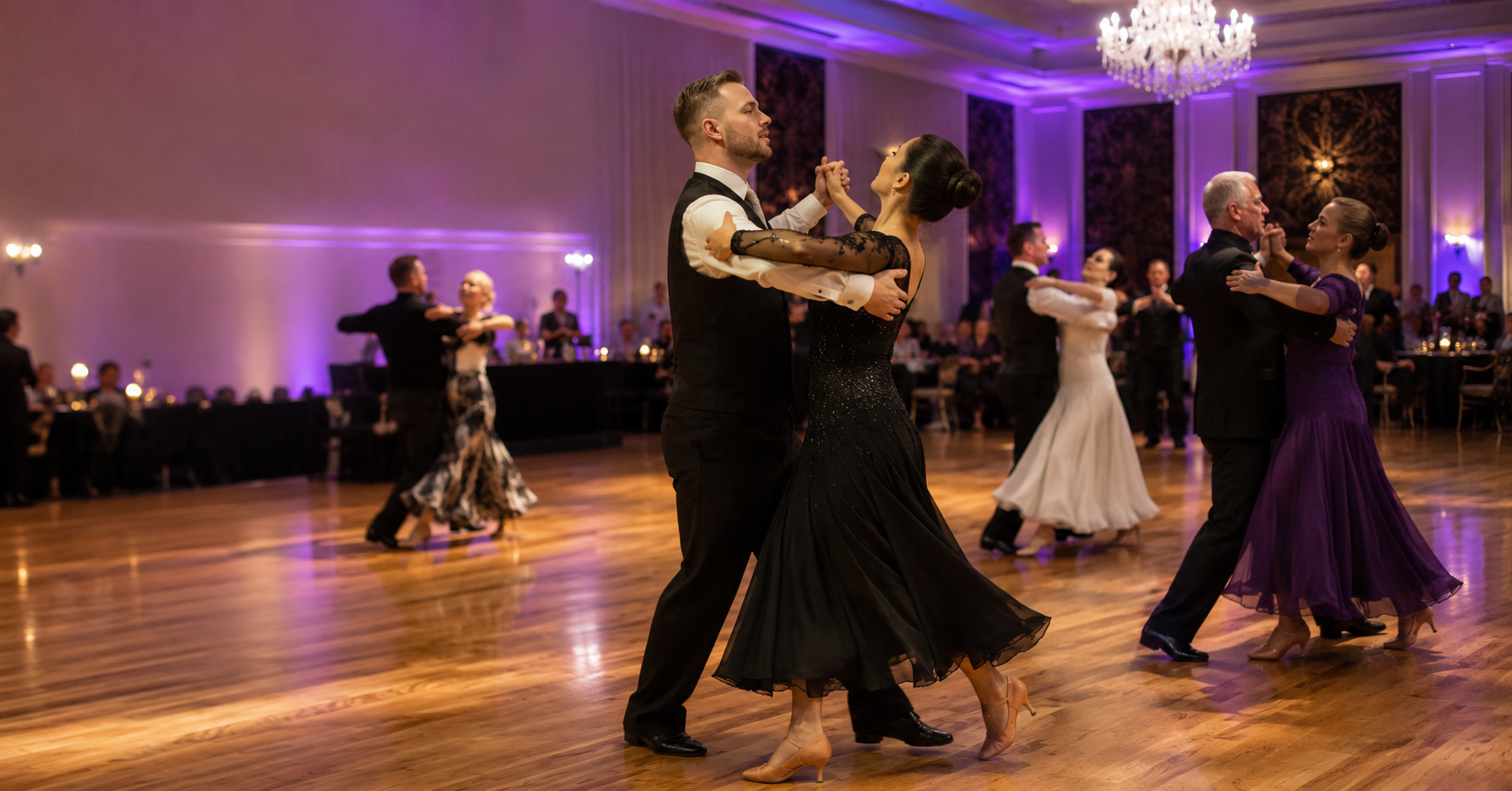
Most new ballroom dancers assume that feeling comfortable at a social dance depends on knowing enough steps. Steps certainly help, but there is another skill that often matters even more once several couples are moving around the same floor: floorcraft.
Floorcraft is the ability to adjust what you are dancing based on the space, traffic and people around you. It is how a couple continues dancing without running into someone, trapping another couple against the wall or turning a crowded social into an obstacle course.
I teach dancers from Saint Paul, Minneapolis, Plymouth, Roseville, Shoreview and communities throughout the Twin Cities, and I have found that dancers usually feel much more confident at parties once they understand that successful social dancing is not about performing every pattern they know. It is about making good choices with the space they actually have.
What Is Floorcraft in Ballroom Dancing?
Floorcraft includes watching the couples around you, choosing appropriately sized movements and changing your intended pattern when the space in front of you disappears. USA Dance describes good floorcraft as moving in a skilled and controlled manner while avoiding collisions and respecting the other couples sharing the floor.
That may sound like a responsibility primarily belonging to the leader, but both partners contribute. The leader generally chooses the couple’s direction and patterns. The follower can help by maintaining balance, responding without anticipating and staying aware enough to protect the partnership when someone suddenly enters their space.
Good floorcraft is not necessarily noticeable. In fact, the best floorcraft often looks like nothing happened. A couple changes direction, shortens a movement or substitutes a simpler figure, and the dance continues naturally.
Understand the Line of Dance Before Entering the Floor
Progressive dances such as waltz, foxtrot, tango and Viennese waltz generally travel counterclockwise around the room. This traffic pattern is called the line of dance.
Think of the floor as having informal traffic lanes. Couples moving more quickly and covering more distance usually travel around the outside. Dancers using smaller figures or moving more slowly should generally remain closer to the center. Stationary or mostly stationary dances should not be danced in the outer traveling lane when other couples are progressing around the room.
The University of Georgia’s ballroom curriculum identifies the line of dance as the counterclockwise flow of traffic around the room. USA Dance’s etiquette guidance similarly recommends observing the room’s traffic patterns to help prevent mishaps.
Before stepping onto a busy floor, take a few seconds to watch the traffic. Look for an opening rather than walking directly into another couple’s path. It is the dance-floor version of checking for traffic before entering a road.
Smaller Dancing Is Often Better Dancing
One of the most common mistakes I see is assuming that a bigger step is automatically a better step. Large movement can be beautiful when there is room for it, but a crowded social floor is not the place to insist on maximum stride length.
Instead, adjust your movement to the conditions:
- Shorten your steps when couples are close.
- Reduce the size of turns and traveling patterns.
- Avoid throwing arms, legs or styling into another couple’s space.
- Use basic figures while waiting for traffic to open.
- Pause or change direction rather than forcing a planned pattern.
Using smaller movements is not an admission that you cannot dance. It shows that you understand the purpose of social dancing. Your goal is to create a comfortable experience for your partner while sharing the floor safely with everyone else.
You Do Not Have to Finish the Pattern
In lessons, dancers often practice a figure from beginning to end. That structure helps you learn it, but social floors do not always cooperate with the lesson plan.
A couple may suddenly stop in front of you. Someone may drift across your lane. A beginner may move unpredictably. When that happens, you are allowed to abandon the pattern.
You can replace it with a basic action, rotate into open space or wait briefly until the traffic clears. The ability to change your mind is a skill, not a mistake.
This is one reason personalized instruction can be especially valuable. During a private ballroom lesson, I can help you learn several safe exits from familiar figures rather than relying on one memorized sequence. Visit Ballroom by Amy to request lesson information.
Leaders: Look Beyond Your Partner’s Shoulder
A leader should develop the habit of seeing beyond the partnership. That does not mean constantly twisting the head or becoming distracted from the person in front of you. It means using peripheral vision and brief glances to understand what is happening nearby.
Try to identify where another couple is likely to be a few seconds from now, not only where they are at the moment. Couples traveling around the floor have momentum. An open space can disappear before you reach it.
Leaders should also resist the temptation to treat every opening as territory that must immediately be claimed. Sometimes the safest decision is to let another couple pass and use a compact figure until a clearer path appears.
Followers Have a Floor-Safety Role, Too
Followers are not responsible for steering the partnership, but they often see hazards that the leader cannot. If someone is directly behind the leader, a follower can protect the partnership without suddenly taking over or pulling the leader off balance.
A controlled stop, a firm but calm connection or a brief verbal warning may be appropriate when a collision is imminent. The priority is safety, not preserving the illusion that nothing unexpected happened.
Followers can also make the floor safer by avoiding anticipation. Moving before a lead is clearly communicated can send the partnership into space the leader has not checked. Staying balanced and responsive makes it easier for the leader to redirect a figure when traffic changes.
What to Do After a Collision
Even careful dancers occasionally bump into someone. Ballroom etiquette is straightforward: stop if necessary, make sure everyone is all right and apologize.
Do not debate which couple caused it while everyone is still standing on the dance floor. A simple “I’m sorry. Are you okay?” is usually all that is needed. Then give each other space and continue when it is safe.
The Ballroom Association at the University of Wisconsin notes that collisions can happen when dancers of different levels share a floor and advises dancers to apologize regardless of fault. That approach keeps a minor accident from becoming an unpleasant interaction.
Do Not Teach Your Partner in the Middle of a Social Dance
Floorcraft is not limited to avoiding physical collisions. It also includes maintaining a welcoming social environment.
Unless your partner has specifically requested instruction, a social dance is not the time to correct technique, test advanced figures or repeatedly tell someone what they did wrong. When a pattern does not work, simplify it and continue dancing.
A social partner may have learned different terminology, timing or styling. They may also be nervous, tired or completely new. The strongest social dancers adapt to the person in front of them rather than trying to prove how much they know.
If you want focused technical feedback, lessons and guided practice give you a better place to work through those details. You can also visit Ballroom by Amy to watch my free lesson videos and review important ballroom concepts away from a crowded social floor.
How Beginners Can Practice Floorcraft
You do not need a packed ballroom to begin developing this skill. Here are several ways I practice it with students:
- Create imaginary obstacles. Place chairs or markers around the floor and practice changing direction before reaching them.
- Dance in a smaller area. See how comfortably you can perform familiar figures without increasing your space.
- Practice alternate endings. Learn two or three ways to exit the same pattern.
- Change plans on command. Begin one figure and switch to another when your instructor gives a cue.
- Attend beginner-friendly events. Social experience helps you learn to read real dancers rather than imaginary traffic.
The Ballroom by Amy homepage also includes upcoming Twin Cities dance opportunities. Check the local events listed on Ballroom by Amy before attending, since schedules, prices and locations can change.
When attending an unfamiliar event, arrive early enough to look at the floor, ask about local customs and become comfortable with the room before it becomes busy.
Floorcraft Builds Confidence Faster Than More Choreography
Dancers sometimes respond to social anxiety by learning more patterns. That can help, but memorizing ten additional figures will not necessarily make a crowded floor feel easier.
Confidence often comes from knowing that you can continue dancing even when your original plan no longer works. A basic step performed comfortably, safely and musically is far more enjoyable than an elaborate pattern squeezed into insufficient space.
I want my students to be able to dance anywhere in the Twin Cities and feel that they can adapt to the room. That means teaching more than choreography. It means teaching judgment, awareness, consideration and the ability to make a partner feel safe.
Practice Floorcraft With Ballroom by Amy
Floorcraft is difficult to learn from a list of rules alone. It becomes much easier when you can practice adjusting your steps, changing direction and navigating around other dancers in a controlled setting.
I offer private lessons, couples lessons, group instruction, social-dance coaching and competitive training throughout the Twin Cities, including Saint Paul, Minneapolis, Plymouth, Roseville, Shoreview and surrounding communities. Visit Ballroom by Amy to ask questions, request lesson information, watch my free ballroom lessons and see upcoming local dance opportunities.
About Ballroom by Amy
Amy Hanson is the three-time defending Dancers Cup Tour Top Teacher. She has danced professionally and internationally and built friendships with dancers many people recognize from Dancing with the Stars.
Think you are not coordinated, confident or good enough to dance? You are exactly the kind of beginner Amy loves to teach. No experience or partner is required.
Visit ballroombyamy.com, call or text 612-308-7708, or email Amy@BallroomByAmy.com.
Sources
- USA Dance: Dance Etiquette
- University of Georgia: Ballroom Dance Course Fundamentals
- Ballroom Association at the University of Wisconsin: Dance Etiquette
- RPI Ballroom Dance: Ballroom Etiquette
- American Dancer: The Art of Ballroom Etiquette
- Arthur Murray Live: What Is Floorcraft in Ballroom Dancing?
Written with the assistance of AI and reviewed for accuracy. Please verify event details before attending. Any accompanying AI-generated image may not perfectly represent a particular studio, event or location.