
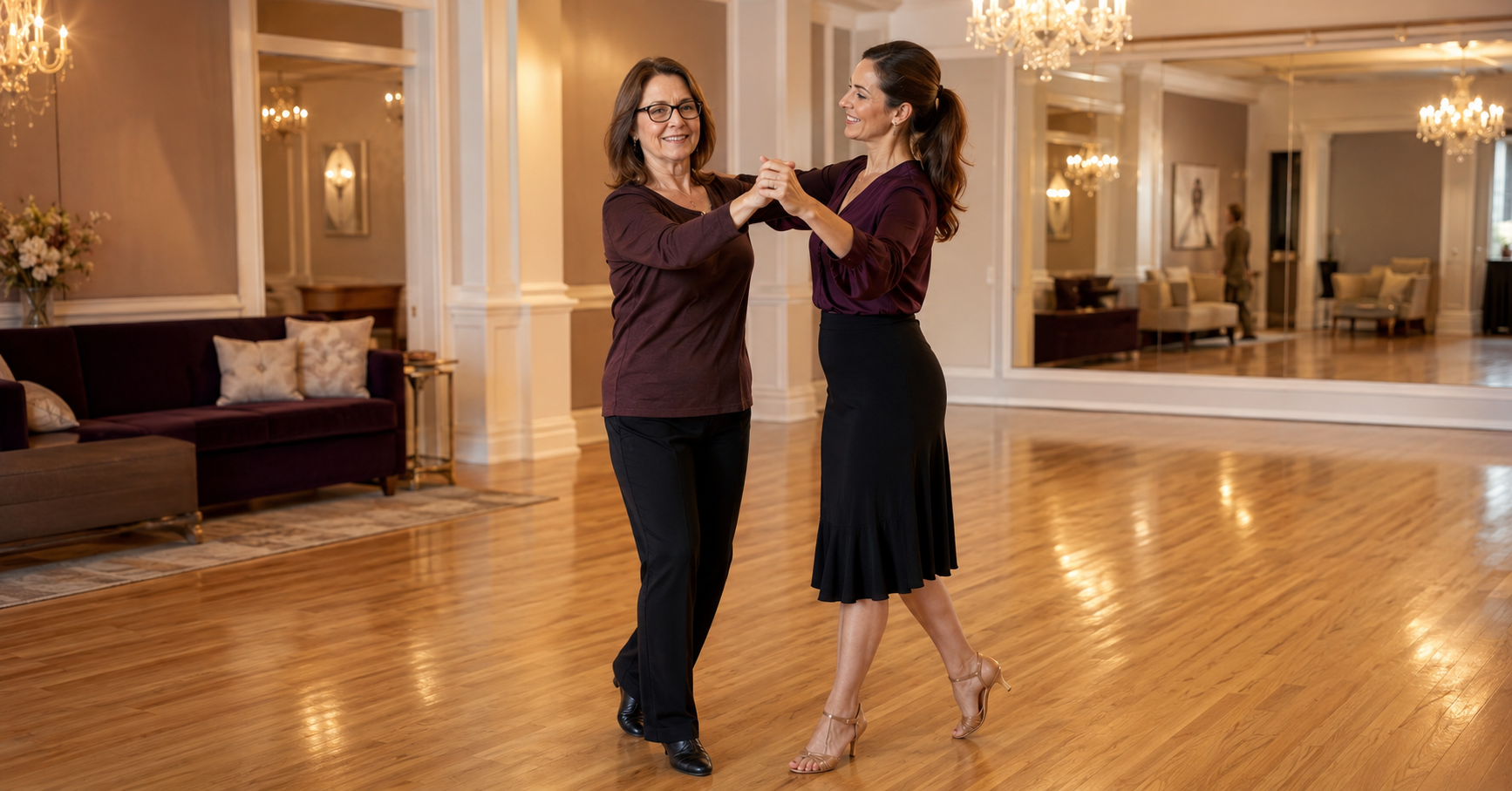
Some beginning dancers quietly wonder whether their glasses are part of the reason ballroom dancing feels harder than expected.
They may feel steady while walking normally but become uncertain when stepping backward, looking past a partner, changing direction or attempting a turn. Others notice that the floor seems slightly distorted when they look through the lower portion of progressive lenses or bifocals.
If that sounds familiar, it does not mean you are uncoordinated or incapable of learning. Your eyes, brain and body may simply be working through a visual challenge that is rarely discussed in ballroom lessons.
I teach adults throughout the Twin Cities, including students from Saint Paul, Minneapolis, Plymouth, Roseville, Shoreview and surrounding communities. I have learned that small adjustments to positioning, instruction and practice can make an enormous difference for dancers who wear progressive lenses, bifocals or other vision correction.
Why Progressive Lenses Can Make Dance Steps Feel Different
Progressive lenses contain different viewing zones. The upper portion is generally used for distance, the middle supports intermediate viewing and the lower portion helps with close-up tasks.
That design is useful during everyday life, but dancing asks your eyes to process several distances and directions in rapid succession. You may look toward your partner, scan the room, glance toward the floor and then redirect your attention during a turn.
Research published through the National Library of Medicine found that multifocal lenses affected stepping patterns in people navigating changes in height. Other research published in Investigative Ophthalmology & Visual Science has associated multifocal spectacles with changes in toe clearance and an increased risk of tripping on steps among older wearers.
A ballroom floor is not a staircase, but the underlying issue can still be relevant: looking downward through a near-vision portion of the lens may affect how clearly you judge the floor, your feet or an obstacle.
This does not mean everyone who wears progressive lenses will have difficulty dancing. It means that a dancer’s visual experience deserves to be taken seriously rather than dismissed as nervousness or poor coordination.
Why Looking Down at Your Feet May Make the Problem Worse
Beginners often look at their feet because they want to confirm that the step is correct. Unfortunately, repeatedly dropping the head can create several new problems.
- It changes posture and balance.
- It can weaken the connection between partners.
- It narrows awareness of the couples and obstacles nearby.
- It may place the floor in a less useful portion of a progressive lens.
- It makes turning the head and body smoothly more difficult.
I do not expect a new dancer to stop looking down simply because I say, “Keep your head up.” That instruction is rarely enough. Instead, I help students understand where the foot is traveling and what the movement should feel like.
Partner dancing provides something that many solo activities do not: physical reference points. Your connection with your partner, the direction of your body and the pressure you feel through the floor can all provide information without requiring you to watch every step.
Tell Your Instructor What You Are Experiencing
You do not need a diagnosis or technical explanation before mentioning a vision concern. A simple description is enough:
- “The floor looks distorted when I glance down.”
- “I recently started wearing progressives and turns feel strange.”
- “I see better from one side of the room.”
- “Low lighting makes it difficult for me to judge distance.”
- “I need to stand closer to see a demonstration.”
Those details help me make the lesson more useful. I may change where we stand, reduce the speed, describe the movement more precisely or let you experience the step through the partnership before asking you to perform it independently.
A dancer with low vision who has participated in dance classes for many years recommends that instructors use specific movement descriptions instead of vague directions such as “over there” or “do it like this.” She also recommends allowing students to choose the part of the room where they can best see the instructor. Her firsthand guidance is available in this detailed article about dance classes and low vision.
Start in a Consistent Part of the Room
An unfamiliar studio requires your brain to process mirrors, lights, doorways, furniture, other students and reflections. That can be a lot of visual information before the dancing even begins.
When possible, arrive a few minutes early and orient yourself to the space. Identify:
- The edges of the dance floor
- Steps or changes in floor height
- Tables, chairs and other obstacles
- Exits and restrooms
- The brightest and darkest areas of the room
- A visible object you can use as a reference during turns
Standing in a consistent area during the early part of a lesson can also help. Once the room feels familiar, it is usually easier to change positions without feeling disoriented.
Research discussed by Neuroscience Research Australia found that people wearing multifocal glasses contacted more obstacles during a walking task that required them to divide their visual attention. A busy ballroom lesson can create a similar demand for attention, even though the activity itself is different.
Use Clear Landmarks Instead of Watching the Floor
During turns, dancers are sometimes told to select a visual point and return their eyes to it. This is commonly called spotting. The idea can be helpful, but the landmark must actually be visible to the dancer.
A small object that blends into the wall is not a useful target. A doorway, contrasting sign, dark window frame or other distinctive feature may work better.
Contrast is especially important for people with reduced visual acuity or depth perception. The American Foundation for the Blind explains that lighting and contrast can improve the visibility of objects and boundaries for many people with low vision.
In a private lesson, we can experiment with several visual references and determine which one feels most stable. That is much more productive than repeatedly telling a dancer to look at something they cannot clearly see.
Practice Foot Placement Without Looking Down
One useful exercise is to learn a very small movement while keeping your gaze comfortably forward.
For example, we might practice a basic rumba box or a slow weight change without music. I can provide verbal cues while the student notices three things:
- Where the weight begins
- How the moving foot brushes or passes the standing foot
- When the new foot receives the body’s weight
This replaces visual checking with physical information. The exercise is not about forbidding someone from ever looking down. It is about showing the dancer that the body can learn where the foot is without constant supervision from the eyes.
Students can review familiar movements at home through my free Ballroom by Amy lesson videos. Watching a demonstration on a personal screen may allow you to adjust the size, distance and viewing angle before trying the movement.
Make Turns Smaller Before Making Them Faster
Turns can feel especially uncomfortable when a dancer is adjusting to new glasses. A common response is to rush through the rotation and hope it ends quickly. That usually makes the dancer feel less secure.
I prefer to separate the turn into manageable pieces:
- Establish balance before rotating.
- Use a smaller amount of turn.
- Keep the eyes level rather than dropping them toward the floor.
- Finish the weight transfer before beginning the next action.
- Add speed only after the pathway feels predictable.
A quarter turn performed comfortably is more valuable than a full turn that leaves you dizzy or frightened. Ballroom dancing is not a test of how quickly you can tolerate discomfort.
If dizziness continues outside dance lessons, begins suddenly or is accompanied by other symptoms, speak with a qualified healthcare professional. Dance instruction cannot determine whether a problem comes from eyewear, the inner ear, medication, blood pressure or another medical cause.
Should You Remove Your Glasses to Dance?
There is no universal answer. It depends on your prescription, your ability to see obstacles and the advice of your eye-care professional.
Some dancers with mild prescriptions feel more comfortable without glasses. Others need them to navigate the room safely, recognize people or maintain orientation. A dancer with low vision may be significantly less safe without corrective lenses.
Do not remove necessary glasses simply because another dancer says they are inconvenient. The better approach is to find a secure and comfortable way to wear them. Options may include properly adjusted frames, nonslip temple grips or an eyewear strap recommended by an optician.
The American Academy of Ophthalmology advises people having difficulty adapting to new glasses to ensure that the prescription and frame fit are correct and to contact their eye doctor when problems persist. You can review general vision information through the American Academy of Ophthalmology’s EyeSmart resources.
New Progressive Lenses May Need an Adjustment Period
If you recently received your first pair of progressive lenses, everyday movement may initially feel different. Your eye-care provider may recommend wearing them consistently so your visual system can adapt.
That does not mean you should force yourself through a fast group class while feeling unsafe. For the first few lessons, you may benefit from:
- Slower music
- Smaller steps
- Fewer turns
- A well-lit section of the room
- More repetition before changing figures
- Private instruction rather than a crowded floor
Let your instructor know that the lenses are new. A temporary adjustment deserves a temporary change in the lesson plan.
Private Lessons Can Reduce Visual Overload
A group class can include many moving bodies, mirrored reflections and rapidly changing instructions. That environment is exciting for some beginners but visually exhausting for others.
A private lesson allows us to reduce the amount of competing information. I can demonstrate from the distance and angle that work best for you, repeat the movement without pressure and use direct verbal descriptions.
It also gives us time to determine whether the difficulty comes from the dance itself or from the way the information is being presented.
If you are nervous about beginning, use the Ballroom by Amy lesson-request form to describe what you are experiencing. You do not need to know which dance to choose, and you do not need to arrive with a partner.
Glasses Do Not Disqualify You From Ballroom Dancing
Ballroom dancing is adaptable. Steps can be made smaller. Turns can be simplified. Demonstrations can be repositioned. Instructions can be verbal, visual or physical. The room can be explored before the lesson begins.
Those are not special favors. They are good teaching.
I especially want to hear from people who believe they are too awkward, too nervous or not coordinated enough to learn. Sometimes the obstacle is not ability at all. The student simply needs the movement explained in a way that works for their body and vision.
You can explore upcoming opportunities through the Ballroom by Amy Twin Cities event calendar, or subscribe to the Ballroom by Amy newsletter for future lessons and dance updates.
About Amy Hanson and Ballroom by Amy
Amy Hanson is the three-time defending Dancers Cup Tour Top Teacher. She has danced professionally and internationally and built friendships with dancers many people recognize from Dancing with the Stars.
Think you are not coordinated, confident or good enough to dance? You are exactly the kind of beginner Amy loves to teach. No experience or partner is required.
Learn more: ballroombyamy.com
Call or text: 612-308-7708
Email: Amy@BallroomByAmy.com
Sources and Further Reading
- National Library of Medicine: Effect of Multifocal-Lens Glasses on Stepping Patterns
- Investigative Ophthalmology & Visual Science: Multifocal Spectacles and Toe Clearance
- Neuroscience Research Australia: Multifocals May Increase the Risk of Falling
- Veronica With Four Eyes: Dance Classes and Low Vision
- American Foundation for the Blind: Lighting and Contrast
- American Academy of Ophthalmology: EyeSmart Vision Resources
Written with the assistance of AI and reviewed for accuracy. This article provides general dance and accessibility information, not medical or vision-care advice. Consult an appropriate healthcare or eye-care professional about persistent dizziness, balance changes or problems with corrective lenses. Any accompanying AI-generated image may not perfectly represent a particular person, studio, lesson or location.