
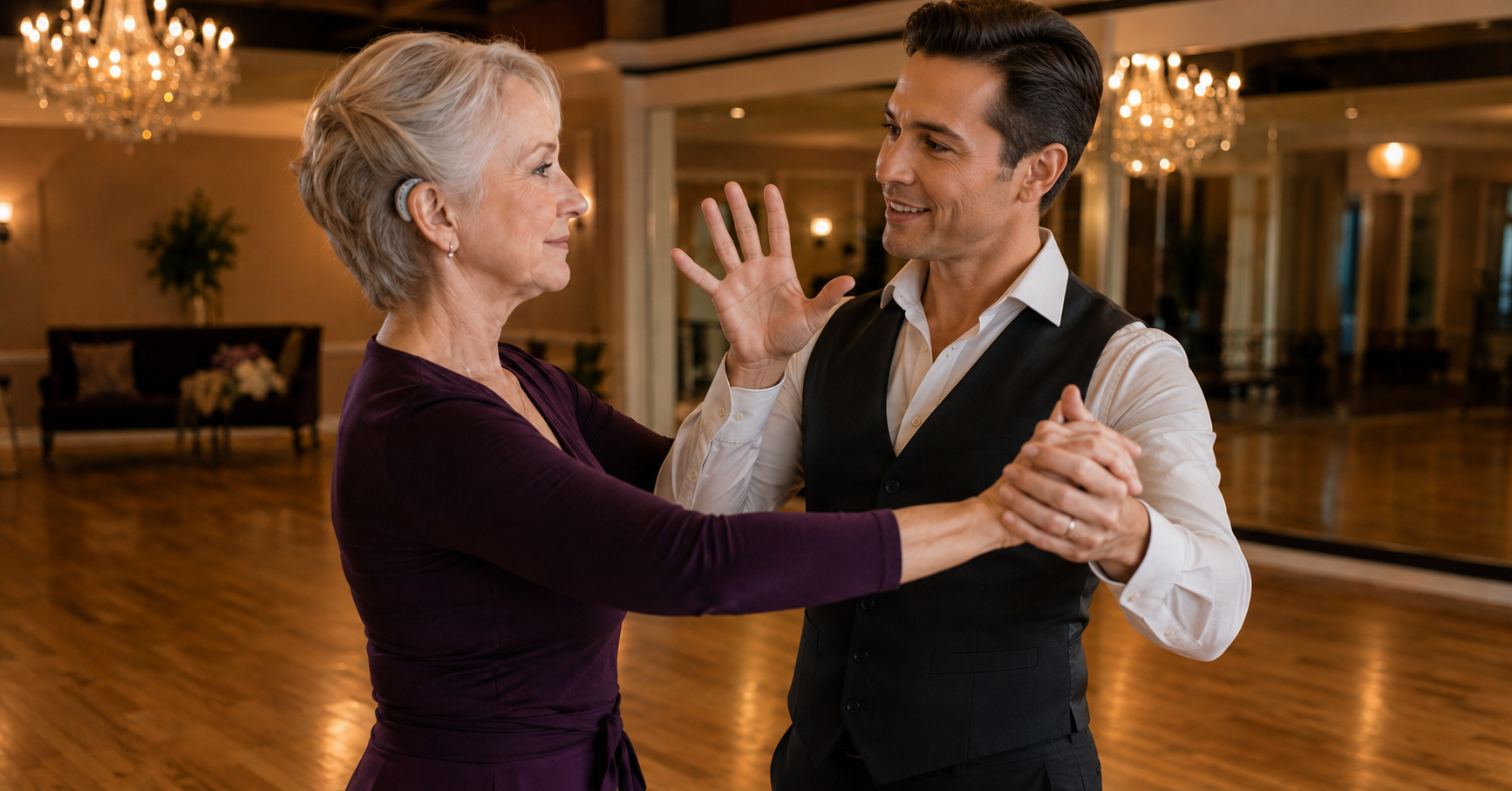
Some adults hesitate to begin ballroom dancing because they wear hearing aids or have difficulty understanding speech when music is playing.
They may wonder whether they will hear the beat, recognize the instructor’s counts or follow a partner in a busy room. Others already enjoy music at home but find that songs sound completely different through hearing aids in a dance studio.
If this sounds familiar, you are not disqualified from ballroom dancing. You may simply need the lesson, music and communication presented in a way that works better for your hearing.
I teach adults from Saint Paul, Minneapolis, Plymouth, Roseville, Shoreview and communities throughout the Twin Cities. My goal is not to make every student learn through one identical method. I want to determine how each person receives information best and build the lesson around that.
Why Hearing Aids Can Behave Differently Around Dance Music
Hearing aids are designed primarily to improve access to sound and speech, but a dance lesson creates a complicated listening environment. Music may be playing through speakers while an instructor talks, other students move nearby and conversations continue around the room.
The National Institute on Deafness and Other Communication Disorders explains that hearing aids cannot completely separate the sound a wearer wants to hear from background noise. The agency recommends discussing persistent difficulty with an audiologist because the device may need adjustment.
The problem is not necessarily that the music is too quiet. Turning everything louder can sometimes make the room more confusing because the hearing aid is receiving more speech, music and ambient sound at once.
This is why someone may hear a song clearly in a quiet living room but struggle to recognize the same rhythm during a crowded class or social dance.
You Do Not Need to Hear Every Instrument to Find the Beat
Ballroom dancers do not usually need to identify every lyric, melody and instrument. We need to locate the rhythmic information that organizes the movement.
Depending on the dance, that might be:
- A strong recurring bass pulse
- A drum pattern
- An accented first beat
- A repeated slow-and-quick structure
- A phrase that returns predictably
The Hearing Loss Association of America notes that rhythm can remain one of the more accessible elements of music for some hearing-aid and cochlear-implant users. It also emphasizes that music listening may improve with practice and device adjustments over time.
In a lesson, I can temporarily choose music with a clearer percussion line and a less complicated arrangement. Once the basic timing feels dependable, we can gradually introduce songs with more layered instrumentation.
Counts Can Be Seen and Felt, Not Only Heard
A dancer does not have to rely exclusively on spoken counts.
If saying “one, two, three” over the music is difficult to hear, I can reinforce the timing in several ways:
- Counting before the music begins
- Using clear hand signals
- Demonstrating the rhythm without traveling
- Clapping or tapping the pulse
- Making the first beat physically distinct
- Allowing the student to feel the timing through the partnership
Closed dance position creates useful physical information. A student can feel when I prepare to move, where the weight changes and when the next step begins. That connection does not replace communication, but it provides another reliable source of timing.
This is one of the reasons private instruction can be helpful. We can identify which combination of verbal, visual and physical cues gives you the clearest result instead of expecting you to keep up with one teaching style.
Tell Your Instructor Which Part Is Difficult
“I cannot hear very well” is useful information, but a more specific description can make the lesson much easier to adapt.
You might say:
- “I hear the music, but I lose your voice once it starts.”
- “I can hear the melody but not the bass.”
- “I need to see your face when you give directions.”
- “Speech becomes unclear when several people are talking.”
- “I hear better when you stand on my right side.”
- “My hearing aids make this speaker sound sharp or distorted.”
The American Speech-Language-Hearing Association identifies difficulty understanding speech in noisy environments as a common hearing challenge. Its guidance also recognizes reducing background noise and using assistive devices as possible communication strategies.
You do not need to apologize for providing this information. It helps me teach you more effectively.
Positioning in the Room Can Matter
A ballroom studio may contain hard flooring, mirrors, high ceilings and multiple speakers. Those surfaces can create reflections and reverberation that make speech less distinct.
When possible, choose a position where you can clearly see the instructor’s face and are not standing directly beside a loud speaker. A quieter edge of the room may make instructions easier to understand than the center of a large group.
During a private lesson, I can also stand closer before giving directions, reduce or pause the music and confirm the instruction before we begin moving.
The National Institute on Deafness and Other Communication Disorders recommends reducing background sound during conversations because competing noise can make speech more difficult to understand.
That principle applies naturally to dance instruction: I do not need to explain a complicated pattern while the music is playing at full volume.
Ask Whether Your Hearing Aids Have a Music Program
Some hearing aids offer different listening programs for speech, music or noisy environments. A music program may process sound differently than a setting intended to emphasize conversation.
That does not mean every dancer should change device settings independently. Hearing aids, prescriptions and listening needs vary greatly.
Before your lesson, ask your audiologist whether your devices have a music setting and how it should be used. Explain that you want to hear both recorded music and spoken instruction in a dance studio.
The Mayo Clinic’s hearing-aid overview recommends working with a hearing professional when choosing and adjusting hearing aids because styles, features and individual needs differ.
It may take more than one appointment to find the most useful setting. Describe what happened during the lesson as specifically as possible. Saying “the piano sounded harsh” or “I lost the instructor’s voice when the music began” gives an audiologist more information than simply saying the room was loud.
Remote Microphones May Help in Some Lessons
Some hearing aids and cochlear implants can connect to a small remote microphone. The instructor wears or holds the microphone, and their voice is transmitted more directly to the listener’s device.
The National Institute on Deafness and Other Communication Disorders explains that assistive listening devices can help emphasize a desired sound when background noise is present.
The Hearing Loss Association of America similarly notes that assistive listening systems can transmit sound directly to a hearing aid, cochlear implant or separate receiver.
A remote microphone may be unnecessary in a quiet private lesson, but it could be useful in a larger group class. Ask your hearing professional whether your current devices support one and how it should be positioned.
Start With Familiar Music
A familiar song gives your brain more information to work with. You may already know where the strong beat occurs, how the phrase develops and when the chorus returns.
For a first lesson, consider bringing the names of two or three songs you know well. I can determine whether one has an appropriate rhythm for the dance we are learning.
The song does not have to be traditional ballroom music. Many familiar popular songs can be used for rumba, swing, foxtrot, cha-cha or other dances when the rhythm and tempo are suitable.
Students can also review basic movements through my free Ballroom by Amy lessons and instructional resources. Practicing with a familiar video and adjustable home audio can make the movement easier to recognize before entering a busier class.
Use a Visual Signal Before the Music Starts
A simple visual cue can prevent a dancer from missing the beginning of a song.
I might make eye contact, raise my hand, nod or visibly count the final beats before movement begins. This lets the student know exactly when we are starting rather than requiring them to identify the first usable beat independently.
The same idea works when restarting after a pause. Instead of speaking from across the room, I can return to the student’s line of sight and confirm that they are ready.
These adjustments are small, but they reduce the anxiety that comes from wondering whether everyone else has already begun.
Your Partner Should Not Shout Into Your Ear
Speaking much louder is not always the same as speaking more clearly. Shouting can distort speech, feel uncomfortable and draw unnecessary attention.
A better approach is to face the person, reduce competing sound when possible and speak clearly at a natural pace.
If you dance with a regular partner, agree on a few simple signals before the lesson or social begins. For example:
- A tap to indicate that the instructor has started speaking
- A hand signal meaning “please repeat that”
- A pause when clarification is needed
- A visual count before entering the floor
The goal is not for your partner to become your interpreter. The goal is to create a respectful system that allows both people to relax and enjoy dancing.
Protect Your Devices From Sweat and Moisture
Ballroom dancing can be gentle, but it is still physical activity. Warm studios, summer humidity and prolonged dancing may expose hearing devices to sweat.
Follow the manufacturer’s instructions for moisture protection, cleaning and storage. Ask your audiologist whether a retention cord, sleeve, drying system or other accessory is appropriate for your device.
Do not apply sprays, powders or adhesives to a hearing aid unless the manufacturer or hearing professional says they are safe. Devices vary, and a product that works for one style may damage another.
Bring your storage case to longer lessons or social dances so you have a secure place for the devices if they need to be removed.
Consider the Sound Level at Social Dances
A social dance may be louder than a private lesson, especially when music, applause and conversation fill the same room.
Repeated exposure to excessive sound can affect hearing. The National Institute on Deafness and Other Communication Disorders recommends moving away from hazardous noise, reducing exposure and using appropriate hearing protection when sound cannot be avoided.
If a social dance feels painfully loud or leaves your ears ringing, move farther from the speakers and take breaks in a quieter area. Ask an audiologist how to protect your hearing without losing the rhythmic information you need for dancing.
Hearing aids are not automatically hearing protection. Device users should seek individualized guidance rather than assuming the hearing aid makes every sound level safe.
You Can Learn Through Repetition Rather Than Constant Verbal Instruction
Some dancers become mentally exhausted from trying to decode spoken instructions in a noisy room. A lesson can be structured to reduce that listening effort.
I can explain one small piece, demonstrate it, practice it several times and wait until it feels familiar before adding another instruction. I do not need to talk continuously while you are moving.
Once a pattern becomes physical memory, the student no longer has to process every verbal cue in real time.
This teaching approach can help many beginners, not only those with hearing loss. Clear instruction is usually better instruction.
Private Lessons Can Be a Comfortable First Step
A private lesson offers a quieter and more predictable introduction than a crowded group class. We can pause the music whenever necessary, choose your position in the room and test several ways of communicating.
You can also bring a spouse, friend or dance partner if having a familiar person present makes the first lesson more comfortable. A partner is never required.
Visit Ballroom by Amy to request lesson information or ask questions before scheduling. You can tell me what kind of environment helps you hear best, and I will use that information when planning the lesson.
You can also subscribe to the Ballroom by Amy newsletter for future lesson opportunities, dance information and Twin Cities updates.
Hearing Loss Does Not Mean You Lack Rhythm
A person can have difficulty hearing speech and still feel rhythm extremely well. Another person may hear the music clearly but need time to connect it to movement. Neither experience determines whether someone can become a good dancer.
Professional dancers have also spoken publicly about performing with hearing loss. New York City Ballet principal dancer Sara Mearns has described using hearing aids after years of missing musical and verbal cues. Deaf performers have likewise demonstrated that timing can be developed through visual information, physical sensation, counting and repetition.
Your lesson does not need to look exactly like someone else’s lesson. What matters is finding a dependable way for you to receive the rhythm, understand the movement and feel secure with your partner.
If you have been postponing ballroom dancing because you are worried about hearing the music or following an instructor, please reach out. You do not need to solve every concern before taking your first step.
About Amy Hanson and Ballroom by Amy
Amy Hanson is the three-time defending Dancers Cup Tour Top Teacher. She has danced professionally and internationally and built friendships with dancers many people recognize from Dancing with the Stars.
Think you are not coordinated, confident or good enough to dance? You are exactly the kind of beginner Amy loves to teach. No experience or partner is required.
Learn more: ballroombyamy.com
Call or text: 612-308-7708
Email: Amy@BallroomByAmy.com
Sources and Further Reading
- National Institute on Deafness and Other Communication Disorders: Hearing Aids
- American Speech-Language-Hearing Association: Hearing Loss in Adults
- Hearing Loss Association of America: What People With Hearing Loss Can Learn From Professional Musicians
- Mayo Clinic: Hearing Aids—How to Choose the Right One
- National Institute on Deafness and Other Communication Disorders: Assistive Listening Devices
- Hearing Loss Association of America: Assistive Listening Systems
- Associated Press: New York City Ballet Principal Dancer Discusses Hearing Aids
- National Institute on Deafness and Other Communication Disorders: Noise-Induced Hearing Loss
Written with the assistance of AI and reviewed for accuracy. This article provides general dance and accessibility information, not medical or audiology advice. Hearing needs and hearing devices vary. Consult an audiologist or other qualified hearing professional for individual recommendations. Any accompanying AI-generated image may not perfectly represent a particular person, device, lesson, studio or location.