
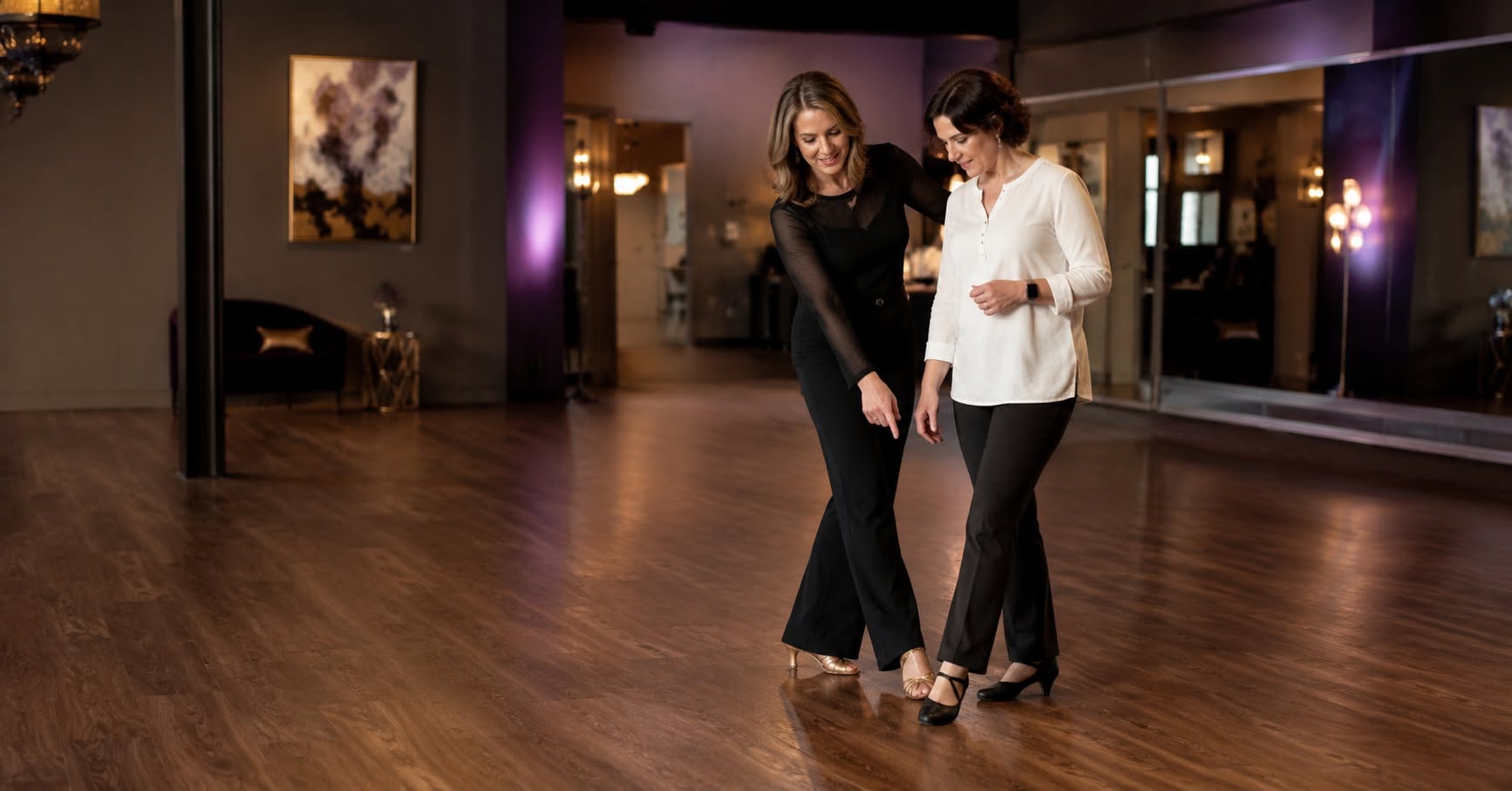
The ballroom dancing mental challenge can surprise new students. You may arrive expecting to learn a few steps and suddenly realize that your brain is trying to follow the music, remember a pattern, maintain balance, move your body and respond to another person—all at the same time.
Feeling confused during a dance lesson does not mean you are uncoordinated or incapable of learning. In many cases, it simply means your brain is doing exactly what it is supposed to do when you try something unfamiliar.
Important reminder: You are not expected to remember every instruction immediately. Learning happens through repetition, adjustment and practice—not instant perfection.
Ballroom Dancing Is More Than Memorizing Steps
A ballroom dance lesson is not simply an exercise in moving your feet from one place to another. Even a basic pattern may ask you to process several things simultaneously:
- Listen for the beat and musical rhythm.
- Remember the order of the steps.
- Shift your weight from one foot to the other.
- Maintain comfortable posture and balance.
- Coordinate your upper and lower body.
- Respond to a partner’s movement or connection.
- Listen to your instructor while continuing to move.
That is a great deal of information for your brain to organize. Experienced dancers make many of these actions look automatic because they have repeated them enough times that they no longer require the same level of conscious thought.
Beginners are still building that familiarity. What looks effortless from the outside may have taken hundreds or thousands of repetitions to develop.
Why Beginners Sometimes Feel Mentally Overloaded
Think about learning to drive. At first, you may have consciously thought about the mirrors, the pedals, your speed, the steering wheel and every nearby vehicle. Eventually, many of those actions became familiar enough that you could perform them without analyzing each one separately.
Dance can develop in a similar way. At the beginning, even a simple weight change may require your full attention. After enough guided practice, your body begins to recognize the movement. That frees your mind to focus on the music, your partner or the character of the dance.
This is why a student might perform a step successfully several times and then temporarily lose it when music, arm styling or a partner is added. The student has not forgotten how to dance. The brain is simply being asked to process another layer of information.
Confusion Can Be Part of Progress
Adults often assume that struggling with a new skill means they are doing poorly. In reality, some uncertainty is a normal part of meaningful learning.
A new dance pattern may initially feel awkward because it does not match your everyday movement habits. You may need time to understand which foot moves, where your weight belongs and how the movement fits the music.
The goal is not to avoid every mistake. The goal is to notice what happened, make a small adjustment and try again. Each repetition gives your brain and body more information.
“I’m confused” does not have to mean “I can’t do this.” It may simply mean, “My brain has not made this familiar yet.”
Rhythm, Balance and Memory Work Together
One reason the ballroom dancing mental challenge feels different from many everyday activities is that it combines movement with music.
You are not only remembering where your feet go. You are also deciding when they should move. A pattern that feels manageable without music may feel entirely different when you try to place it within a steady beat.
At the same time, your body is working to stay balanced as your weight transfers from one foot to another. Your memory is recalling the sequence, your ears are listening for the rhythm and your attention is shifting between your own movement and the person dancing with you.
That combination is one reason ballroom dancing can remain interesting long after someone has learned the basic steps. There is always another layer to explore, whether it involves timing, musicality, technique, styling or connection.
Partner Dancing Adds Another Layer
Dancing with another person introduces communication that often happens without words. Partners learn to recognize changes in direction, timing, pressure and movement.
Leaders are learning to communicate clearly without forcing. Followers are learning to remain responsive without guessing. Both dancers are working to stay connected to the music and to each other.
This can feel unfamiliar at first, especially for adults who are accustomed to planning every action independently. With practice, the partnership begins to feel less like a set of instructions and more like a conversation.
You also do not need to bring a partner to begin. Amy works with individual students as well as couples, allowing each lesson to be adapted to the student’s goals and comfort level.
You Do Not Need to Be Naturally Coordinated
Many adults describe themselves as uncoordinated before they have taken a single lesson. Often, that belief comes from an old experience, an uncomfortable school dance or the assumption that good dancers were simply born knowing how to move.
Coordination is not necessarily a fixed trait. It can improve as you practice specific movements, learn how your weight shifts and become more aware of rhythm and balance.
A patient instructor can also present the same idea in several different ways. One student may respond best to counting. Another may understand through music, imagery, demonstration or physical repetition.
The right explanation can turn something that initially felt impossible into something that suddenly makes sense.
Why Private Dance Lessons Can Help
Private lessons give students the opportunity to learn at a pace that fits them. Amy can slow a movement down, isolate one part of a pattern or repeat an explanation without the pressure of keeping up with a large class.
Lessons can also be shaped around what the student actually wants to accomplish. That may include preparing for a wedding, becoming more comfortable at social events, learning a specific style or simply finding an enjoyable way to move.
A private setting also makes it easier to ask questions. Students do not have to pretend they understand something or worry that everyone else is learning faster.
The lesson can focus on one manageable improvement at a time. That helps turn the ballroom dancing mental challenge into a series of achievable steps.
Why Ballroom Dancing Matters Right Now
Many adults spend much of the day repeating familiar routines. Work, errands, household responsibilities and screen time may leave few opportunities to practice a genuinely new skill.
Ballroom dancing offers a reason to pay attention differently. You listen to music, move through space, solve small problems and interact with another person in real time.
It can also provide something many adults are missing: a chance to be a beginner again in an environment where they are not expected to have all the answers.
For adults throughout Roseville, St. Paul, Minneapolis and the wider Twin Cities, dance lessons can offer a structured break from the usual routine while creating a skill that can be enjoyed at weddings, parties, social dances and future events.
What Your First Lesson May Feel Like
Your first ballroom dance lesson may include a mixture of excitement, concentration and uncertainty. You may understand one part quickly and need more time with another.
You might notice that:
- A movement feels easier on one side than the other.
- You can perform a pattern without music but lose it when the song begins.
- Your feet improve before your arms feel natural.
- You remember more after taking a short break.
- You need an explanation presented in a different way.
None of these experiences means you are failing. They are common parts of learning a physical skill.
Progress Matters More Than Perfection
Ballroom dancing does not require perfection to be enjoyable. You do not need flawless technique to move comfortably with music, enjoy a wedding dance or feel more confident at a social event.
A successful lesson may mean hearing the beat more clearly, recovering from a missed step without stopping or feeling less tense than you did at the beginning.
Those improvements may seem small, but they create the foundation for everything that follows.
The ballroom dancing mental challenge is not a test you either pass or fail. It is part of what makes dance an engaging skill that can continue growing with you.
Ready to Let Your Brain Learn Something New?
You do not need previous dance experience, a partner or natural coordination to begin. Amy offers welcoming, personalized ballroom dance lessons for adults throughout the Twin Cities.
Learn more:
BallroomByAmy.com
Call or text:
612-308-7708
Email:
Amy@BallroomByAmy.com
About Amy Hanson
Amy Hanson is the three-time defending Dancers Cup Tour Top Teacher. She has danced professionally and internationally and built friendships with dancers many people recognize from Dancing with the Stars.
People who think they are not coordinated, confident or good enough are exactly the beginners Amy loves to teach. No experience or partner is required.
Visit
BallroomByAmy.com,
call 612-308-7708
or email
Amy@BallroomByAmy.com.
Sources and Further Reading
National Institute on Aging: Cognitive Health and Older Adults
Centers for Disease Control and Prevention: About Physical Activity
National Institutes of Health
American Psychological Association
American Heart Association: Healthy Living and Fitness
This article is intended for general educational and informational purposes. It is not medical advice. Images associated with this article may be created or enhanced with artificial intelligence.