
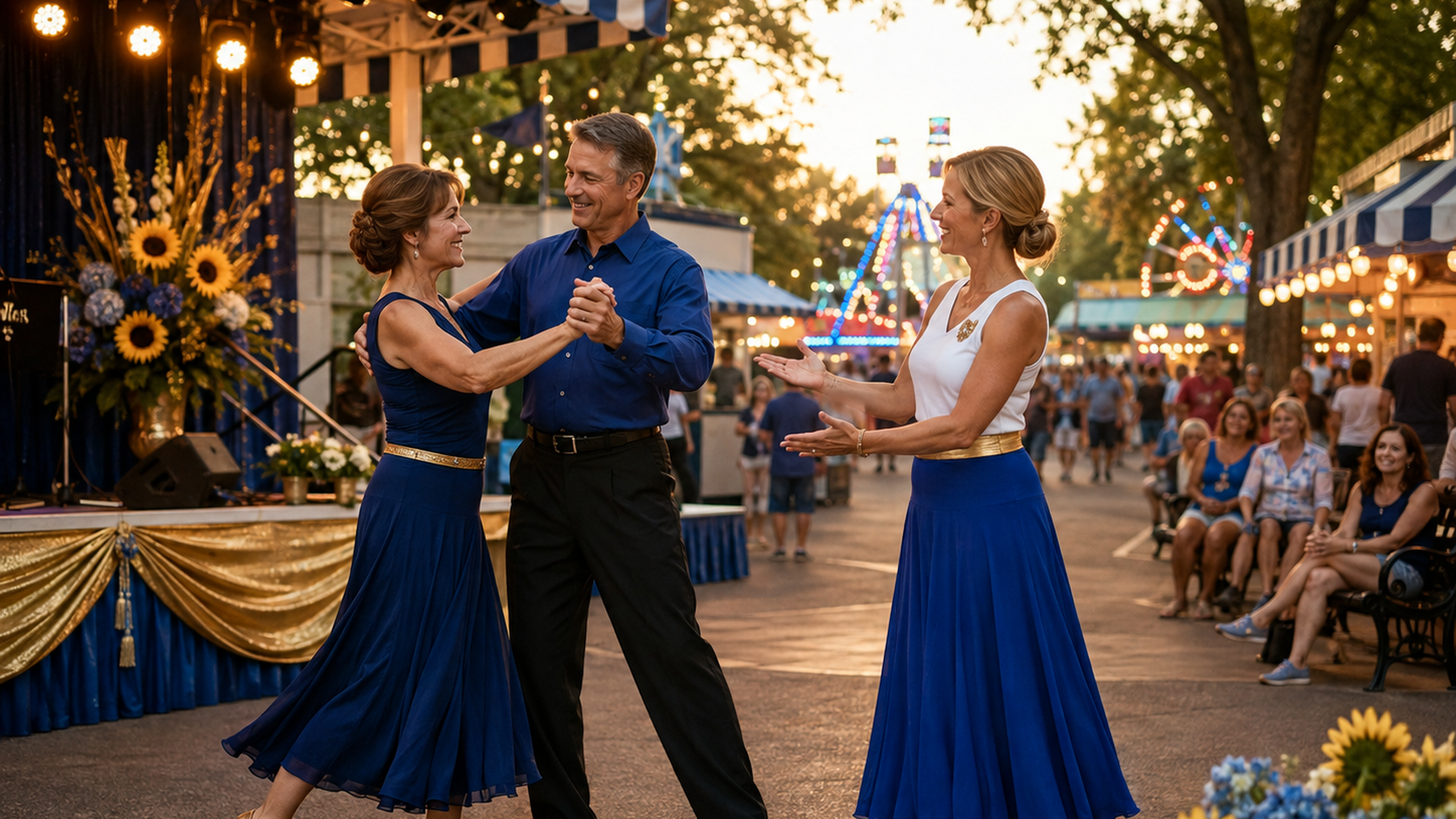
Dance Has Always Belonged at the Great Minnesota Get-Together
The Minnesota State Fair is not just a place to eat something on a stick.
It is one of Minnesota’s biggest annual classrooms.
Every year, people walk the fairgrounds and learn something without realizing they are learning. They learn what farmers are raising. They learn which musicians are playing. They learn what foods people are inventing. They learn which traditions still matter. They learn what draws a crowd, what makes people stop, and what makes strangers clap along together.
And if you pay attention, you can learn something about dance.
Not because the Fair is a ballroom.
Because the Fair is full of rhythm, pattern, performance, tradition, music, crowds, timing, and shared movement. Those are the same ingredients that make dancing feel human.
Fairground Lesson
Dance is not just steps.
Dance is how people respond to music, culture, memory, celebration, nerves, joy, community, and the moment they are standing in.
The State Fair Started as Agriculture, But It Became a Showcase of Minnesota Life
The official Minnesota State Fair history traces the Fair back to the Minnesota Agricultural Society, founded in 1854 to promote agriculture in the Minnesota Territory. The first territorial fair was held in 1855 in Minneapolis.
That original purpose still matters. Agriculture, animals, crops, competitions, and education are still central to the Fair.
But over time, the Fair became much more than an agricultural exhibition. The Fair’s own History & Heritage Center describes the heart of the Fair as a mix of competition, entertainment, agriculture, food, merchandise, rides and games, and Minnesota industry.
That mix is important.
The State Fair is where practical life and performance life meet. You can walk from a cattle barn to a concert, from a crop display to a stage, from a machinery exhibit to a dance performance.
That is one reason the Fair is such a good way to think about dance.
Dance is practical and expressive at the same time. It can be social. It can be cultural. It can be formal. It can be playful. It can be something you watch, something you learn, or something you finally try for yourself.
The Grandstand Shows How Entertainment Became Part of the Fair’s Identity
The Grandstand is one of the best examples of how the Fair grew into a major entertainment tradition.
The official Minnesota State Fair Grandstand timeline shows how the Grandstand became a home for racing, speeches, concerts, spectacles, aviation, fireworks, and other large public moments across different eras of the Fair.
That history matters because dance often works the same way as Fair entertainment.
It changes with the times.
One generation may gather for polka. Another may love swing. Another may be drawn to country line dance, Latin rhythms, wedding choreography, social dance, or a favorite song that does not fit neatly into one category.
The music changes. The clothing changes. The setting changes.
But the basic idea remains familiar:
People hear music, notice movement, and want to be part of it.
What the Grandstand Teaches About Dance
Scale: Some performances are meant to feel big.
Memory: People remember the music tied to a moment.
Tradition: Entertainment changes, but gathering for it does not.
Participation: Even when we are watching, we often feel the beat.
The Cosgrove Stage Reminds Us That Dance Is Something You Can Join
If the Grandstand represents spectacle, the Cosgrove Stage represents something more personal and community-based.
The official Cosgrove Stage schedule describes the stage as being filled with energy as dance groups showcase their moves during the Fair.
That schedule includes many forms of movement and cultural performance. Fairgoers can encounter traditions such as polka, line dance, folk dance, Irish dance, samba, clogging, and other styles during the Fair’s run.
But there is another side to dancing at the Fair that is easy to overlook:
You do not necessarily have to be the person on the stage.
If you already know a little Swing, Waltz, Foxtrot, Rumba or another social dance, there may be opportunities around the fairgrounds to actually use what you have learned.
Amy Hanson of Ballroom by Amy explains what to watch for:
Amy’s State Fair Dance Tip
Amy suggests checking the Cosgrove Stage, where dance groups perform and some presentations may even offer opportunities to learn a few steps.
She also recommends paying attention to live-music stages around the Fair. In some areas, there may be room in front of the stage or off to the side where fairgoers can simply start dancing.
That means the ballroom skills you learn do not have to stay in a ballroom.
That may be one of the most useful lessons the Fair can teach about social dancing.
Sometimes a band starts playing, there is a little room near the stage, somebody reaches out a hand, and suddenly something you practiced in a lesson becomes something you can use in real life.
You do not need a competition floor.
You do not need formal clothes.
You may just need music, enough room to move, and the confidence to recognize the opportunity.
That is worth remembering at the Fair, but also at weddings, concerts, festivals, cruises, parties and community events.
A Mini Field Guide to What You Are Actually Watching
When people watch dance, they often say things like, “They’re good,” or “That looks hard,” or “I could never do that.”
But there is a more interesting way to watch.
Instead of asking whether you could immediately do it, notice what the dancers are using.
Rhythm
How are the dancers using the beat? Are they smooth, bouncy, sharp, slow, or playful?
Pattern
Do you see steps repeating? Many dances become less mysterious once you notice the pattern.
Connection
Are people dancing alone, in pairs, in lines, or in a group? That changes the whole feeling.
Tradition
Does the dance seem connected to a culture, region, community, or social setting?
Improvisation
Does it look choreographed, spontaneous, or somewhere in between?
Purpose
Is the dance for performance, celebration, social connection, storytelling, or fun?
This is a useful way to watch dance at the Fair, at a wedding, at a party, or anywhere else.
Once you start seeing those ingredients, dance feels less like a secret code.
Social Dance Has Always Changed With the Music Around It
One reason people feel confused by dance is that they assume there must be one correct style for every situation.
History says otherwise.
The Library of Congress collection An American Ballroom Companion shows how social dancing changed over time as music, manners, fashion, and public taste changed. The collection includes dance instruction manuals from 1490 to 1920 and documents the evolution of ballroom and social dance traditions.
That is a helpful reminder.
Dance has never been frozen in place.
People have always adapted movement to the music and social life around them.
That is why someone today might want to dance to a wedding song, a pop song, an old standard, a country song, a swing tune, or something that does not seem “ballroom” at all.
The real question is not:
“What dance am I supposed to know?”
The better question is:
“What movement fits this music and this moment?”
Curious What Dance Fits Your Music?
If a song, performance, or Fair moment makes you wonder what kind of dance would fit, Amy can help you explore that question privately and comfortably.
Folk Dance, Fair Dance, and Ballroom All Have One Thing in Common
At first, ballroom dance and folk dance may seem like completely different worlds.
One may make people think of polished shoes, elegant posture, and a dance floor. The other may make people think of cultural costumes, community festivals, and group traditions.
But both forms preserve something.
The Smithsonian Center for Folklife and Cultural Heritage describes its work as promoting understanding and sustainability of cultural heritage through research, education, and community engagement. Dance is often part of that kind of living heritage because it carries memory through the body, not just through words.
That is one reason dance performances at the Fair can feel meaningful even if you do not know the steps.
You are not just watching movement.
You are watching people keep something alive.
Ballroom and social dance do this in a different way. They preserve social rituals: asking someone to dance, moving together, listening to music, learning timing, sharing a moment, and feeling connected to another person.
Those rituals still matter.
Why Watching Dance Can Be Educational Even If You Never Step Onto the Stage
Most people at the Fair will not climb onto a stage and perform.
That is fine.
You can still learn a lot by watching.
Try This the Next Time You See Dance at the Fair
First: Notice the music before the steps.
Second: Watch the feet for the repeating pattern.
Third: Watch the upper body for style and confidence.
Fourth: Notice whether dancers are following choreography, a leader, a partner, or a shared tradition.
Fifth: Ask yourself: does this look elegant, fun, relaxed, dramatic, social, or athletic?
That last question is useful because it moves the focus away from fear.
Instead of thinking, “Could I do that?” you can think, “What kind of movement do I enjoy watching?”
That is often the first clue toward finding a dance style that fits.
The Fair Is Also a Reminder That Adults Still Like to Learn
One of the best things about the State Fair is that it gives adults permission to be curious.
Adults ask questions in the barns. They read signs in the crop art exhibit. They try new foods. They watch demonstrations. They listen to music they might not have searched for on purpose. They wander into buildings just to see what is inside.
That curiosity matters.
Adults do not stop needing new experiences just because they are busy.
The CDC notes that physical activity can provide important health benefits for adults, but movement does not always have to look like a gym routine. Sometimes movement looks like music, learning, and trying something new.
Dance fits that space well.
It is movement, but it is also attention. It is coordination, but it is also listening. It is learning, but it is also play.
What the Fair Can Teach You About Choosing a Dance Style
If you are curious about dance, the Fair offers a simple lesson:
Start with what catches your attention.
Do you like something smooth?
Something lively?
Something traditional?
Something romantic?
Something social?
Something that gives you a goal?
Something you can use at a wedding, party, fundraiser, cruise, or family event?
You do not need to know the official name yet.
You can begin with the feeling.
A Simple Way to Think About Dance Style
If you like smooth and classic: you may enjoy slower ballroom styles.
If you like playful and social: you may enjoy swing-based movement.
If you like romantic and personal: you may want a dance built around one special song.
If you like structure: you may enjoy learning a repeatable pattern.
If you like expression: you may enjoy something with more musical interpretation.
The point is not to label yourself too quickly.
The point is to notice what kind of movement feels inviting.
The Fair Ends, But the Music Does Not
The State Fair is temporary. That is part of what makes it special.
For 12 days, the fairgrounds become their own little city of food, animals, music, rides, history, demonstrations, performances, and people moving in every direction.
Then it ends.
But sometimes something follows you home.
A song. A performance. A conversation. A feeling that you might want to try something new.
If that something is dance, you do not need to have a complete plan.
You can start with curiosity.
You can start with a song.
You can start with the thought, “I liked watching that.”
You can start by asking what kind of dance might fit you.
Want Help Finding a Dance Style That Fits?
Ballroom by Amy helps adults, couples, and wedding dancers across the Twin Cities explore dance in a way that feels personal, comfortable, and connected to real life.
Schedule a private dance lesson with Ballroom by Amy
Call 612-308-7708 or email Amy@BallroomByAmy.com.
Helpful Sources and Further Reading
For readers interested in the Minnesota State Fair, dance history, cultural performance, and movement, these sources may be helpful:
Minnesota State Fair — official Fair history.
Minnesota State Fair History & Heritage Center — overview of the Fair’s historic themes and exhibits.
Minnesota State Fair Grandstand Timeline — history of Grandstand entertainment.
Minnesota State Fair Cosgrove Stage — dance and performance schedule.
Minnesota State Fair Free Live Music & Shows — free entertainment across the Fair.
Minnesota Historical Society — Minnesota State Fair history and Great Minnesota Get-Together resources.
Library of Congress — history of Western social dance and ballroom dance instruction manuals.
Smithsonian Center for Folklife and Cultural Heritage — cultural heritage, tradition, and community education.
CDC — health benefits of physical activity for adults.
AI Note: This article includes content supported by AI. While we strive for accuracy, please use your own judgment and double-check details as needed. Photos or graphics may include AI-assisted elements.