
One word quieted the ballroom on Dancing with the Stars Super Bowl Night: “lift.” Within days, that critique had led to a pro’s one-week suspension, and it left a lot of viewers asking a simple question. What actually counts as a lift in ballroom dancing?
The answer is more specific than most people expect, and it explains a lot about how ballroom is judged, why some routines on the show can fly and others can’t, and whether a lift belongs in your wedding first dance.
Quick Answer
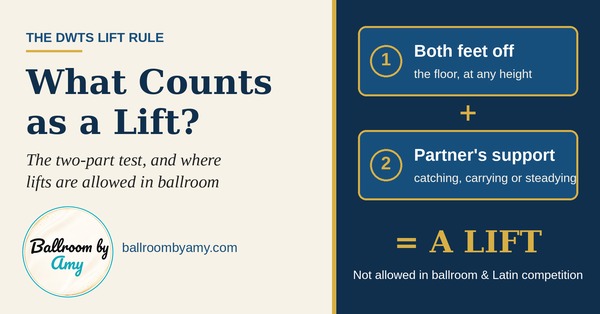
In competitive ballroom, a lift is any moment when one dancer has both feet off the floor at the same time with the partner’s help or support. Height doesn’t matter, and it doesn’t matter who gets lifted. Lifts are banned in standard ballroom and Latin competition and allowed in show categories like Showdance and Cabaret, where they’re used for big musical moments.
What Happened on Dancing with the Stars?
On the October 13 Super Bowl Night episode, pro Jenna Johnson and actor Harry Shum Jr. danced a samba. Judge Carrie Ann Inaba praised the performance and asked for more content in the dancing, then flagged a lift and read the definition aloud: a movement in which a dancer has both feet off the floor with a partner’s assistance or support. Johnson, visibly surprised, said she had understood a lift to mean lifting your partner, and that she would take the note. The couple scored 33 out of 40 and moved on to the next week, Parade reported.
The next day, pro Val Chmerkovskiy, who is married to Johnson, posted a since-deleted TikTok reacting to the critique. Entertainment outlets read it as a reference to the 2022 Oscars slap. On Saturday, October 17, BBC Studios, which produces the show, called the post inappropriate and announced that Chmerkovskiy would sit out the next episode, according to Good Morning America. Chmerkovskiy later posted an apology, saying he made a poor decision. His celebrity partner, Jenna Dewan, will dance with pro Alan Bersten on Dedication Night, Tuesday, October 20, at 7 p.m. Central on ABC.
Set the drama aside and Johnson’s reaction is the useful part. It’s a common way to picture a lift: one partner hoisting the other into the air. The rulebook definition is much broader, and that gap is exactly where routines get into trouble. (If you’re catching up on the season, start with our Season 35 cast guide.)
What Is a Lift in Ballroom Dancing?
A lift has two parts, and both have to be true at the same moment:
- One dancer has both feet off the floor.
- The partner is helping or supporting them while they’re in the air.
That’s nearly word for word how the World DanceSport Federation’s published competition rules define it. The same rulebook’s salsa section goes further and says it counts even if the dancer leaves the floor by only a small amount. The country-dance world’s UCWDC rules use a similar test: both feet off the floor, with body weight lifted by the other partner.
Notice what’s missing from those definitions. There’s no minimum height, no minimum time in the air, and no rule about which partner goes up. A leader who hops into a follower’s arms for half a second has technically done a lift. So has a follower who’s swept a few inches off the floor during a turn.
Lift or Not? A Quick Guide
Here’s how the two-part definition plays out on real moves. Event rules vary, so treat this as a guide to the definition, not a ruling for every competition.
Counts as a lift
- A partner raises the other off the floor, at any height
- A dancer jumps and the partner catches, carries or steadies them in the air
- A dancer is swung or spun with both feet off the floor
- Aerials and flips, where a dancer is thrown or flipped with the partner’s help
Usually not a lift
- A dip or oversway where the dancer keeps a foot on the floor
- A jump or kick the dancer does on their own, with no support in the air
- A lean or drop that’s controlled but keeps one foot down
- Leg lines and ronde actions where only one foot leaves the floor
Why Aren’t Lifts Allowed in Ballroom and Latin Competition?
The rule is clear in the major rulebooks. The WDSF rules state that lifts are not permitted in Standard or Latin couple competition, or in formation teams, and that the chairperson may disqualify a couple that performs one. At the USA Dance National DanceSport Championships, the competition rules say that except in ShowDance, no lifts or props are permitted in any division.
The rulebooks don’t spell out the reasoning, but the logic is easy to see once you understand how these dances are judged:
- The dance is the test. A waltz is judged on rise and fall, partnership and movement across the floor. A samba is judged on its bounce, rhythm and character. A lift isn’t part of either dance, so it can’t show the skills being judged.
- It keeps the comparison fair. When every couple dances the same style to the same music, judges compare like with like. A big trick can grab the eye without showing better dancing.
- The floor is shared. In most heats, several couples dance at once, traveling in the same direction. A lift takes space and attention away from everyone else’s safety.
That’s also why Inaba’s other note on the samba, asking for more content, goes hand in hand with the lift call. In a traditional ballroom or Latin dance, every moment spent on a trick is a moment not spent dancing the dance.
Where Are Lifts Allowed?
Lifts aren’t bad. They’re a tool, and plenty of dance categories are built around them.
| Setting | Lifts? |
|---|---|
| Standard and Latin couple competition (WDSF) | Not permitted |
| Showdance (WDSF) | Allowed; the 2018 Showdance rules set no limit on the number |
| NDCA professional Cabaret | Allowed; built around lift work and aerial dancing |
| NDCA Theatrical Ballroom | Allowed, up to 50% of the bars of music |
| NDCA Exhibition | Allowed, up to 3 lifts |
| Country (UCWDC) couples contests | Only in Stationary Freestyle Strictly |
| Dancing with the Stars | Not in the traditional ballroom and Latin dances; allowed in styles like contemporary, jazz and salsa |
The NDCA categories come from the NDCA Rule Book, which describes Cabaret as aerial dancing that transitions on and off the floor, and Theatrical Ballroom as recognizable ballroom enhanced with lift work. Even in that lift-friendly category, the 50% cap is a reminder that the dancing still has to carry the routine.
On DWTS, the rule has been around for years. In a 2017 post, Inaba listed jitterbug, Argentine tango, Charleston, salsa, jazz and contemporary as styles where lifts are fine, and said there would be no lifts in the proper ballroom and Latin dances, Distractify reported. One wrinkle: salsa on the show isn’t the same as competitive salsa. The WDSF’s own salsa rules don’t permit lifts, and they deduct points if both feet of either dancer leave the ground.
Swing dancers have their own version, called aerials or air steps. Lindy Hop history credits Frankie Manning with creating the air step at Harlem’s Savoy Ballroom, and accounts of that era date the first one, a flip over his back with partner Freda Washington, to 1935.
Why Do Dancers Use Lifts?
In the categories where they’re legal, a good lift does a specific job. It isn’t there just because it looks hard.
- To hit a musical peak. A lift can match a key change, a big crescendo or the final note, the moment the music itself seems to rise.
- To tell a story. In a show routine, a lift can show joy, rescue, longing or triumph in a way that footwork alone can’t.
- To show trust and partnership. A clean lift only works when both dancers commit to the same timing, so it reads as connection.
- To change the picture. Most dancing happens at one level. Going up, or coming down from up, gives an audience a new shape to look at.
When Should You Use a Lift?
Choreographers who use lifts well tend to follow a few simple principles:
- Only where the rules allow it. Check the rulebook for your event and category before a lift goes into a routine. Rules differ between organizations and get updated.
- Where the music asks for it. A lift placed on a musical high point feels inevitable. One dropped into a quiet phrase feels like a stunt.
- Sparingly. The more lifts in a routine, the less each one means, and the less time there is for actual dancing.
- Only when both dancers can do it safely every time. A lift that works three times out of five isn’t ready for a performance.
Should You Add a Lift to Your Wedding First Dance?
Some couples picture a final lift and the photo that comes with it. A first dance isn’t a competition, so there’s no rulebook stopping you. The real questions are practical:
- The dress. Long skirts, trains and fitted bodices change how a body can be held and where hands can safely go.
- The shoes and the floor. Wedding shoes and a slick or uneven reception floor make every landing less predictable. Practice in your actual shoes whenever you can.
- The space. Guests, tables and a photographer often crowd in closer than you expect.
- The rehearsal time. A lift has to be learned step by step and practiced until it’s automatic, not attempted for the first time at the reception.

A well-timed dip can give a similar big finish, and because one foot stays on the floor, it’s simpler to learn and safer to land. Whatever you choose, learn it from a qualified instructor in person. Ballroom by Amy’s wedding first dance lessons help Twin Cities couples build a dance that fits their song, their skill level and their wedding day.
Can You Do Lifts at a Social Dance?
No. On a social floor, lifts, aerials and drops are off the table. The Rensselaer Polytechnic Institute ballroom team’s social dancing etiquette guide puts it plainly: when it comes to aerials on a social floor, don’t do them, and the same goes for other lifts and drops. A crowded floor has no room for a move that takes your attention off the couples around you.
Good social dancing is about choosing moves that fit the space and your partner. If you’re heading to your first social, our guide to going to a ballroom social alone covers what to expect on the floor.
How Do Dancers Learn Lifts Safely?
Coaches and professional dancers say safe lifting starts long before anyone leaves the floor. In Dance Magazine’s partnering tips, coaches and dancers, including DWTS alum Edyta Śliwińska, stress a few themes:
- Communication first. Partners talk through every lift and check how it feels to the other person.
- Timing over strength. Momentum, breath and a shared preparation, like bending the knees together, do more of the work than muscle.
- Build up gradually. Partners start with no weight shared and add weight step by step.
This article is general information, not a substitute for in-person instruction. Lifts carry real risk of injury, so learn them only with a qualified instructor, and check with your doctor if you have any health concerns.
Frequently Asked Questions
Is a dip a lift?
Not if the dipped dancer keeps a foot on the floor. Under the standard definition, a lift needs both feet off the floor with the partner’s support.
Does a jump count as a lift?
A jump a dancer does entirely on their own doesn’t meet the definition. Once the partner catches, carries or steadies them while both feet are off the floor, it does.
Does it matter who gets lifted?
No. The rule is about one dancer leaving the floor with help. It doesn’t matter whether that’s the leader or the follower.
Are lifts allowed in salsa?
It depends where you’re dancing. Dancing with the Stars allows them in its salsa routines. The WDSF’s competitive salsa rules don’t, and on a social floor they’re never a good idea.
Do beginners need to learn lifts?
Not at all. Lifts aren’t part of social ballroom or the traditional competition dances. Beginners spend their time on timing, posture and connection, the skills that make every dance feel good. If rhythm is your first hurdle, start with why some songs make the beat hard to find.
|
Not sure which lesson fits you? Wedding couples, total beginners and experienced dancers are all welcome. No partner needed. |
About Amy
Amy Hanson is the three-time defending Dancer’s Cup Tour Top Teacher. She has danced professionally and internationally and built friendships with dancers many people recognize from Dancing with the Stars. People who believe they’re not coordinated, confident, or good enough are exactly the beginners Amy loves to teach, and she also helps experienced dancers keep improving. Ballroom by Amy is based in the Twin Cities and welcomes dancers from across the metro. No experience or partner is required.
Sources and Further Reading
| Source | What it supports |
|---|---|
| Parade | Super Bowl Night samba, the lift critique, Johnson’s response, score |
| Good Morning America (ABC) | BBC Studios statement, Chmerkovskiy’s one-week absence and apology, Dedication Night |
| World DanceSport Federation: Competition Rules | Definition of a lift; no lifts in Standard, Latin, formation or salsa competition |
| WDSF Showdance Rules (2018, via Finnish DanceSport Federation) | Lifts in Showdance |
| NDCA Rule Book (July 2025) | Cabaret, Theatrical Ballroom and Exhibition lift rules |
| USA Dance National DanceSport Championships | No lifts or props except in ShowDance |
| UCWDC Worlds DanceHall Rules | Lift and aerial definitions in country dance |
| Distractify | Which DWTS styles allow lifts |
| Frankie Manning: Ambassador of Lindy Hop and Wikipedia: Aerial (dance move) | History of the Lindy Hop air step |
| Dance Magazine | How partners learn lifts safely |
| RPI Ballroom Dance Team | No aerials, lifts or drops on the social floor |
What Is a Lift
DWTS Lift Rule
Dancing with the Stars
DWTS Season 35
Ballroom Competition Rules
Showdance
Wedding First Dance
Social Dance Etiquette
Twin Cities Dance Lessons
AI assisted with research support, organization and editing for this article.