
One of the first questions couples ask me when they hear the word “waltz” is which one. Is it the slow, floating waltz from the movies, or the fast, swirling one where the dress never stops moving?
They’re two different dances, and choosing the right one can make your first dance feel effortless instead of stressful. With three couples dancing waltz and Viennese waltz on Dancing with the Stars this Tuesday, it’s a great week to see the difference for yourself.
Quick Answer
Both dances are in 3/4 time, but Viennese waltz moves about twice as fast and turns almost constantly. The slow waltz (often just called “waltz”) is the better fit for most first dances because it’s easier to learn, easier to smile through, and works with more slow love songs. Choose Viennese waltz if your song is truly fast, you have room to travel, and you’re willing to practice turning.
What’s the Difference Between Waltz and Viennese Waltz?
Both dances count “1-2-3” and come from the same family tree. The word itself comes from the German walzen, “to revolve,” and Britannica describes two main branches growing from it: the rapid, whirling Viennese waltz and a smoother, slower style that eventually became the waltz most of us picture today.
On the dance floor, the difference comes down to speed and rotation.
Waltz (slow waltz)
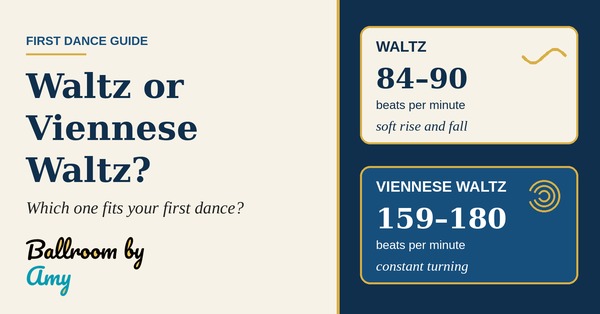
Speed: about 84–90 beats per minute
Feel: soft, floating, rise and fall
Movement: boxes, gentle turns, pauses you can hold
Beginner fit: excellent
Viennese waltz
Speed: about 159–180 beats per minute
Feel: sweeping, romantic, almost dizzying
Movement: continuous turning around the room
Beginner fit: possible, with extra practice
Why Does Viennese Waltz Feel So Much Faster?
Because it is. In international competition, the slow waltz is danced at 28 to 30 bars per minute, or about 84 to 90 beats. The Viennese waltz runs at 58 to 60 bars per minute, roughly twice that tempo. The American Smooth version is a little gentler, about 53 bars per minute according to the NDCA tempos listed by Ballroom Pages, but it’s still quick.
Speed is only half of it. A traditional Viennese waltz is built almost entirely from turns, rotating to the right and then to the left as the couple travels around the floor. Competitors even call it “the dance of endurance.” In Vienna, where it grew up, it still opens the ball season. The city’s tourism office counts more than 450 balls a year, and guests flood the floor when the call “Alles Walzer!” goes out.
The slow waltz gives you time. Each step can rise, lower and sway, and you can hold a pose for a full count without falling behind the music.
Which Waltz Is Easier for Beginners?
The slow waltz, for almost everyone. When I start a couple with no dance background, a simple box step and a gentle turn usually feel comfortable within the first lesson or two. From there, we add one or two moments that look special, like an underarm turn or a slow, easy dip.
Viennese waltz isn’t off-limits for beginners, but it asks more of you. You need steady footwork while rotating, a solid frame so you turn together, and enough stamina to keep going. Even Ballroom Pages notes the Viennese waltz “is not ideal for raw beginners” and recommends turn drills first.
What about getting dizzy? Turning does get easier with practice. Researchers at Imperial College London found that years of training change how dancers’ brains process spinning. You won’t need years for a wedding, but it explains why the first few rotations feel wild and the fiftieth feels normal. If turning makes you uneasy, the slow waltz is the kinder choice.
Lesson Tip
Choose the dance that lets you look at each other. Your guests will remember how you looked together far more than how many turns you did.
How Do I Know If Our Song Is a Waltz?
Try this at home before your first lesson. If you’re not sure where the beat is, my guide to finding the beat in ballroom music walks through it step by step.
The 60-Second Waltz Test
- Play your song and count along: “1-2-3, 1-2-3.” If the strong beat lands naturally on every “1,” it’s likely in waltz time. If “1-2-3-4” feels better, it’s not a waltz.
- Count only the “1”s for 15 seconds, then multiply by four. Around 28–30 is slow waltz territory. Around 50–60 points to Viennese waltz.
- Some songs written in 6/8 or 12/8 can be danced as a waltz, while others feel like a slow sway. This is where an instructor’s ear really helps.
- Bring the exact version you’ll use at the reception to your lesson. A live cover or radio edit can change the tempo.
One more thing to watch: length. The Knot’s experts suggest a first dance of two to three minutes as the sweet spot, and your DJ can edit a longer song. That matters even more for Viennese waltz, where three minutes of nonstop turning is a real workout.
Can a Slow Waltz Still Look Dramatic?
Absolutely. Most of the drama in a first dance comes from a strong entrance, a confident frame, one well-timed moment and a clean finish, not from speed.
Style matters here too. International Standard waltz stays in closed hold the entire time. American Smooth, a style that suits weddings especially well, lets partners move freely in and out of dance position. That opens the door to side-by-side moments, underarm turns and a reveal of the dress, all at a pace you can actually enjoy.
What Can I Learn From DWTS Mariah Carey Night?
On Tuesday, October 6, Dancing with the Stars Season 35 airs Mariah Carey Night on ABC and Disney+. According to the song and dance lists reported by Entertainment Now and Just Jared, you’ll see both dances side by side:
- Waltz: Jackson Olson and Emma Slater (“Without You”), and Maura Higgins and Mark Ballas (“If It’s Over”)
- Viennese waltz: Julia Stiles and Ezra Sosa (“Vision of Love”)
What to watch for
- In the waltzes: the rise and fall. Watch the couple lift onto the balls of their feet and lower again, like a wave rolling across the floor.
- In the Viennese waltz: how much ground the couple covers and how rarely they stop turning.
- For your wedding: notice which one you’d rather be dancing, not just watching. That instinct is a good starting point.
Keep in mind that TV routines are built by professionals with long rehearsal weeks, and the music may be cut or arranged for the show. Your first dance doesn’t need to look like television. It needs to look like the two of you. If you’re following the season with me, my Season 35 cast and predictions post is a good place to start.
Wedding-Day Details That Matter More for Waltz
- The dress: A long train and turning don’t mix. WeddingWire notes that bustling at the reception helps you execute your first dance with ease. Practice at least once in a skirt of similar length and fullness.
- The floor: Viennese waltz travels around the room. A small reception floor usually favors the slow waltz, which can stay compact.
- The shoes: Rehearse in your wedding shoes, or something with the same heel height, well before the day.
- The practice: Short, focused sessions beat long ones. If steps disappear between lessons, read why you remember your wedding dance in the lesson but forget it at home.
For timelines, song ideas and parent dances, see my complete guide to wedding dance lessons in the Twin Cities.
Waltz vs. Viennese Waltz: Frequently Asked Questions
Is a wedding waltz the same as a ballroom waltz?
Usually, yes. Most wedding waltzes are a simplified slow waltz, often in American Smooth style, built around the couple’s song and comfort level.
Can we learn a waltz if we’ve never danced?
Yes. The slow waltz is one of the most beginner-friendly dances there is, and you don’t need any experience or natural coordination to start.
Is Viennese waltz too fast for a first dance?
Not always. It works beautifully with a truly fast 3/4 song, enough floor space and a couple willing to practice turning. If any of those are missing, a slow waltz will usually look and feel better.
What if our song isn’t a waltz at all?
That’s very common. Many first dances are foxtrot, rumba or a simple sway in 4/4 time. Bring the song to a lesson and we’ll find the dance that fits it, instead of forcing the song to fit a dance.
|
Not sure which waltz fits your song? Send it to me. I’ll help you choose the dance and build a first dance you’ll actually enjoy. No experience needed. Schedule a Lesson Or call or text 612-308-7708 |
About Amy
Amy Hanson is the three-time defending Dancer’s Cup Tour Top Teacher. She has danced professionally and internationally and built friendships with dancers many people recognize from Dancing with the Stars. People who believe they’re not coordinated, confident, or good enough are exactly the beginners Amy loves to teach, and she also helps experienced dancers keep improving. Ballroom by Amy teaches in Saint Paul, Roseville, Shoreview and Plymouth and welcomes dancers and wedding couples from across the Twin Cities. No experience or partner is required.
Sources and Further Reading
| Source | What it supports |
|---|---|
| Encyclopaedia Britannica: Waltz | Origin of the word, Viennese and slower branches |
| Wikipedia: International Standard Waltz | Slow waltz tempo, closed hold |
| Wikipedia: Viennese Waltz | Viennese tempo, rotation, history |
| Ballroom Pages: Tempo Chart | NDCA tempos, beginner guidance |
| Oxford University Dancesport Club: Viennese Waltz | “Dance of endurance,” figures |
| Vienna Tourist Board: Ball Season | Vienna’s ball tradition, “Alles Walzer” |
| DanceVision: American vs. International Style | American Smooth open positions |
| Imperial College London | Training and dizziness research |
| The Knot: First Dance Tips | First dance length, editing songs |
| WeddingWire: Wedding Dress Bustles | Bustling the dress for the first dance |
| Entertainment Now and Just Jared | DWTS Season 35 Week 4 dances and songs |
Viennese Waltz
First Dance
Wedding Dance Lessons
Dancing with the Stars
AI assisted with research support, organization and editing for this article.