Ballroom How-To · Bachata · Beginner
Learn the bachata basic: three steps and a tap, side to side, with soft knees.
Illustration (AI-generated): a guitar waiting in an empty studio.
Quick Answer
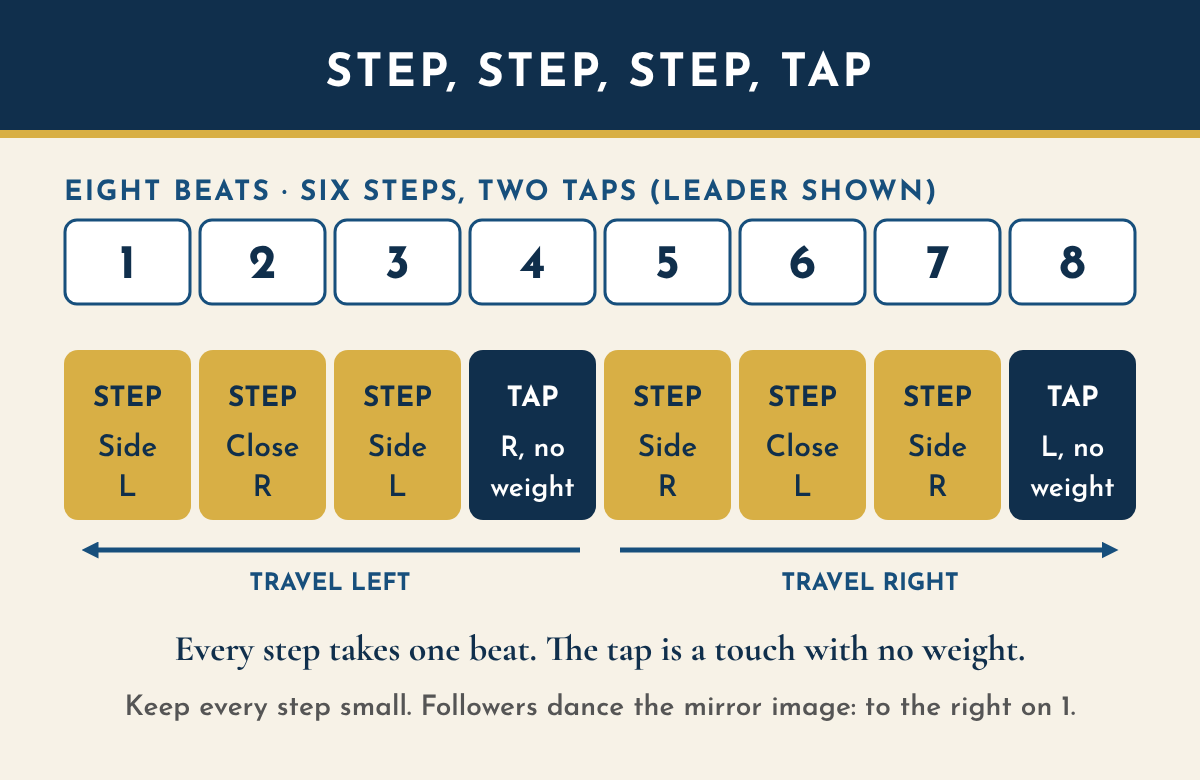
To start dancing bachata, learn the side basic: step, step, step, tap. Leaders step to the side on the left (1), bring the right next to it (2), step left again (3) and tap the right with no weight (4), then do the same back to the right on 5, 6, 7 and 8. Followers dance the mirror image, starting to the right.
Bachata is the romantic one at a Latin night: a guitar-driven dance from the Dominican Republic, slower and smoother than salsa. The good news is that the basic is simple. You travel a little to one side, tap, and come back.
This guide breaks the basic down for both partners, with footwork diagrams, a count-along video, two practice tracks and a five-minute drill. You don’t need a partner, experience or natural rhythm to start. If you can count to four, you can learn it.
In this lesson
What you’ll learn
Skill
The bachata side basic, both parts
Style
Social (modern) bachata
Level
First-timer to beginner
Partner?
Optional. Practice it solo
Step 1: Learn the count before the feet
Bachata is counted in eights: 1, 2, 3, tap, 5, 6, 7, tap. You take a step on 1, 2 and 3, then tap on 4 without putting weight on that foot. Then you do the same thing going the other way on 5, 6, 7 and 8. Every step takes one beat. That’s the count given by Ballroom Pages, Salsa Vida and God’s Ballroom.
This guide teaches the side basic that most social and “modern” bachata classes start with. Ballroom Pages describes several styles: traditional Dominican bachata, which is grounded and often footwork-rich; modern bachata, built on the side basic with turns; and sensual bachata, with flowing body movement, which it says isn’t the usual beginner experience. Amy can point you toward the style that fits where you’ll dance.
Bachata vs salsa
Both dances step on 1, 2, 3 and 5, 6, 7. In salsa you pause on 4 and 8; in bachata you tap there instead. Bachata also travels side to side rather than forward and back, and it’s usually slower: Salsa Vida puts most bachata music between 108 and 152 beats per minute.
Step 2: Get the bachata feel
Good bachata looks relaxed and smooth, not big. Here’s what to aim for in your first basics:
- Small side steps. “Keep the steps smaller than you think,” as Ballroom Pages puts it. Your side steps only need to be a few inches.
- A weightless tap. On 4 and 8, touch the floor with the free foot but keep your weight where it is. That leaves the tapping foot free to take the next step.
- Soft knees, natural hips. Ballroom Pages says hip movement tends to appear on its own when your “weight changes are clear and the knees stay relaxed.” Don’t force it.
- Tall and easy. God’s Ballroom suggests a straight back with the knees slightly bent.
- Hold your partner lightly. Many beginners start holding hands in an open position. A closer hold is optional and should feel comfortable to both partners; “do not force close hold,” Ballroom Pages advises.
Step 3: The leader’s basic, step by step
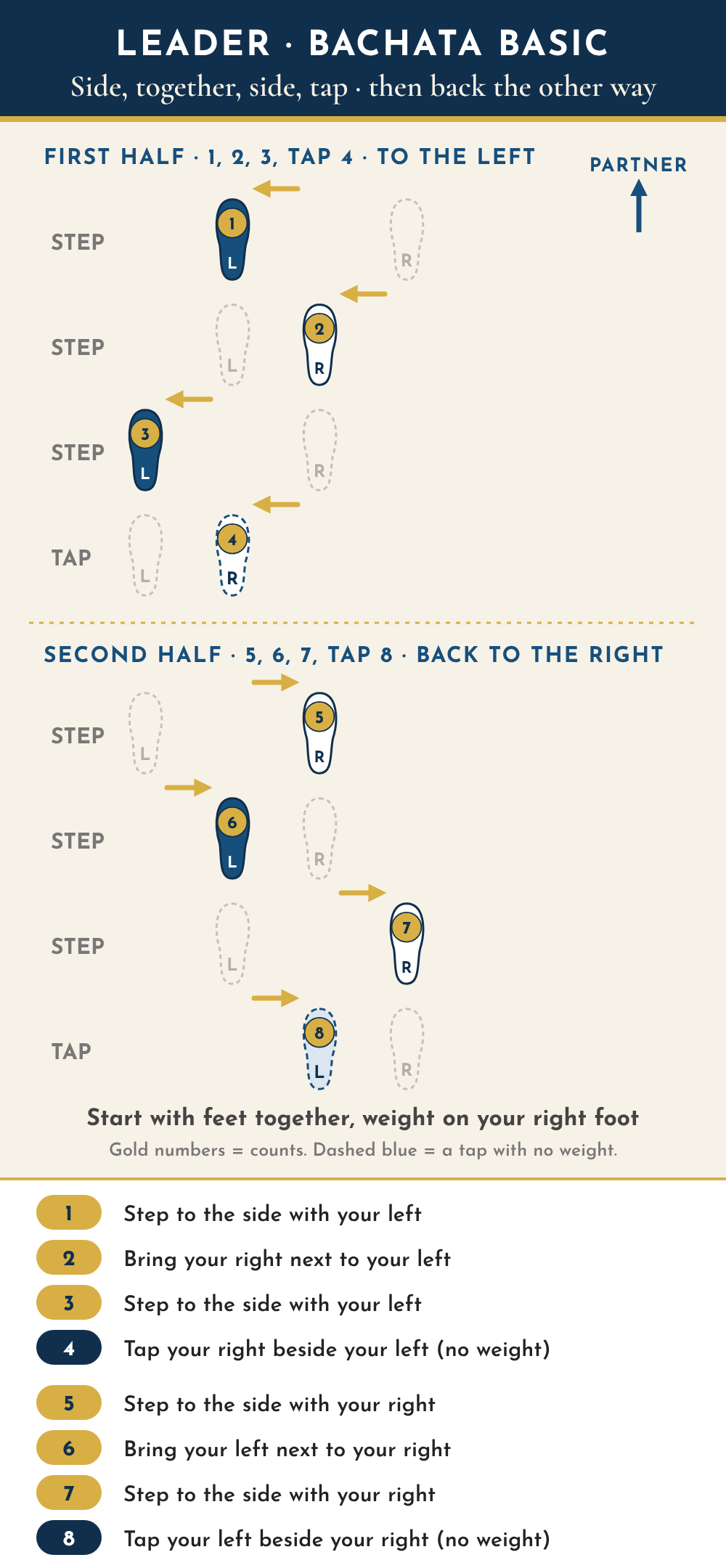
Start: feet together, facing your partner, weight on your right foot, so your left foot is free.
First half: to the left
- Step (1): step to the side with your left foot.
- Step (2): bring your right foot next to your left and put your weight on it.
- Step (3): step to the side with your left foot again.
- Tap (4): touch your right foot beside your left, with no weight.
Second half: back to the right
- Step (5): step to the side with your right foot.
- Step (6): bring your left foot next to your right and put your weight on it.
- Step (7): step to the side with your right foot again.
- Tap (8): touch your left foot beside your right, with no weight. You’re ready to start again.
Say it out loud: “One, two, three, tap. Five, six, seven, tap.” The same left-first side basic for leaders appears in Ballroom Pages’ bachata guide and God’s Ballroom’s beginner steps.
Step 4: The follower’s basic, step by step
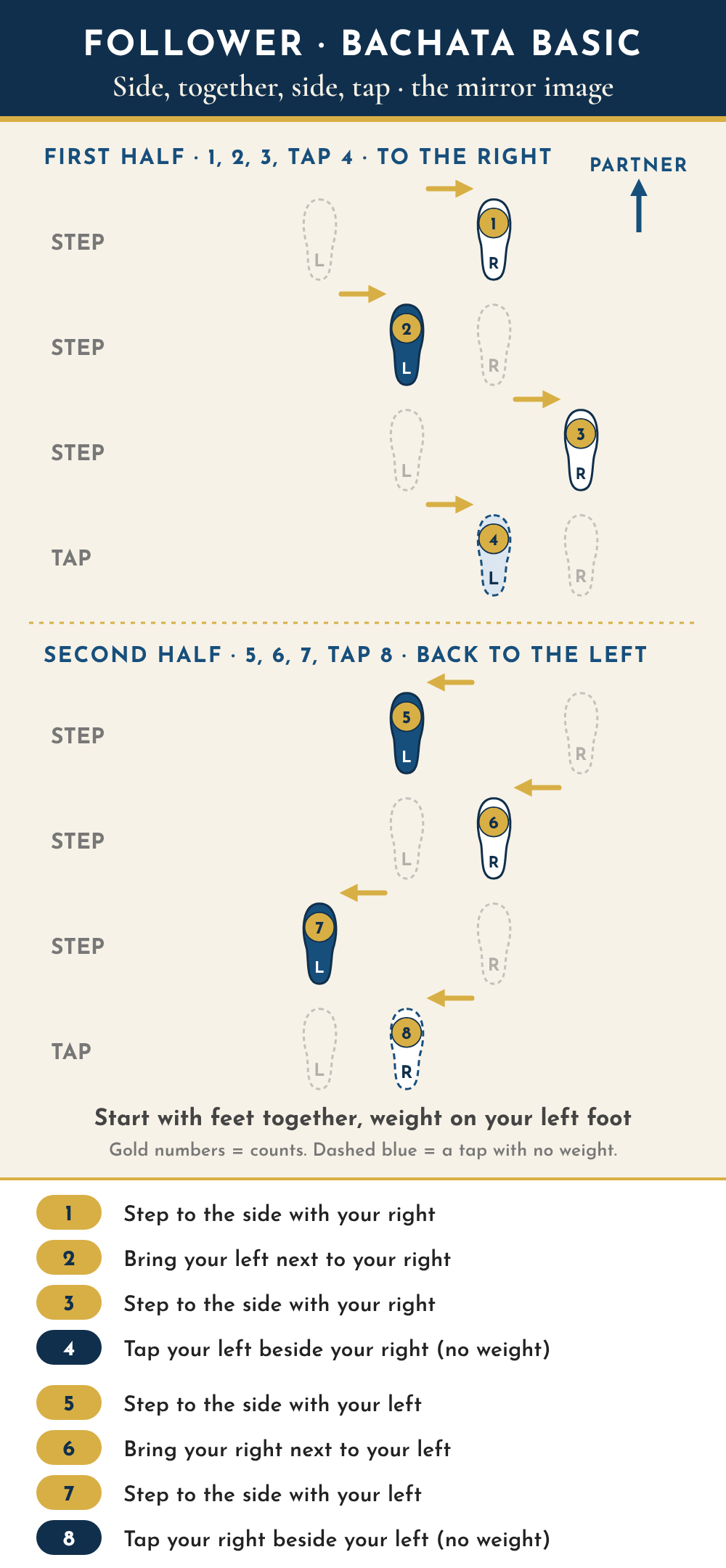
Start: feet together, facing your partner, weight on your left foot, so your right foot is free.
First half: to the right
- Step (1): step to the side with your right foot.
- Step (2): bring your left foot next to your right.
- Step (3): step to the side with your right foot again.
- Tap (4): touch your left foot beside your right, with no weight.
Second half: back to the left
- Step (5): step to the side with your left foot.
- Step (6): bring your right foot next to your left.
- Step (7): step to the side with your left foot again.
- Tap (8): touch your right foot beside your left, with no weight.
Your part is the mirror image of the leader’s: when the leader travels to their left, you travel to your right, so you move the same way together.
Step 5: Put it together
Face your partner, holding hands or in a light hold, and dance the basic together. On 1, 2 and 3 you both travel the same way across the floor (the leader to their left, the follower to their right), and you both tap on 4. Then you travel back on 5, 6 and 7 and tap on 8. Dance at least eight basics in a row.
The basic only travels a step or two each way, so you can dance it on a small piece of floor. Some teachers say “tap,” some “touch,” “hip” or “hold” for count 4. It’s the same moment, and Amy may use any of them.
Watch the count-along lesson (about 3 minutes)
This short video walks both parts step by step, then counts along with you at a slow practice tempo and again at social dance tempo. Press play and dance along; captions are available.
Read the video transcript
Let’s learn the bachata basic. Bachata is a romantic, guitar-driven dance from the Dominican Republic, and you’ll find it at Latin nights, weddings and parties. You can practice it right where you are.
Bachata is counted in eights. You take three steps and a tap. Count it with me: one, two, three, tap. Five, six, seven, tap.
Every step takes one beat. The tap is just a touch of the foot, with no weight on it. The basic travels side to side, so keep your steps small and your knees soft.
Leaders, start with your feet together and your weight on your right foot. On one, step to the side with your left. On two, bring your right foot next to your left. On three, step to the side with your left again. On four, tap your right foot beside your left, without putting weight on it.
Now go back the other way. On five, step to the side with your right. On six, bring your left foot next to your right. On seven, step to the side with your right again. On eight, tap your left foot. That’s one full basic.
Followers, you dance the mirror image. Start with your weight on your left foot. On one, step to the side with your right. On two, bring your left next to your right. On three, step right again. On four, tap your left. Then on five, step to the side with your left. On six, bring your right next to your left. On seven, step left again. On eight, tap your right.
Now let’s practice with the count. You’ll hear a bright tone on one and five, softer tones on the next two steps, and a short, low tap sound on four and eight. Here we go, nice and slow.
[Practice tones at 100 beats per minute: after four count-in clicks, a bright tone on 1 and 5, softer tones on 2, 3, 6 and 7, and a short, low tap sound on 4 and 8.]
Now at social dance tempo, 128 beats per minute. Keep your steps small.
[Practice tones at 128 beats per minute.]
Two quick reminders. Don’t put weight on the tap, so your other foot is free to step. And let your hips follow your knees and your weight changes. Don’t force them.
Want to dance it with an instructor? Ballroom by Amy teaches private lessons across the Twin Cities. Visit BallroomByAmy.com.
Instructor tip
Make the tap tiny and weightless. If your weight stays on the standing foot, the next step is already waiting for you.
Ballroom Pages lists shifting weight on the tap by accident among the most common beginner mistakes.
Hear the counts: two practice tracks
These original practice tracks (no music, just tones) play the bachata basic for you. After four count-in clicks, you’ll hear a bright tone on 1 and 5, softer tones on the next two steps, and a short, low tap sound on 4 and 8. Press play, stand up, and dance along. Neither track plays automatically.
Slow practice · 100 beats per minute
Social tempo · 128 beats per minute
What you’ll hear (text version)
Each track has no words or music. It opens with four clicks to count you in. Then the pattern repeats every four beats: a bright tone on 1 (step), softer tones on 2 and 3 (step, step), and a short, low tap sound on 4 (tap). The second half, 5 to 8, sounds the same. The slow track plays 10 basics in about 53 seconds and the social-tempo track 14 basics in about 56 seconds.
Beyond the basic: what comes next
Once the side basic is steady, bachata opens up into new directions and turns, all on the same step, step, step, tap timing. These are best learned with a teacher, but here’s what to look forward to:
Forward and back basic
The same three steps and a tap, but traveling forward and back instead of side to side. God’s Ballroom describes it as a common second basic.
The follower’s turn
The follower turns under the leader’s raised hand, timed so the turn finishes before the tap.
Dominican footwork
Traditional bachata adds playful, rhythmic footwork. Ballroom Pages warns it’s more than just “fast footwork.”
Common mistakes and quick fixes
Putting weight on the tap
Fix: touch the floor lightly and keep your weight on the standing foot. Your next step uses the foot you just tapped.
Forgetting the tap
Fix: say “tap” out loud on 4 and 8. Skipping it puts you on the wrong foot for the next step.
Big side steps
Fix: shrink each step to a few inches. Big steps make you late and pull your partner off balance.
Forcing the hips or the hold
Fix: let your hips follow soft knees and clear weight changes, and keep the hold as close as is comfortable for both of you.
Your five-minute practice
- Minute 1: play the count-along video above and say “one, two, three, tap” out loud with it.
- Minutes 2-3: dance your own part alone, no music. Exaggerate the tap: touch, but don’t step.
- Minute 4: play the slow practice track above and dance along with it.
- Minute 5: try the social-tempo track with small steps. If it falls apart, go back to the slow one. That’s how everyone learns.
If finding the beat is the hard part, read why some songs make the beat hard to find.
|
Print the one-page bachata practice sheet |
Music, clothes and where you’ll dance it
The steps are only half the picture. Here’s what to play, what to wear, and where bachata will actually come in handy.
What music works for bachata?
Bachata music is guitar-led Latin music in four-beat time, with a steady pulse and expressive vocals. UNESCO describes the traditional group as one or two guitars with bongos, maracas, a güiro and bass. Most bachata falls between 108 and 152 beats per minute, according to Salsa Vida, with traditional Dominican bachata usually faster. Find the steady beat first; styling can come later.
Songs to try
- Darte un Beso, Prince Royce
- Eres Mía, Romeo Santos
- Tengo un Amor, Toby Love
- El Mismo, Eunel
- Quiero, Joe
From GoAndance’s list of bachata songs to dance to. Tempos vary by recording, so test yours: count “one, two, three, tap” along with it. If the tap lands comfortably on 4, it will work. The practice tracks above are a good warm-up first.
What should you wear?
For lessons and practice
Clothes you can move in. For shoes, the same advice that works for salsa works here: Salsa Vida suggests jazz or practice shoes, dance sneakers, or a low heel of one to two inches for beginners.
For a Latin night
Dress for the venue, then check you can take small, smooth side steps and a turn in it. Shoes that grip the floor too much make turning harder.
For competitions and shows
Bachata competitions and showcases set their own costume and shoe rules by event and level. Read them before you buy anything.
Skip flip-flops, rubber soles that grab the floor, and loose or chunky heels. Leave pencil skirts, scarves and long jewelry at home for lessons (Supadance’s guide to dressing for dance has more). You don’t need special shoes to start; ask Amy before you buy.
Where will you dance bachata?
- Latin nights and bachata socials. Bachata is a staple at Latin nights and mixed salsa and bachata events, and the side basic is the first thing you’ll dance there. Find Twin Cities nights on Where to Go Dancing in the Twin Cities.
- Weddings and parties. Bachata works when the song clearly has a bachata rhythm, as Ballroom Pages notes. For a slow, romantic song without that rhythm, the rumba or foxtrot may suit better. See wedding dance lessons.
- Vacations and cruises. A steady basic and one turn will get you onto almost any Latin dance floor.
Social bachata has its own etiquette: ask before you dance, respect your partner’s space, and save dips and body rolls for partners who have learned them together. Ballroom Pages also suggests thanking your partner after the song.
A little history
Where did bachata come from?
Bachata comes from the Dominican Republic. UNESCO, which added the music and dance of Dominican bachata to its list of the world’s intangible cultural heritage in 2019, describes the music as a fusion of rhythmic bolero with other Afro-Antillean styles such as son, cha-cha-chá and merengue; the word first meant a lively party. According to Salsa Vida’s history of bachata, the first songs later recognized as bachata were recorded by José Manuel Calderón in 1962, and the music was looked down on for years. Juan Luis Guerra’s 1990 album Bachata Rosa brought it to new audiences, and Aventura, a group from the Bronx, carried it worldwide in the 2000s.
Next steps
Learn
How to dance the hustle: another Nightclub favorite
Learn
How to dance the rumba: a slower Latin romance
Watch
Free video lessons and step-by-step guides
|
Learn with Amy Ready to dance bachata with an instructor? Ballroom by Amy offers private bachata lessons for dancers across the Twin Cities, whether you’re heading to your first Latin night or getting ready for a wedding. Beginners are welcome, and no partner is needed. See private lessons Or call or text 612-308-7708. Amy typically replies within one business day. |
About Amy
Amy Hanson is the three-time defending Dancer’s Cup Tour Top Teacher. She has danced professionally and internationally and built friendships with dancers many people recognize from Dancing with the Stars. People who believe they’re not coordinated, confident, or good enough are exactly the beginners Amy loves to teach, and she also helps experienced dancers keep improving. No experience or partner is required.
Sources & Further Reading
- Ballroom Pages: Bachata Dance Style Guide. 1-2-3-tap, 5-6-7-tap; leader and follower side basic; small steps, natural hips; styles; common mistakes; music; weddings and social etiquette.
- Salsa Vida: Salsa vs Bachata. Bachata steps on 1-2-3 and 5-6-7 with a tap on 4 and 8; music typically 108–152 BPM; Dominican bachata faster.
- God’s Ballroom: How to Dance Bachata for Beginners. Leader and follower side basic with a partial-weight tap; forward and back basic; posture.
- UNESCO: Music and Dance of Dominican Bachata. 2019 inscription; origins in rhythmic bolero and other Afro-Antillean genres; instruments; the meaning of the word.
- Salsa Vida: History of Bachata Dance and Music. José Manuel Calderón (1962); early stigma; Juan Luis Guerra; Aventura; dance styles.
- GoAndance: The Best Bachata Songs to Dance. Song titles and artists.
- Salsa Vida: Best Shoes for Salsa Dancing. Beginner shoes, heel height, grippy soles.
- Supadance: How to Dress for Ballroom Dancing. Lesson clothes and shoes to avoid.
AI-Assisted Content Disclaimer
This educational guide was created with assistance from artificial intelligence (AI), including portions of the written content and visual materials. While we strive to provide accurate and helpful ballroom dance information, AI-generated content and illustrations may contain errors or inaccuracies, including in dance positions, footwork, timing, and technique.
Please independently verify important information and use your own judgment when practicing. Images are intended to support learning and may not always represent technically precise movements. For personalized guidance and instruction, consider learning directly with a qualified ballroom dance instructor.
Some images are AI-generated illustrations and do not show real people. The narration in the count-along lesson is an AI-generated voice. The footwork diagrams and practice tones were created for this guide.