Ballroom How-To · Salsa · Beginner
Learn the salsa basic: three small steps, a pause, and you’re dancing.
Illustration (AI-generated): a summer salsa night on a city plaza.
Quick Answer
To start dancing salsa, learn the basic on 1: step on counts 1, 2 and 3, pause on 4, then step on 5, 6 and 7 and pause on 8 (quick, quick, slow). Leaders step forward on the left, shift back onto the right and close the left, then step back on the right, shift forward onto the left and close the right. Followers dance the mirror image, starting back on the right.
Salsa is the Latin dance you’re most likely to meet out in the world: at Latin nights, summer festivals, weddings and parties. The good news is that the basic is just three small steps and a pause, repeated.
This guide breaks the basic down for both partners, with footwork diagrams, a count-along video, two practice tracks and a five-minute drill. You don’t need a partner, experience or natural rhythm to start. If you can count to eight, you can learn it.
In this lesson
What you’ll learn
Skill
The salsa basic, both parts
Style
Social salsa “on 1” (linear)
Level
First-timer to beginner
Partner?
Optional. Practice it solo
Step 1: Learn the count before the feet
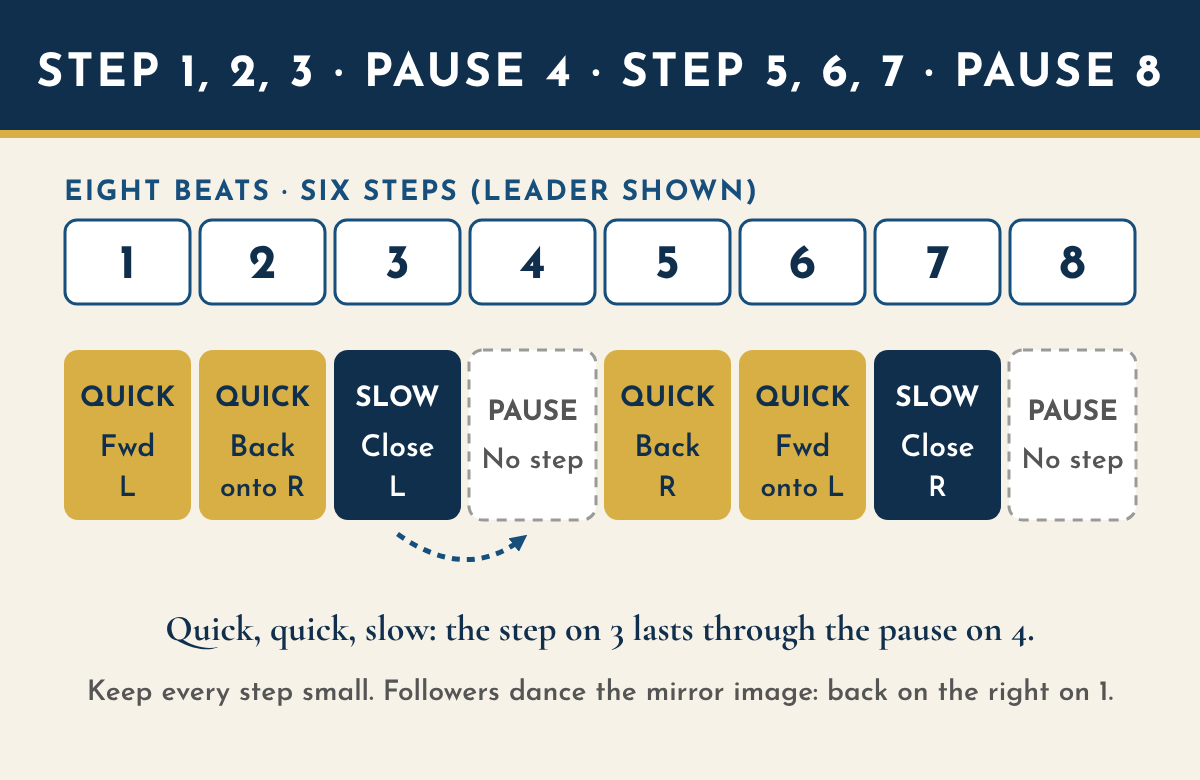
Salsa is counted in eights: 1, 2, 3, pause, 5, 6, 7, pause. You step on 1, 2 and 3, don’t step on 4, then step on 5, 6 and 7 and don’t step on 8. The rhythm is quick, quick, slow: the step on 3 is the slow because it lasts through the pause. That’s the count given by Ballroom Pages, Salsa Vida and God’s Ballroom.
This guide teaches salsa “on 1,” the style where the first forward or back step (the “break”) lands on count 1. Ballroom Pages links on-1 timing with linear, LA-style salsa, danced back and forth along a line called the slot. Other rooms dance “on 2” (New York style) or Cuban style, which moves in a circle, as Salsa Vida’s basic-step guide explains. Amy may start you on whichever style fits where you plan to dance.
If you know the mambo
You already know the shape. The ballroom mambo uses the same three steps, but holds 1 and breaks on 2. Salsa on 1 breaks on 1 and pauses on 4. Same feet, different place in the music, and Ballroom Pages calls the mambo salsa’s closest relative.
Step 2: Get the salsa feel
Good salsa looks relaxed and on time, not big. Here’s what to aim for in your first basics:
- Small steps under your body. “The faster the music… the smaller the steps,” as God’s Ballroom puts it. Small steps keep you on time and ready to turn.
- Clear weight changes. Put your full weight on each step rather than tapping the floor. On 2 and 6 your weight simply rocks back to the foot that didn’t move.
- Tall and soft. “Stand tall, soften the knees, and keep your weight over your own feet,” says Ballroom Pages. The hip motion comes from the knees and the weight changes; let it happen rather than forcing it.
- Let the pause be a pause. On 4 and 8 you settle. That moment is what gives salsa its rhythm.
- Hold your partner lightly. When the leader breaks forward, the follower breaks back, so you stay together. Salsa uses “connection rather than force,” in Ballroom Pages’ words, so no pulling with the arms.
Step 3: The leader’s basic, step by step
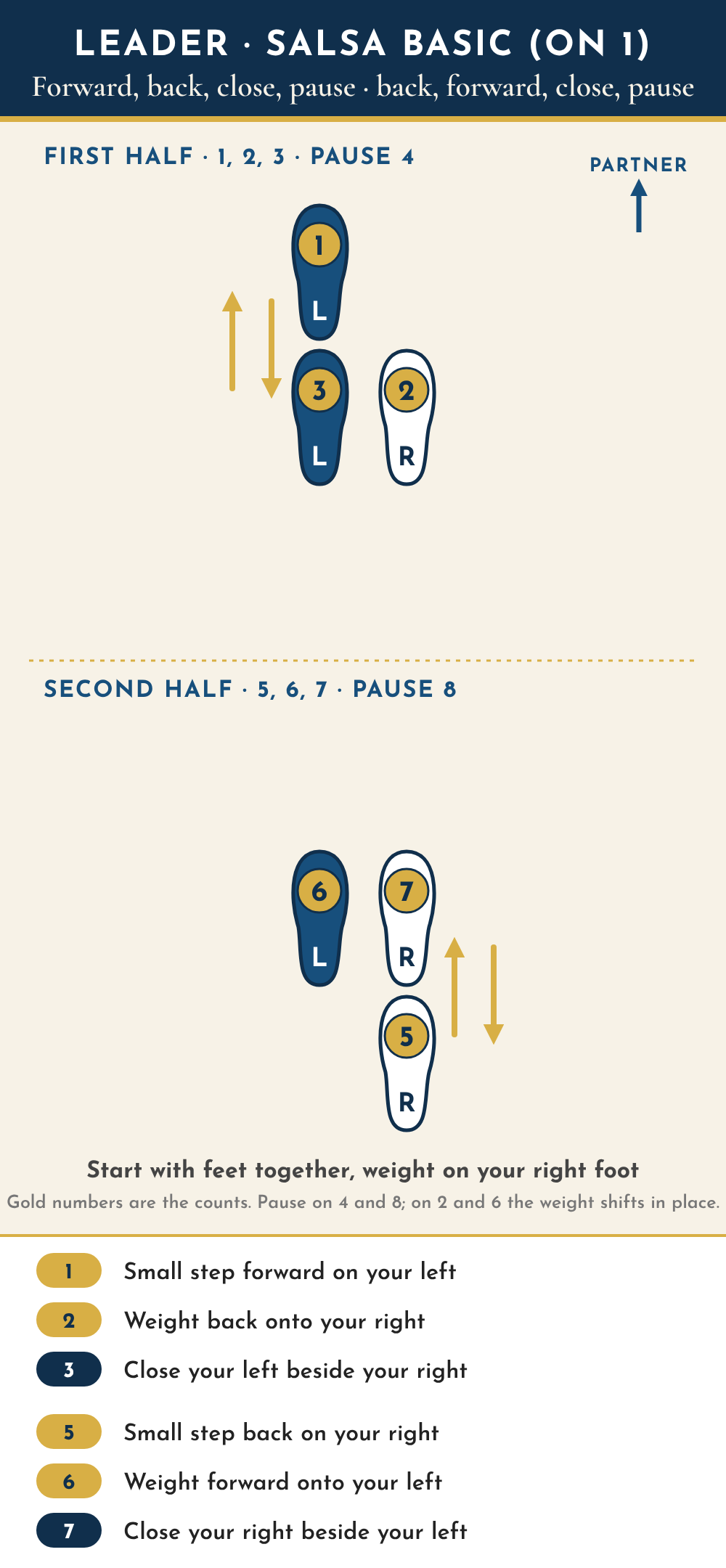
Start: feet together, facing your partner, weight on your right foot, so your left foot is free.
First half: forward, back, close, pause
- Quick (1): take a small step forward on your left foot. This is the break.
- Quick (2): shift your weight back onto your right foot, which hasn’t moved.
- Slow (3): bring your left foot back beside your right.
- Pause (4): don’t step. Let the slow on 3 carry you through 4.
Second half: back, forward, close, pause
- Quick (5): take a small step back on your right foot.
- Quick (6): shift your weight forward onto your left foot.
- Slow (7): bring your right foot back beside your left.
- Pause (8): don’t step. You’re ready for the next basic on 1.
Say it out loud: “One, two, three… five, six, seven.” The same forward break on the left on 1 and back break on the right on 5 appears in Ballroom Pages’ salsa guide and GoAndance’s beginner steps.
Step 4: The follower’s basic, step by step
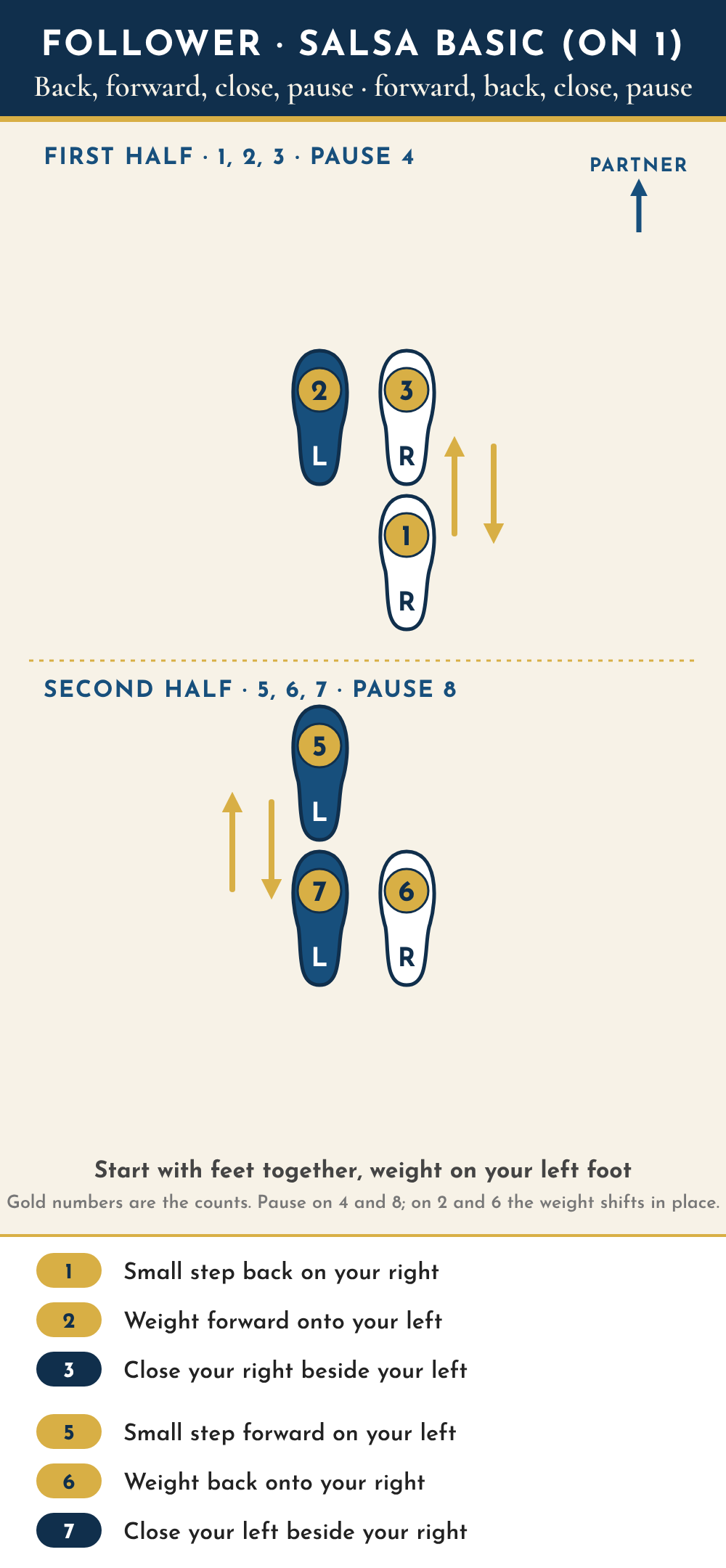
Start: feet together, facing your partner, weight on your left foot, so your right foot is free.
First half: back, forward, close, pause
- Quick (1): take a small step back on your right foot.
- Quick (2): shift your weight forward onto your left foot.
- Slow (3): bring your right foot back beside your left.
- Pause (4): don’t step.
Second half: forward, back, close, pause
- Quick (5): take a small step forward on your left foot.
- Quick (6): shift your weight back onto your right foot.
- Slow (7): bring your left foot back beside your right.
- Pause (8): don’t step. You’re ready for the next basic.
Your part is the mirror image of the leader’s: when the leader breaks forward, you break back, and both of you close your feet together on 3 and 7.
Step 5: Put it together
Face your partner in a light hold and dance the basic together. On 1, the leader breaks forward as the follower breaks back; on 2, you both shift your weight back to where you started; on 3, you close your feet, and you both pause on 4. Then the leader breaks back as the follower breaks forward on 5. Dance at least eight basics in a row.
The basic stays almost in place, so you can dance it on a small piece of floor. Some teachers count it “quick, quick, slow” and some “one, two, three, five, six, seven.” It’s the same timing, and Amy may use either.
Watch the count-along lesson (under 3 minutes)
This short video walks both parts step by step, then counts along with you at a slow practice tempo and again at social dance tempo. Press play and dance along; captions are available.
Read the video transcript
Let’s learn the salsa basic. Salsa is a fast, joyful Latin dance you’ll find at Latin nights, weddings and parties. You can practice it right where you are.
Salsa is counted in eights. You step on one, two, three, pause on four, then step on five, six, seven, and pause on eight. Count it with me: one, two, three, pause. Five, six, seven, pause.
One and two are quicks. Three is a slow, because it lasts through the pause on four. Keep every step small and right under your body.
Leaders, start with your feet together and your weight on your right foot. On one, take a small step forward with your left. On two, shift your weight back onto your right. On three, bring your left foot back beside your right. Pause on four.
Second half. On five, take a small step back with your right. On six, shift your weight forward onto your left. On seven, bring your right foot back beside your left. Pause on eight. That’s one full basic.
Followers, you dance the mirror image. Start with your weight on your left foot. On one, step back on your right. On two, forward onto your left. On three, close your right beside your left. Then on five, step forward on your left. On six, back onto your right. On seven, close your left beside your right.
Now let’s practice with the count. You’ll hear a bright tone on one and five, a softer tone on two and six, a deeper tone on three and seven, and a light click on each pause. Here we go, nice and slow.
[Practice tones at 120 beats per minute: after four count-in clicks, a bright tone on 1 and 5, a softer tone on 2 and 6, a deeper tone on 3 and 7, and a light click on each pause, 4 and 8.]
Now at social dance tempo, 180 beats per minute. Keep your steps tiny.
[Practice tones at 180 beats per minute.]
Two quick reminders. Pause on four and eight, so you don’t run ahead of the music. And keep your steps small, so your feet can keep up.
Want to dance it with an instructor? Ballroom by Amy teaches private lessons across the Twin Cities. Visit BallroomByAmy.com.
Instructor tip
Listen first, then count, then step. Find the steady pulse of the song before your feet join in.
Ballroom Pages suggests that order for beginners, and lists counting without listening to the music among the most common mistakes.
Hear the counts: two practice tracks
These original practice tracks (no music, just tones) play the salsa basic for you. After four count-in clicks, you’ll hear a bright tone on 1 and 5, a softer tone on 2 and 6, a deeper tone on 3 and 7, and a light click on each pause. Press play, stand up, and dance along. Neither track plays automatically.
Slow practice · 120 beats per minute
Social tempo · 180 beats per minute
What you’ll hear (text version)
Each track has no words or music. It opens with four clicks to count you in (think “5, 6, 7, 8”). Then the pattern repeats every four beats: a bright tone on 1 (quick), a softer tone on 2 (quick), a deeper tone on 3 that rings through 4 (slow), and a light click on 4 (pause). The second half, 5 to 8, sounds the same. The slow track plays 12 basics in about 52 seconds and the social-tempo track 20 basics in about 56 seconds.
Beyond the basic: what comes next
Once the basic is steady, salsa opens up into turns and figures, all on the same 1-2-3, 5-6-7 timing. These are best learned with a teacher, but here’s what to look forward to:
Side basic
The same quick, quick, slow, but stepping to the side instead of forward and back. Salsa Vida lists front, back and side basics as common variations.
Right turn
The follower turns under the leader’s raised hand, timed so the turn finishes on the slow and the pause.
Cross-body lead
The signature move of linear salsa: the leader opens a path and the partners trade places along the slot.
Common mistakes and quick fixes
Stepping through the pause
Fix: say “pause” out loud on 4 and 8 and keep your feet still. Your next step always lands on 1 or 5.
Big steps
Fix: shrink each break to a few inches. If the music keeps leaving you behind, your steps are too big.
Pulling or steering with the arms
Fix: leaders, lead with your body and a light hold. Followers, keep your own balance instead of leaning on your partner.
Looking at your feet
Fix: look at your partner or over their shoulder and trust the count. Ballroom Pages lists looking down among common beginner habits.
Your five-minute practice
- Minute 1: play the count-along video above and say “one, two, three, pause” out loud with it.
- Minutes 2-3: dance your own part alone, no music. Exaggerate the pause: stand still on 4 and 8 every time.
- Minute 4: play the slow practice track above and dance along with it.
- Minute 5: try the social-tempo track with tiny steps. If it falls apart, go back to the slow one. That’s how everyone learns.
If finding the beat is the hard part, read why some songs make the beat hard to find.
|
Print the one-page salsa practice sheet |
Music, clothes and where you’ll dance it
The steps are only half the picture. Here’s what to play, what to wear, and where salsa will actually come in handy.
What music works for salsa?
Salsa music is layered Latin dance music in four-beat time: congas and timbales, piano, bass, vocals and horns, as Ballroom Pages describes it. It’s quick. Salsa Vida puts most salsa in the 160 to 220 beats-per-minute range, and God’s Ballroom says it’s typically around 180. That’s why beginners practice slower first.
Songs to try
- La vida es un carnaval, Celia Cruz
- Periódico de ayer, Héctor Lavoe
- Vámonos pal monte, Eddie Palmieri
- Vivir mi vida, Marc Anthony
- Qué haces aquí, Los Hermanos Lebrón
From GoAndance’s list of salsa songs to dance to. Tempos vary by recording, so test yours: count “one, two, three, pause” along with it. If you can pause on 4 without feeling rushed, it will work. The practice tracks above are a good warm-up first.
What should you wear?
For lessons and practice
Clothes you can move and turn in. Shoes matter most: Salsa Vida suggests jazz or practice shoes, dance sneakers, or a low heel of one to two inches for beginners.
For a salsa night
Dress for the venue, then check you can spin in it. Shoes that are too grippy make turning harder, and suede soles wear out fast on outdoor pavement.
For competitions and shows
Salsa competitions and showcases set their own costume and shoe rules by event and level. Read them before you buy anything.
Skip flip-flops, rubber soles that grab the floor, and loose or chunky heels. Leave pencil skirts, scarves and long jewelry at home for lessons (Supadance’s guide to dressing for dance has more). You don’t need special shoes to start; ask Amy before you buy.
Where will you dance salsa?
- Latin and salsa nights. Salsa is one of the most useful social partner dances, and the basic you just learned is the first thing you’ll dance there. Find Twin Cities nights on Where to Go Dancing in the Twin Cities.
- Weddings and parties. Salsa suits an upbeat Latin song or a surprise switch after a slow start, but not a slow ballad, as Ballroom Pages points out. See wedding dance lessons.
- Summer festivals and outdoor dances. Bring shoes with smooth, street-friendly soles for pavement.
- Cruises and trips. A steady basic and one turn will get you onto almost any Latin dance floor.
On a busy floor, keep your steps compact, watch the space around you, and thank your partner after the song. The basic stays nearly in place, so it fits almost anywhere.
A little history
Where did salsa come from?
Salsa grew out of Afro-Cuban dance music. Britannica describes it as a hybrid based on Afro-Cuban music with elements of other Latin American styles, developed largely in New York City beginning in the 1940s and ’50s and peaking in popularity in the 1970s, with stars such as Celia Cruz, Eddie Palmieri, Willie Colón and Rubén Blades. The name stuck thanks to bandleader Johnny Pacheco: according to the U.S. Patent and Trademark Office, he founded Fania Records and the Fania All Stars in the 1960s and called it all “salsa,” the music, the dancing and the culture. Its dance roots run through the mambo, which is why the two basics look so alike.
Next steps
Learn
How to dance the mambo: the basic step
Learn
How to dance the hustle: another Nightclub favorite
Watch
Free video lessons and step-by-step guides
|
Learn with Amy Ready to dance salsa with an instructor? Ballroom by Amy offers private salsa lessons for dancers across the Twin Cities, whether you’re heading to your first Latin night or getting ready for a wedding. Beginners are welcome, and no partner is needed. See private lessons Or call or text 612-308-7708. Amy typically replies within one business day. |
About Amy
Amy Hanson is the three-time defending Dancer’s Cup Tour Top Teacher. She has danced professionally and internationally and built friendships with dancers many people recognize from Dancing with the Stars. People who believe they’re not coordinated, confident, or good enough are exactly the beginners Amy loves to teach, and she also helps experienced dancers keep improving. No experience or partner is required.
Sources & Further Reading
- Ballroom Pages: Salsa Dance Style Guide. 1-2-3, 5-6-7 with pauses on 4 and 8; leader and follower basic; on 1 vs on 2; posture, connection, common mistakes; music; weddings and social etiquette.
- Salsa Vida: Basic Step. On 1, on 2 and Cuban basics; front, back and side variations.
- Salsa Vida: Salsa vs Bachata. Salsa counts; music usually 160–220 BPM.
- God’s Ballroom: How to Salsa Dance for Beginners. Leader and follower basic; quick, quick, slow; small steps; typically around 180 BPM.
- GoAndance: Basic Salsa Steps for Beginners. Leader forward on the left, follower back on the right; pauses on 4 and 8.
- GoAndance: The Best 9 Salsa Songs to Dance. Song titles and artists.
- Salsa Vida: Best Shoes for Salsa Dancing. Beginner shoes, heel height, suede outdoors, grippy soles.
- Encyclopaedia Britannica: Salsa (music). Afro-Cuban hybrid; New York from the 1940s and ’50s; 1970s peak; key artists.
- U.S. Patent and Trademark Office: Inventing Salsa, Johnny Pacheco. Fania Records, the Fania All Stars and the name “salsa.”
- Supadance: How to Dress for Ballroom Dancing. Lesson clothes and shoes to avoid.
AI-Assisted Content Disclaimer
This educational guide was created with assistance from artificial intelligence (AI), including portions of the written content and visual materials. While we strive to provide accurate and helpful ballroom dance information, AI-generated content and illustrations may contain errors or inaccuracies, including in dance positions, footwork, timing, and technique.
Please independently verify important information and use your own judgment when practicing. Images are intended to support learning and may not always represent technically precise movements. For personalized guidance and instruction, consider learning directly with a qualified ballroom dance instructor.
Some images are AI-generated illustrations and do not show real people. The narration in the count-along lesson is an AI-generated voice. The footwork diagrams and practice tones were created for this guide.