Ballroom How-To · West Coast Swing · Beginner
Smooth, stretchy and danced in a straight line. Your first pattern is the sugar push.
Illustration (AI-generated): a long, sunlit practice studio.
Quick Answer
Start West Coast Swing with the sugar push, a six-beat pattern counted 1, 2, 3, 4, 5 & 6: walk, walk, tap, step, anchor step. Facing your partner in a low one-hand hold, the leader steps back left, back right, taps the left, steps forward left, then anchors (right foot back, left, right in place). The follower walks forward right, left, taps the right, steps back right, then anchors (left foot back, right, left in place). Keep your steps small and stay in your lane, the “slot.”
West Coast Swing looks different from every other swing dance. Instead of turning in a circle, the follower travels back and forth along a straight lane while the leader stays close to the middle. The feel is smooth and a little elastic, and it fits a huge range of music, from blues to today’s pop and R&B.
This guide teaches the pattern almost every West Coast Swing dancer learns first, the sugar push, for both leader and follower. You’ll get footwork diagrams, a count-along video, two practice tracks and a five-minute drill. No partner or experience needed to start.
In this lesson
What you’ll learn
Skill
The sugar push, both parts
Style
West Coast Swing (Nightclub)
Level
Beginner
Partner?
Optional. Practice it solo
Step 1: Find the slot and the hold
West Coast Swing is danced in a slot: a long, narrow lane on the floor. Ballroom Pages suggests picturing a long rug, with the follower usually traveling up and down it. Wikipedia’s overview notes the slot is around eight or nine feet long for slower songs and shorter for fast ones. The leader mostly stays near the middle and moves a little to make room.
For the sugar push, stand facing your partner a few feet apart. The leader’s left hand holds the follower’s right hand, low (around waist height) and relaxed. Round-dance teachers call this left open facing position; the Roundalab standard starts and ends the sugar push there.
If you already know East Coast Swing
Expect a different feel. East Coast Swing turns around a small circle with a bouncy triple step. West Coast Swing stays in its lane and moves smoothly, “without the Jive bounce,” as Dan and Sandi Finch put it. Ballroom Pages lists mixing up the two swings as a common beginner mistake.
Step 2: Learn the count
Most beginner West Coast Swing patterns take six beats, and the sugar push is one of them. Count it 1, 2, 3, 4, 5 & 6. The “&” is a half beat, so 5 & 6 squeezes three quick weight changes into two beats. The Finches give a handy memory line: “walk, walk, touch, step, triple step.” In this guide we call the touch a tap and the triple an anchor step.
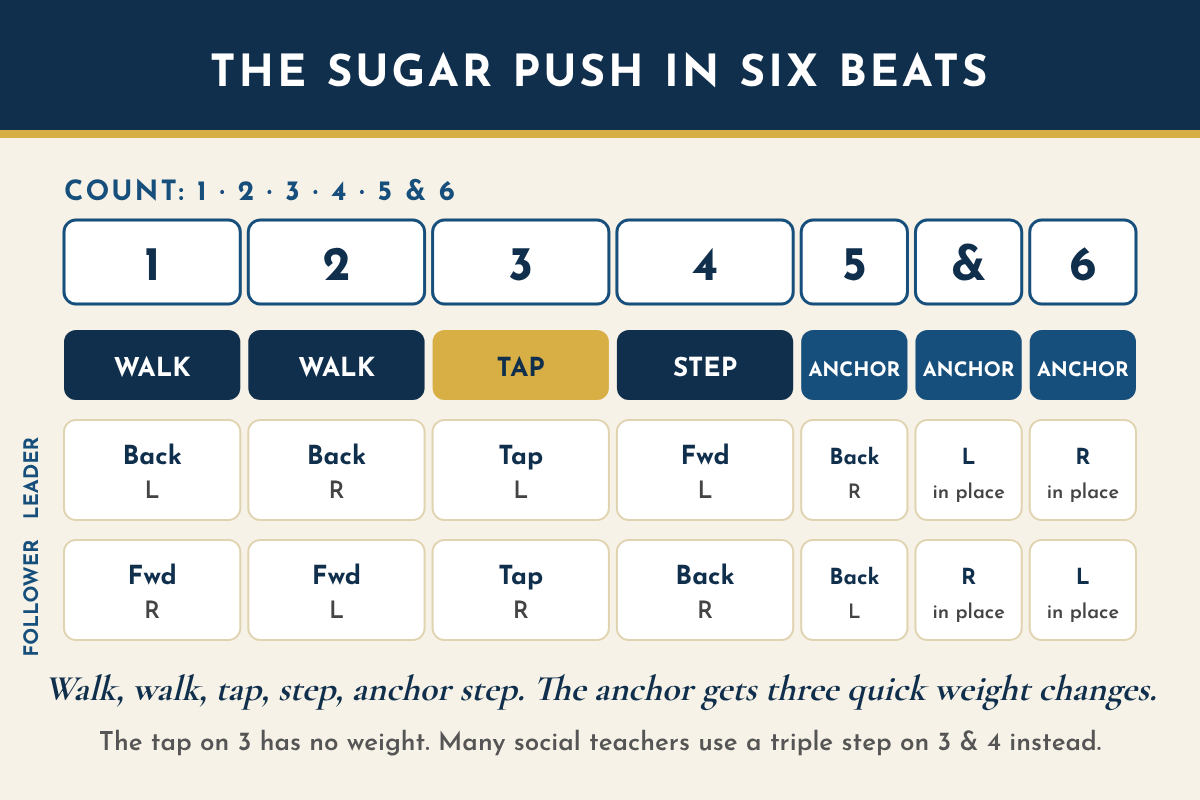
One honest note: teachers count the middle of the sugar push in two ways. The Roundalab standard uses a tap on 3 and a step on 4, which is what we teach here because it’s the easiest start. Ballroom Pages and many social teachers dance a triple step on 3 & 4 instead. Both use the same anchor on 5 & 6, and Amy may teach either one.
Step 3: Understand the anchor step
The anchor step on 5 & 6 is what makes West Coast Swing feel like West Coast Swing. Ballroom Pages describes it as the moment that helps both partners finish the pattern, settle their weight and get ready for the next one.
- The footwork: a small step back with your free foot, just behind the heel of your other foot with the toes turned slightly out, then two weight changes in place. That’s how the Roundalab standard describes it.
- The feeling: settle your weight slightly back, away from your partner, so your arms feel a gentle stretch. Skippy Blair, longtime education coordinator for the World Swing Dance Council, wrote that “an anchor is a body action,” not just a rhythm (WSDC article on anchors).
- Small and in place: the anchor doesn’t travel. Keep it under your body.
Practice just the anchor first: step back, change, change, and feel yourself settle. Then add the walks in front of it.
Step 4: The leader’s sugar push, step by step
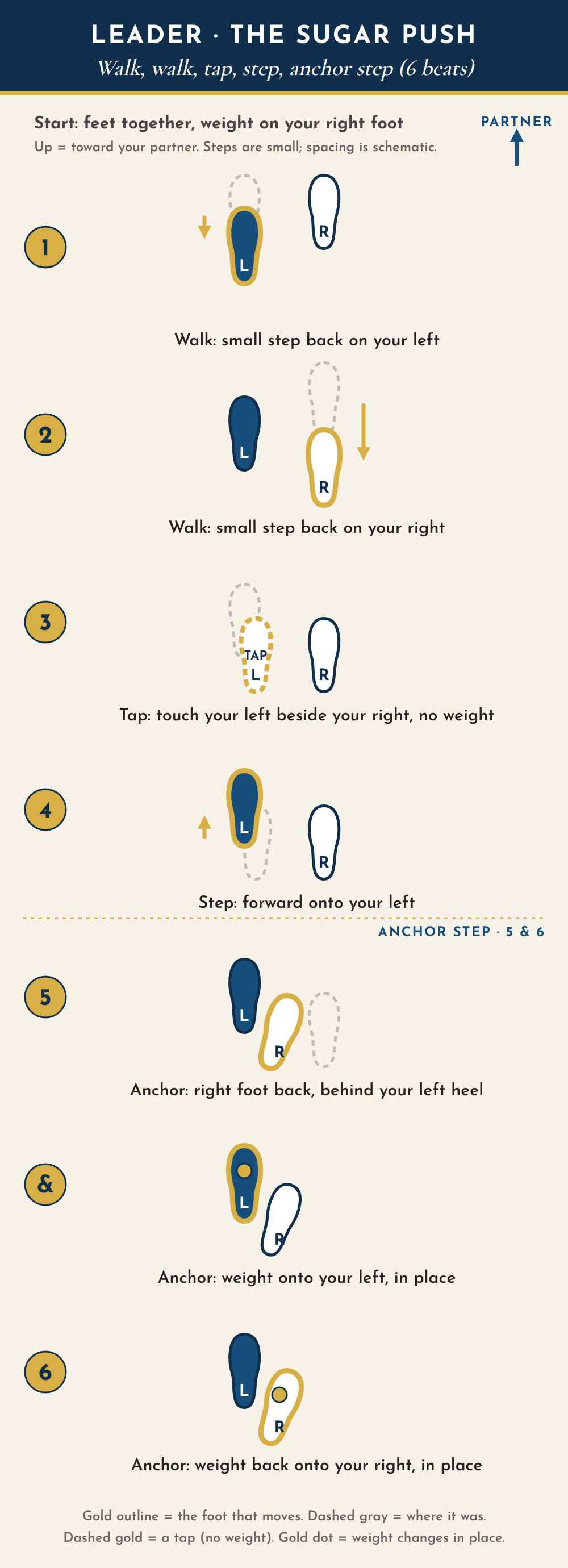
Start: feet together, facing your partner, weight on your right foot, so your left foot is free.
Counts 1-4: walk, walk, tap, step
- Count 1: take a small step back with your left foot. (walk)
- Count 2: take a small step back with your right foot. (walk)
- Count 3: tap your left foot beside your right, with no weight on it. (tap)
- Count 4: step forward onto your left foot. (step)
Counts 5 & 6: anchor step
- Count 5: step your right foot back, just behind your left heel, toes turned slightly out.
- Count &: shift your weight onto your left foot, in place.
- Count 6: shift your weight back onto your right foot, in place. Settle back, as if you’re sitting into it.
Keep every step small. You stay near the middle of the slot while your partner travels toward you and back. The Finches describe the leader taking two small steps back, then stopping to receive the follower’s momentum.
Step 5: The follower’s sugar push, step by step
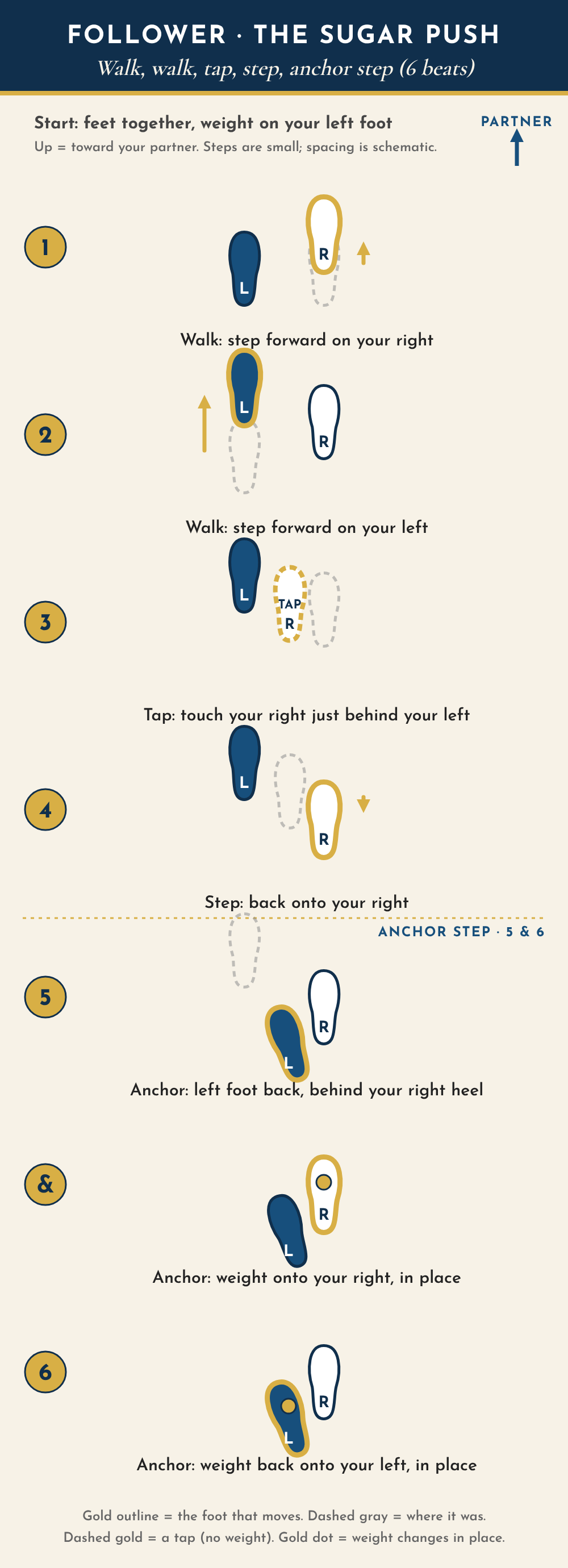
Start: feet together, facing your partner, weight on your left foot, so your right foot is free.
Counts 1-4: walk, walk, tap, step
- Count 1: walk forward on your right foot. (walk)
- Count 2: walk forward on your left foot. (walk)
- Count 3: tap your right foot just behind your left, with no weight on it, as you meet your partner’s hand. (tap)
- Count 4: step back onto your right foot. (step)
Counts 5 & 6: anchor step
- Count 5: step your left foot back, just behind your right heel, toes turned slightly out.
- Count &: shift your weight onto your right foot, in place.
- Count 6: shift your weight back onto your left foot, in place. You’ve traveled down the slot and back.
Your walks carry you toward your partner along the slot. You don’t need to be led backward by a push; your step on 4 and your anchor take you back.
Step 6: Put it together
Take a low one-hand hold. On 1 and 2, the follower walks toward the leader as the leader takes two small steps back. On 3 the follower arrives and both of you tap: your arms bend a little and you feel a soft, springy pressure through the hands, sometimes called compression. On 4 that spring sends the follower back, and on 5 & 6 you both anchor, settling back until the arms feel a gentle stretch.
Wikipedia’s overview describes this as “compression” with “firm but flexible arms.” Think of a spring, not a shove: nobody pushes and nobody pulls. Dance six or eight sugar pushes in a row until it feels easy.
Watch the count-along lesson (about 3 minutes)
This short video walks both parts step by step, then counts along with you at a slow practice tempo and again at social dance tempo. Press play and dance along; captions are available.
Read the video transcript
Let’s learn the West Coast Swing sugar push. West Coast Swing is a smooth partner dance done in a long, narrow lane called the slot, to blues, pop and R&B music. The sugar push is the first pattern most dancers learn.
The sugar push takes six beats: one, two, three, four, five and six. Think of it as walk, walk, tap, step, anchor step. Face your partner a few feet apart. The leader’s left hand holds the follower’s right hand, low and relaxed.
Leaders, start with your weight on your right foot. On one, take a small step back with your left. On two, a small step back with your right. On three, tap your left foot beside your right without putting weight on it. On four, step forward onto your left.
Then the anchor step on five and six. On five, step your right foot back, just behind your left heel. On and, shift onto your left foot in place. On six, back onto your right. Settle your weight back, as if you’re sitting into it.
Followers, start with your weight on your left foot. On one, walk forward with your right. On two, walk forward with your left. On three, tap your right foot just behind your left as you meet your partner’s hand. On four, step back onto your right.
Then your anchor step. On five, step your left foot back, just behind your right heel. On and, shift onto your right foot in place. On six, back onto your left. You’ve traveled down the slot and back again.
Now let’s practice with the count. You’ll hear a soft click on each walk, a bright tone on the tap, a lower tone on four, and three quick tones for the anchor step. Here we go, nice and slow.
[Practice tones at 84 beats per minute: after four count-in clicks, a soft click on each walk (1 and 2), a bright tone on the tap (3), a lower tone on the step (4), and three quick tones on the anchor step (5 & 6).]
Now at social dance tempo, about 100 beats per minute. Keep your steps small.
[Practice tones at 100 beats per minute.]
Two quick reminders. Keep your arm relaxed. Don’t push or pull, just meet your partner’s hand on three and four. And don’t rush the anchor step. Let it finish before the next pattern starts.
Want to dance it with an instructor? Ballroom by Amy teaches private lessons across the Twin Cities. Visit BallroomByAmy.com.
Instructor tip
Don’t rush the anchor. Let 5 & 6 finish completely, then start the next pattern.
Ballroom Pages lists rushing the anchor among the most common beginner mistakes.
Hear the counts: two practice tracks
These original practice tracks (no music, just tones) play the sugar push for you. After four count-in clicks, you’ll hear a soft click on each walk (1 and 2), a bright tone on the tap (3), a lower tone on the step (4), and three quick tones on the anchor step (5 & 6). Press play, stand up, and dance along. Neither track plays automatically.
Slow practice · 84 beats per minute
Social tempo · 100 beats per minute
What you’ll hear (text version)
Each track has no words or music. It opens with four clicks to count you in. Then each sugar push gets seven sounds: a click on 1 and on 2 (walk, walk), a bright tone on 3 (tap), a lower tone on 4 (step), and three quick tones on 5, & and 6 (anchor step). The slow track plays 8 sugar pushes in about 40 seconds and the social-tempo track 12 sugar pushes in about 48 seconds.
Beyond the sugar push: what comes next
The sugar push teaches the slot, the count and the anchor. The next patterns use the same six-beat timing and the same anchor, but the follower travels past the leader. These are best learned with a teacher, but here’s what to look forward to:
Left side pass
The leader steps out of the slot and the follower walks past on the leader’s left side, turning to face back at the other end.
Right side pass
Also called the underarm pass: the follower passes on the leader’s right side, usually turning under the joined hands.
The whip
An eight-count pattern where the couple rotates together before the follower is sent back down the slot. Wikipedia lists it among the basic patterns.
Common mistakes and quick fixes
Drifting out of the slot
Fix: followers, walk straight toward your partner and straight back, as if on a long rug. Leaders, stay near the middle.
Steps that are too big
Fix: keep every step small, especially the anchor. Big steps make the pattern late and pull partners off balance.
Rushing the anchor
Fix: finish all three weight changes on 5 & 6 before starting the next pattern. Ballroom Pages flags this one.
Pushing or pulling with the arms
Fix: keep your arm soft and bent. The tap on 3 is a gentle spring, not a shove, and the anchor is a light stretch.
Your five-minute practice
- Minute 1: anchor steps only. Step back, change, change, and settle. Count “5 & 6” out loud.
- Minutes 2-3: your part of the sugar push alone, no music. Say “walk, walk, tap, step, anchor step.”
- Minute 4: play the slow practice track and dance along with the tones.
- Minute 5: play the count-along video above and dance with it, ending each sugar push with a calm anchor.
If finding the beat is the hard part, read why some songs make the beat hard to find.
|
Print the one-page sugar push practice sheet |
Music, clothes and where you’ll dance it
The steps are only half the picture. Here’s what to play, what to wear, and where West Coast Swing will actually come in handy.
What music works for West Coast Swing?
West Coast Swing grew up on the blues; the Finches call blues “the basic music for West Coast Swing.” Today it’s danced to almost anything with a steady beat in 4/4 time: blues, R&B, pop, contemporary, country and funk, according to Ballroom Pages. For tempo, West Coast Swing Online says most social music now falls between about 90 and 120 beats per minute and suggests newer dancers look for songs around 95 to 105. Ballroom Pages reports a social average of about 90 to 110.
Songs to try
- Call Me Maybe, Carly Rae Jepsen
- Payphone, Maroon 5 featuring Wiz Khalifa
- At Least I’m Not With You, The Insomniacs
- I Got the Blues, Brother Yusef
From a Dance Teacher magazine profile of instructor Tybaldt Ulrich, who uses these songs in his West Coast Swing classes. Tempos vary by recording, so test yours: count along and walk to it. If you can fit a calm anchor step on 5 & 6 without rushing, it will work. The practice tracks above are a good warm-up first.
What should you wear?
For lessons and practice
Clothes you can walk and bend your knees in. Shoes with smooth soles that let you glide a little and swivel, like suede or leather; dance sneakers are fine to start.
For socials and events
Dress for the venue, then check you can walk, anchor and turn comfortably. Swing socials are often more relaxed than a ballroom gala.
For competitions
West Coast Swing events, including Jack and Jill contests, set their own dress and shoe rules by event and level. Read them before you buy anything.
Skip flip-flops, rubber soles that grab the floor, and loose or chunky heels. Leave scarves and long jewelry at home for lessons (Supadance’s guide to dressing for dance has more). You don’t need special shoes to start; ask Amy before you buy.
Where will you dance West Coast Swing?
- Swing socials and dance weekends. Ballroom Pages lists swing socials, workshops and weekend events as West Coast Swing’s home, along with Jack and Jill contests where partners are drawn at random.
- Country and western nights. West Coast Swing often shows up at country dance events, and it fits plenty of modern country songs.
- Weddings and parties. Some receptions play exactly the mid-tempo pop and R&B that West Coast Swing loves. See wedding dance lessons.
- Studios and mixed social dances. Find Twin Cities nights on Where to Go Dancing in the Twin Cities.
On a busy floor, keep your slot short and line it up with the couples around you, so nobody walks into anybody. And thank your partner after the song.
A little history
Where did West Coast Swing come from?
West Coast Swing is a California dance. The California State Capitol Museum traces it to the Lindy Hop of the 1930s and the later Jitterbug, and notes that its straight lines suited Hollywood filming better than circular swing. Teachers in the 1950s called the slotted style “Western Swing.” Skippy Blair wrote that around 1960 a newspaper editor objected to the cowboy sound of “Western,” so the next ad said “West Coast Swing” instead (WSDC history article). In 1988 California named West Coast Swing its official State Dance.
Next steps
Learn
How to dance East Coast Swing: the triple-step basic
Learn
How to dance single-time swing
Watch
Free video lessons and step-by-step guides
|
Learn with Amy Ready to dance West Coast Swing with an instructor? Ballroom by Amy offers private lessons for dancers across the Twin Cities, whether you want to feel at home at a swing social, a country dance night or a wedding reception. Beginners are welcome, and no partner is needed. See private lessons Or call or text 612-308-7708. Amy typically replies within one business day. |
About Amy
Amy Hanson is the three-time defending Dancer’s Cup Tour Top Teacher. She has danced professionally and internationally and built friendships with dancers many people recognize from Dancing with the Stars. People who believe they’re not coordinated, confident, or good enough are exactly the beginners Amy loves to teach, and she also helps experienced dancers keep improving. No experience or partner is required.
Sources & Further Reading
- Ballroom Pages: West Coast Swing Dance Style Guide. Sugar push and side passes counted 1 2, 3&4, 5&6; the slot; the anchor’s purpose; tempo ranges; music styles; where it’s danced; common mistakes.
- Roundalab Phase IV Standards: West Coast Swing (PDF). Sugar push footwork for man and woman (back L, back R, tap, forward L; anchor) and the anchor step; left side pass.
- Dan and Sandi Finch: A Few Notes on West Coast Swing. “Walk, walk, touch, step, triple step”; the leader’s two steps back; smooth, no bounce; blues roots; 26–32 measures a minute.
- World Swing Dance Council: Anchors in West Coast Swing (Skippy Blair, PDF). “An anchor is a body action”; settling behind the forward heel.
- World Swing Dance Council: The Evolution of West Coast Swing (Skippy Blair, PDF). “Western Swing” and the c. 1960 name change.
- California State Capitol Museum: Dance – West Coast Swing. Lindy Hop and Jitterbug roots; straight lines for film; State Dance since 1988.
- Wikipedia: West Coast Swing. Slot length; six- and eight-count basics; compression with firm but flexible arms; the whip.
- West Coast Swing Online: West Coast Swing Music. Social tempos of about 90–120 BPM; 95–105 for newer dancers.
- Dance Teacher: Music for Class, Tybaldt Ulrich. Songs used in West Coast Swing classes.
- Supadance: How to Dress for Ballroom Dancing. Lesson clothes and shoes to avoid.
AI-Assisted Content Disclaimer
This educational guide was created with assistance from artificial intelligence (AI), including portions of the written content and visual materials. While we strive to provide accurate and helpful ballroom dance information, AI-generated content and illustrations may contain errors or inaccuracies, including in dance positions, footwork, timing, and technique.
Please independently verify important information and use your own judgment when practicing. Images are intended to support learning and may not always represent technically precise movements. For personalized guidance and instruction, consider learning directly with a qualified ballroom dance instructor.
Some images are AI-generated illustrations and do not show real people. The narration in the count-along lesson is an AI-generated voice. The footwork diagrams and practice tones were created for this guide.