Ballroom How-To · Jive · Beginner
Fast, bright and full of bounce. Start with the jive basic: rock step, two chassés.
Illustration (AI-generated): the bandstand at an evening dance.
Quick Answer
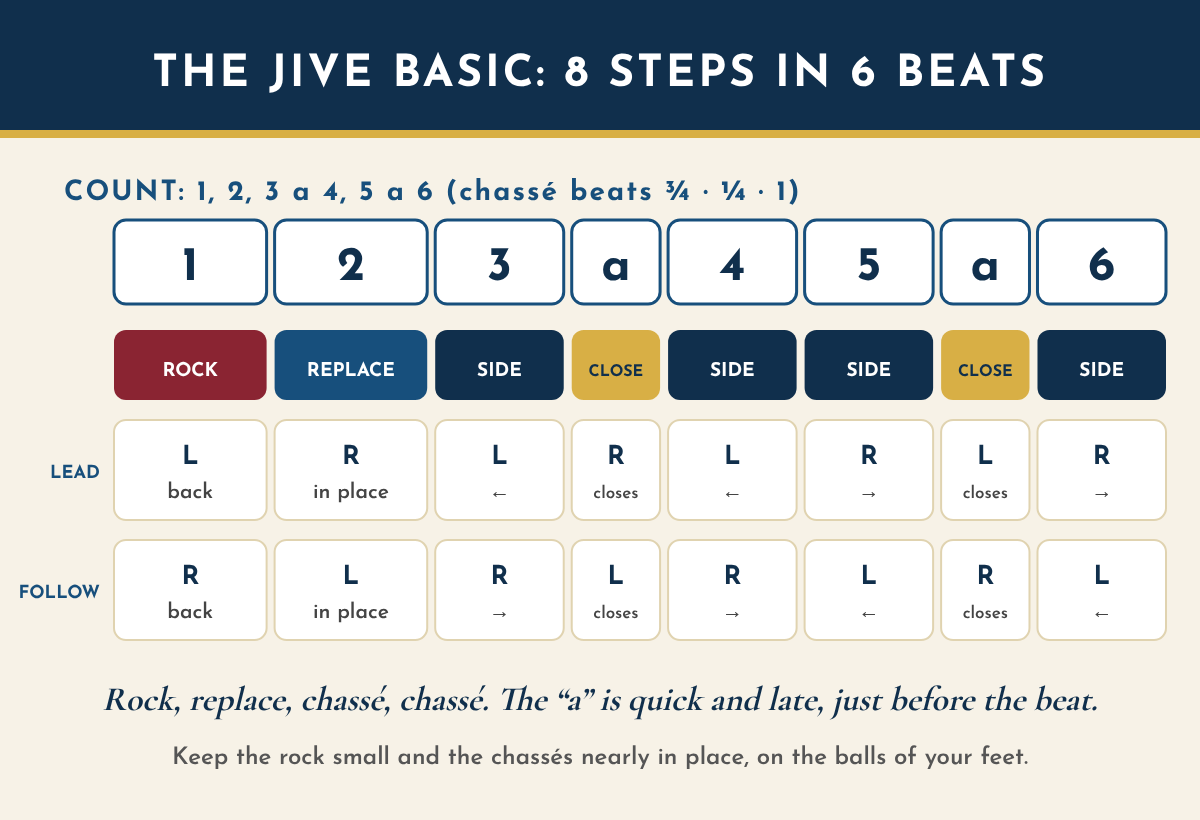
Start jive with the basic in place: eight steps in six beats, counted “1, 2, 3 a 4, 5 a 6.” Leaders take a small rock step back on the left (1), replace onto the right (2), then dance two chassés nearly in place: side left, close, side left (3 a 4) and side right, close, side right (5 a 6). Followers dance the mirror image. Stay on the balls of your feet, keep the rock small and the “a” quick and late.
Jive is the fastest of the five International Latin competition dances, and it grew from American swing. It’s bright, springy and playful, with a lively bounce in the knees and lots of kicks once you get going. At its heart is one simple pattern: the basic in place.
This guide teaches that basic for both leader and follower. You’ll get footwork diagrams, a count-along video, two practice tracks and a five-minute drill. No partner or experience needed to start.
In this lesson
What you’ll learn
Skill
The jive basic in place, both parts
Style
International Latin
Level
Beginner
Partner?
Optional. Practice it solo
Step 1: Learn the jive count
The jive basic fits eight steps into six beats: a rock step on 1 and 2, then two chassés (triple steps) on “3 a 4” and “5 a 6.” You may also hear the second chassé counted “3 a 4” again: same steps, same timing.
What makes it jive is the timing of the chassé. The 3 takes about three quarters of a beat, the “a” a quick quarter beat, and the 4 a full beat. The round-dance jive figure guide and Dance Central both give it that shape, and Dance Central lists counting it evenly as a common mistake.
If you already know East Coast Swing
The pattern will feel familiar: a rock step and two triple steps. The difference is the feel. East Coast Swing splits its triple evenly, while jive’s “a” comes late, and jive is danced more on the balls of the feet, with more knee action and chassés that stay almost in place (Round Dancing: Swing and Jive).
Step 2: Find your stance and hold
Stand with your feet close together and your weight over the balls of your feet, heels just off the floor or barely touching it. Keep your knees soft. One round-dance teacher sums it up: weight mostly on the balls of your feet, heels very close to the floor.
With a partner, face each other with a little space between you, in either a relaxed closed hold or a simple one-hand hold (the leader’s left hand holding the follower’s right). Amy can show you which she likes for beginners. Practicing alone? Hands on your hips work fine.
Step 3: The leader’s basic, step by step
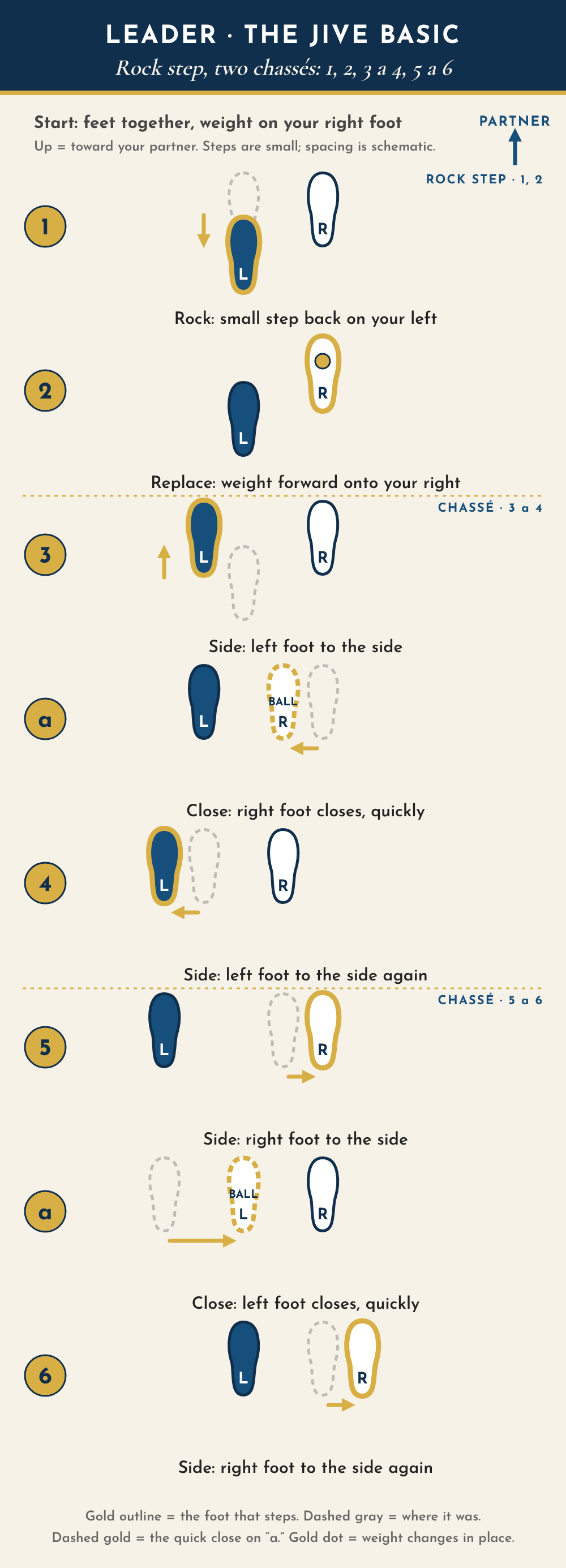
Start: feet together, facing your partner, weight on your right foot, so your left foot is free.
Counts 1, 2: rock step
- Count 1: take a small rock step back with your left foot, on the ball of the foot, keeping your weight forward. (rock)
- Count 2: replace your weight forward onto your right foot. (replace)
Counts 3 a 4, 5 a 6: two chassés
- Count 3: small step to the side with your left foot. (side)
- Count a: close your right foot toward your left, quickly. (close)
- Count 4: small step to the side with your left again. (side)
- Count 5: small step to the side with your right foot. (side)
- Count a: close your left foot toward your right, quickly. (close)
- Count 6: small step to the side with your right again. Then you’re ready to rock again.
Keep the rock tiny. Dance Central describes the back foot as barely touching the floor, with your weight staying forward. The chassés stay nearly under your body.
Step 4: The follower’s basic, step by step
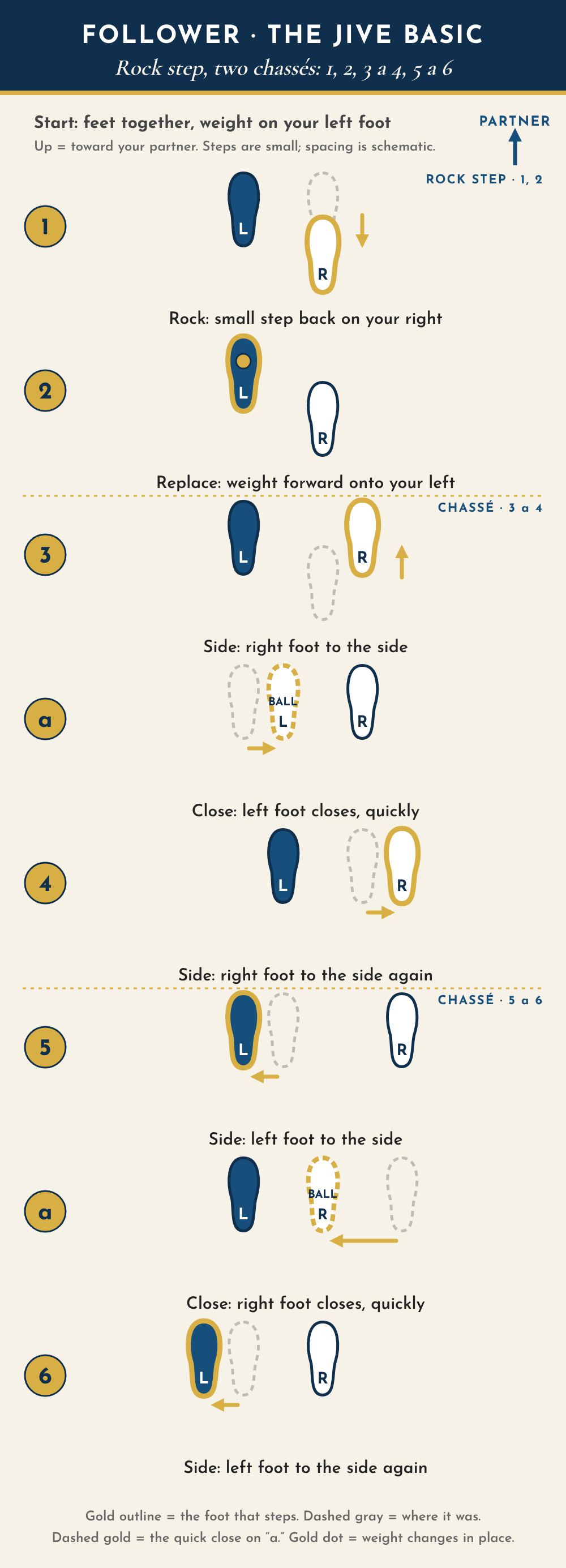
Start: feet together, facing your partner, weight on your left foot, so your right foot is free.
Counts 1, 2: rock step
- Count 1: take a small rock step back with your right foot, on the ball of the foot, keeping your weight forward. (rock)
- Count 2: replace your weight forward onto your left foot. (replace)
Counts 3 a 4, 5 a 6: two chassés
- Count 3: small step to the side with your right foot. (side)
- Count a: close your left foot toward your right, quickly. (close)
- Count 4: small step to the side with your right again. (side)
- Count 5: small step to the side with your left foot. (side)
- Count a: close your right foot toward your left, quickly. (close)
- Count 6: small step to the side with your left again. One full basic, done.
You both rock back at the same time, away from each other, then come back together for the chassés. Your chassés travel the same way in the room as your partner’s.
Step 5: Add the jive feel
Once the footwork is steady, add the springy quality that makes jive look like jive. Keep it small at first.
- Bounce in the knees, not a jump. Jive has more knee action than swing, and one round-dance teacher calls it an “in the floor” dance: keep your feet low.
- Stay on the balls of your feet. Dan and Sandi Finch describe jive chassé footwork as ball, ball, ball flat.
- Kicks come later. LiveAbout’s jive guide notes the dance is full of kicks and flicks; those come once the basic is automatic.
How much bounce, and exactly where it goes in the count, is something teachers shape in person. Start gentle and let Amy fine-tune it.
Step 6: Put it together
Take your hold. On 1, both partners rock back, a small step away from each other. On 2, come back. Then chassé together: on 3 a 4 the leader goes to his left as the follower goes to her right, so you travel the same way in the room, and on 5 a 6 you come back. Dance six or eight basics in a row, slowly at first.
The basic in place is the first figure on beginner jive syllabi, such as the MIT Ballroom Dance Club list, and most other jive figures are built from the same rock step and chassés.
Watch the count-along lesson (under 3 minutes)
This short video walks both parts step by step, then counts along with you at a slow practice tempo and again at a faster tempo. Press play and dance along; captions are available.
Read the video transcript
Let’s learn the jive basic. Jive is the fastest and most energetic of the Latin dances, with roots in American swing. It’s bright and bouncy, and danced on the balls of your feet.
The jive basic takes six beats: a rock step, then two chassés, counted one, two, three a four, five a six. The a is quick, and it comes late, just before the beat. Face your partner. Leaders, start with your weight on your right foot. Followers, on your left.
Leaders, on one, take a small rock step back with your left foot, keeping your weight forward. On two, replace your weight onto your right.
Now two chassés, almost in place. On three, step to the side with your left. On a, close your right foot. On four, side left again. Then on five, side right. On a, close your left. And on six, side right again.
Followers, you dance the mirror image. On one, a small rock step back with your right foot. On two, replace onto your left. On three, side right. On a, close your left. On four, side right again.
Then on five, side left. On a, close your right. And on six, side left again. Keep your knees soft and your steps small, right under your body.
Now let’s practice with the count. You’ll hear a low tone on the rock step, a click on the replace, and bright tones for each chassé. Here we go, nice and slow.
[Practice tones at 100 beats per minute: after four count-in clicks, a low tone on each rock step (1), a click on the replace (2), and for each chassé a bright tone on the side steps with a soft, quick tone on the late “a.”]
Now a little faster, at 152 beats per minute. Competitions go even faster, so stay light on the balls of your feet.
[Practice tones at 152 beats per minute.]
Two quick reminders. Keep the rock step small, so you barely step back. And keep the chassés tight and in place, with a bounce in your knees, not a jump.
Want to dance it with an instructor? Ballroom by Amy teaches private lessons across the Twin Cities. Visit BallroomByAmy.com.
Instructor tip
Small steps make fast music easy. If you’re falling behind, make the chassés smaller, not faster.
Several teaching sources stress tidy chassés that stay mostly in place.
Hear the counts: two practice tracks
These original practice tracks (no music, just tones) play the jive basic for you. After four count-in clicks, you’ll hear a low tone on each rock step (1), a click on the replace (2), and for each chassé a bright tone on the side steps with a soft, quick tone on the late “a.” Press play, stand up, and dance along. Neither track plays automatically.
Slow practice · 100 beats per minute
Faster practice · 152 beats per minute
What you’ll hear (text version)
Each track has no words or music. It opens with four clicks to count you in. Then each basic gets eight sounds: a low tone on 1 (rock), a click on 2 (replace), then bright, soft, bright for 3 a 4 and again for 5 a 6. The slow track plays 10 basics in about 41 seconds and the faster track 16 basics in about 41 seconds. 152 beats per minute is the low end of the learning range Ballroom Pages suggests; competitions run faster.
Beyond the basic: what comes next
Beginner jive syllabi build on the basic in place with figures like these, best learned with a teacher:
Fallaway rock
The same footwork and timing, but the rock step opens into a side-by-side (fallaway) position.
Change of places
The follower turns under the leader’s arm and the partners trade sides, right to left and back again.
American spin
A spin for the follower, also on beginner (bronze) lists like Oxford’s.
Common mistakes and quick fixes
Counting the chassé evenly
Fix: say “threeee-a-four”: the “a” is short and late. Even triples turn jive into swing.
A big rock step
Fix: keep it tiny with your weight forward. You should barely step back.
Traveling chassés
Fix: keep each chassé small and nearly in place. Big steps make you late at jive tempos.
Jumping
Fix: keep your feet low and let the bounce live in your knees and ankles.
Your five-minute practice
- Minute 1: clap “1, 2, 3 a 4, 5 a 6” with the slow practice track, making the “a” late.
- Minutes 2-3: chassés only, side to side, on the balls of your feet. Then add the rock step in front.
- Minute 4: the whole basic with the slow track, then try the faster one.
- Minute 5: play the count-along video above and dance with it.
If finding the beat is the hard part, read why some songs make the beat hard to find.
|
Print the one-page jive basic practice sheet |
Music, clothes and where you’ll dance it
The steps are only half the picture. Here’s what to play, what to wear, and where jive will come in handy.
What music works for jive?
Jive is danced in 4/4 time to fast, bright music: 1950s rock and roll, swing, boogie-woogie and plenty of upbeat modern pop. It’s quick. The World DanceSport Federation’s rules set 42 to 44 bars a minute, about 168 to 176 beats, and Ballroom Pages’ tempo chart lists 43 bars (172 beats) for NDCA events, with about 152 to 168 beats a minute as a comfortable range for learning.
Songs to try
- Jump Jive an’ Wail, The Brian Setzer Orchestra
- Rock Around the Clock, Bill Haley & His Comets
- Dance With Me Tonight, Olly Murs
- Hound Dog, Elvis Presley
- Happy, Pharrell Williams
From the jive lists of the Staten Island Ballroom Dancers and RPI Ballroom. Tempos vary by recording, so test yours: count “1, 2, 3 a 4, 5 a 6” along with it. If you can keep the chassés small without rushing, it will work. The practice tracks above are a good warm-up first.
What should you wear?
For lessons and practice
Clothes you can bend your knees and kick in. Shoes with smooth suede or leather soles; dance sneakers are fine to start.
For socials and events
Dress for the event, then check you can bounce and turn freely. A skirt with some swing shows off jive well.
For competitions
Rules vary by event. Some collegiate competitions, like Rutgers’, don’t allow costumes at newcomer level but do from bronze up. Read the rules first.
Skip flip-flops, rubber soles that grab the floor, and loose or chunky heels. Lower heels are steadier while you learn (Capezio’s heel guide), and many competitions require heel protectors on high heels (Rutgers competition rules). You don’t need special shoes to start; ask Amy before you buy.
Where will you dance jive?
- Competitions and showcases. Jive is one of the five International Latin dances. It isn’t part of American Rhythm, which uses East Coast Swing instead (DanceVision). Curious about competing with your teacher? See Pro-Am and competitive dancing.
- Ballroom socials and parties. When a fast rock and roll or swing song comes on, your jive basic fits right in. Find Twin Cities nights on Where to Go Dancing in the Twin Cities.
On a busy floor, keep the basic compact and in place; it barely needs any room. And thank your partner after the song.
A little history
Where did jive come from?
Jive grew out of African-American swing dancing of the 1930s and ’40s, the same family as the Lindy hop and the jitterbug. Britannica notes that American servicemen spread the jitterbug around the world during World War II. In England, where some ballrooms tried to keep it out, teachers tamed the acrobatics into a ballroom version (Oxford University DanceSport). Jive is usually dated as joining the International Latin competition dances in 1968 (Dan and Sandi Finch), though sources differ on the exact milestones.
Next steps
Learn
How to dance East Coast Swing
Learn
How to dance samba
Watch
Free video lessons and step-by-step guides
|
Learn with Amy Ready to dance jive with an instructor? Ballroom by Amy offers private lessons for dancers across the Twin Cities, whether you want to have fun on a fast song at a party or start working toward a Latin competition. Beginners are welcome, and no partner is needed. See private lessons Or call or text 612-308-7708. Amy typically replies within one business day. |
About Amy
Amy Hanson is the three-time defending Dancer’s Cup Tour Top Teacher. She has danced professionally and internationally and built friendships with dancers many people recognize from Dancing with the Stars. People who believe they’re not coordinated, confident, or good enough are exactly the beginners Amy loves to teach, and she also helps experienced dancers keep improving. No experience or partner is required.
Sources & Further Reading
- Round Dancing: Jive Figures. Basic rock and fallaway rock footwork; jive triple timing of 3/4, 1/4 and 1 beat.
- Roundalab Phase VI Standards: Jive (PDF). Eight steps in six beats; rock on the ball of the foot with forward poise; soft knees.
- Dance Central: Jive Technique. Beat values; small rock with weight forward; compact chassés; common mistakes.
- Round Dancing: Swing and Jive, Different?. How jive’s late “a,” knee action and in-place chassés differ from swing.
- Dan and Sandi Finch: Chassé. Jive chassé footwork: ball, ball, ball flat.
- Round Dancing: Some Dance Tips for Jive. Weight on the balls of the feet; an “in the floor” dance.
- DanceVision: How to Dance Jive. Leader’s basic: rock back left, replace, chassés left and right.
- Staten Island Ballroom Dancers: Jive Basics. Basic counted 1, 2, 3 and 4, 5 and 6; follower mirrors.
- MIT Ballroom Dance Club: Syllabus. Basic in place and fallaway rock as the first jive figures.
- LiveAbout: Jive Dance Basics. Kicks, flicks and knee action; African-American origins.
- World DanceSport Federation: Competition Rules (2012, PDF). Jive tempo of 42–44 bars a minute.
- Ballroom Pages: Ballroom Music Tempo Chart. NDCA 43 bars (172 BPM); learning range.
- Staten Island Ballroom Dancers: Jive Songs. Practice songs.
- RPI Ballroom: Music. Practice songs.
- Britannica: Jitterbug. Spread worldwide by American servicemen in World War II.
- Dan and Sandi Finch: All American. Jive standardized in England; added to International Latin in 1968.
- Oxford University DanceSport: Jive. Jive figures by level; how English teachers developed the ballroom form.
- DanceVision: American Rhythm Explained. American Rhythm dances (no jive).
- Rutgers Ballroom: Competition Rules. Costume rules by level; heel protectors.
- Capezio: Ballroom Shoe Heel Height Guide. Lower heels for stability.
AI-Assisted Content Disclaimer
This educational guide was created with assistance from artificial intelligence (AI), including portions of the written content and visual materials. While we strive to provide accurate and helpful ballroom dance information, AI-generated content and illustrations may contain errors or inaccuracies, including in dance positions, footwork, timing, and technique.
Please independently verify important information and use your own judgment when practicing. Images are intended to support learning and may not always represent technically precise movements. For personalized guidance and instruction, consider learning directly with a qualified ballroom dance instructor.
Some images are AI-generated illustrations and do not show real people. The narration in the count-along lesson is an AI-generated voice. The footwork diagrams and practice tones were created for this guide.