Ballroom How-To · Quickstep · Beginner
Light, bright and fast. Start with the quarter turns: slow, quick-quick, slow.
Illustration (AI-generated): dancers walking out onto a sunlit ballroom floor.
Quick Answer
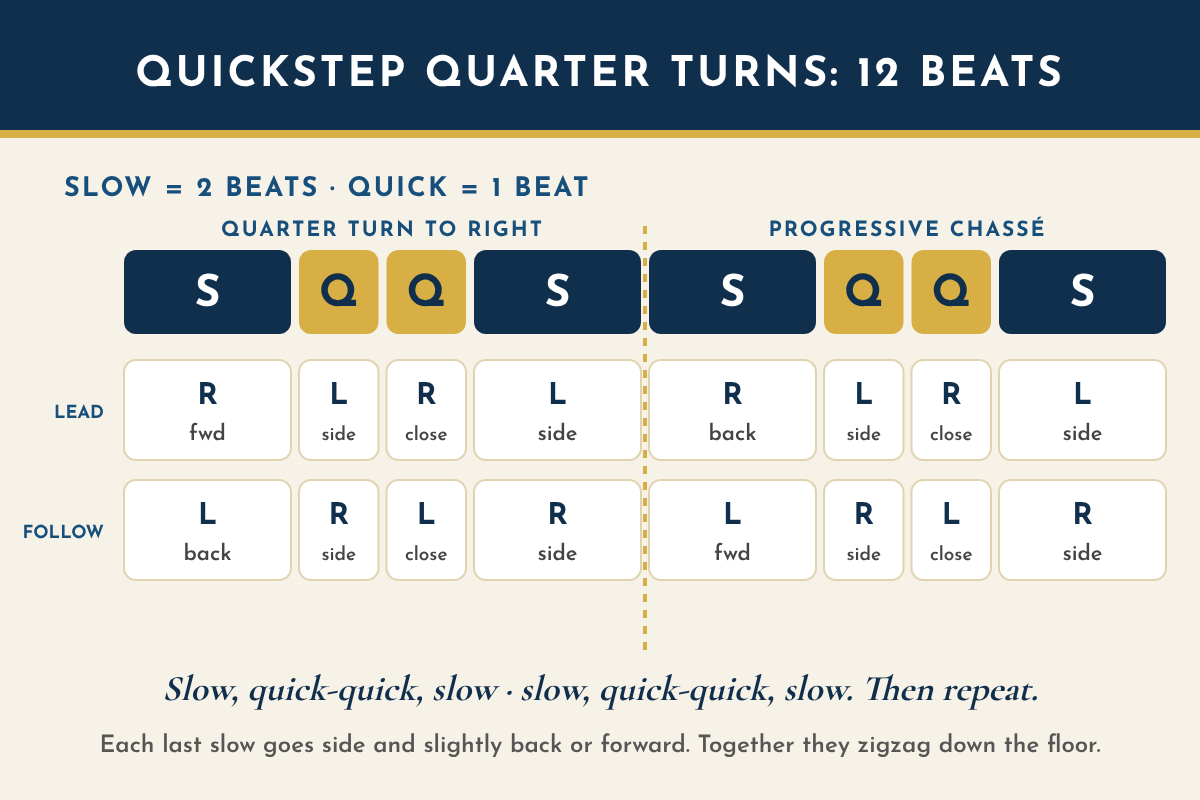
Start quickstep with the quarter turns: a quarter turn to the right, then a progressive chassé, each counted “slow, quick, quick, slow” (a slow is two beats, a quick is one). In a closed hold, facing diagonally toward the wall, leaders step forward on the right, side left, close right, then side left and slightly back; then back on the right, side left, close right, side left and slightly forward. Followers dance the opposite. The pattern zigzags down the floor; keep it light and on the balls of your feet.
Quickstep is the fast, happy member of the ballroom family. It grew out of the foxtrot in 1920s England, when bands played so fast that dancers needed something lighter, and today it’s one of the five International Standard dances. Watch it on a competition floor and it looks like flying.
You don’t start by flying, though. You start with the quarter turns, the classic first figures in beginner quickstep. This guide teaches both parts with footprint charts, a count-along video, two practice tracks and a five-minute drill. No partner or experience needed to start.
In this lesson
What you’ll learn
Skill
The quarter turns, both parts
Style
International Standard
Level
Beginner
Partner?
Optional. Practice it solo
Step 1: Learn slows and quicks
Quickstep is counted in slows and quicks. In its 4/4 music, a slow takes two beats and a quick takes one (Ballroom Pages). Both quarter-turn figures use the same rhythm, slow, quick, quick, slow: six beats each, twelve for the pair.
The two quicks in the middle are a chassé: side, close. The last slow finishes the chassé with one more side step. The round-dance quickstep figure guide gives both figures the same slow, quick, quick, slow timing.
If you already know the foxtrot
Quickstep and foxtrot are cousins: both use slows and quicks and travel around the room. The differences are speed and the chassé. Quickstep is much faster, and leaders close their feet in the chassés, which the modern foxtrot doesn’t do (Wikipedia: Quickstep). Our foxtrot guide is a gentle place to warm up.
Step 2: Find your hold and your direction
Hold. Quickstep uses the International closed hold the whole time. DanceVision describes it: the leader’s left arm extended, the follower’s right hand resting in it, the leader’s right hand on the follower’s left shoulder blade, and the follower’s left hand on the leader’s shoulder. Keep it toned and still.
Direction. Couples travel counterclockwise around the room, a direction called the line of dance. Leaders, face the line of dance with the outside wall on your right, then turn about an eighth to the right, so you face diagonally toward the wall. Followers face the leader, backing diagonally toward the wall.
Weight. Leaders start with weight on the left foot, followers on the right. Many teachers add a preparation step before the first quarter turn; Amy can show you how she likes to start. Practicing alone? Hold your arms in a light frame and imagine your partner.
Step 3: The leader’s quarter turns, step by step
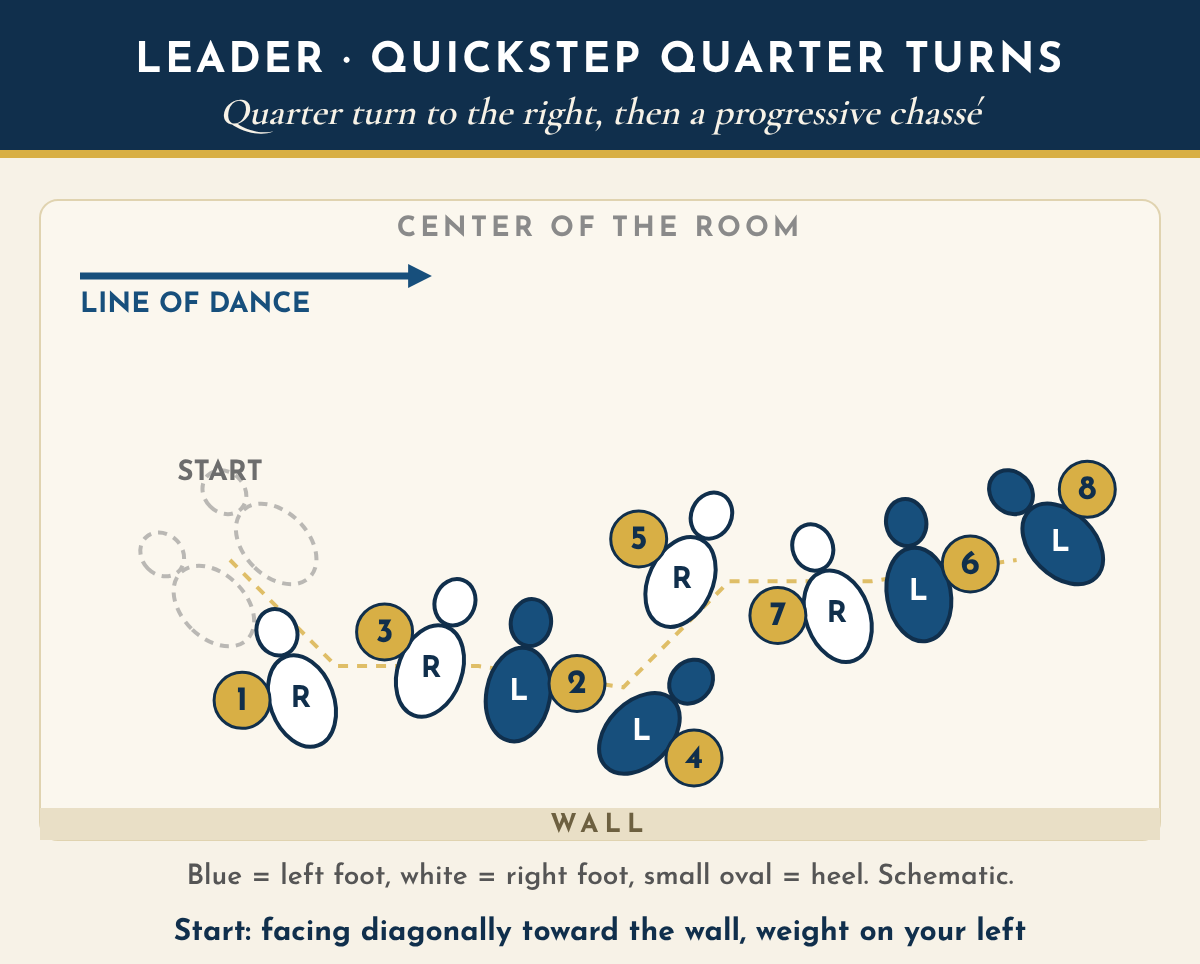
Start: closed hold, facing diagonally toward the wall, weight on your left foot.
Quarter turn to the right
- 1, slow: step forward on your right foot, starting to turn right.
- 2, quick: left foot to the side.
- 3, quick: close your right foot to your left.
- 4, slow: left foot to the side and slightly back. You’ve turned about a quarter to the right and now back diagonally toward the center of the room.
Progressive chassé
- 5, slow: step back on your right foot, turning left.
- 6, quick: left foot to the side.
- 7, quick: close your right foot to your left.
- 8, slow: left foot to the side and slightly forward. You face the wall diagonal again, ready to repeat.
Each figure turns about a quarter, first right and then left, so the pair zigzags down the floor. The Round Dancing figure notes notes the progressive chassé is normally danced after the first four steps of the quarter turns.
Step 4: The follower’s quarter turns, step by step
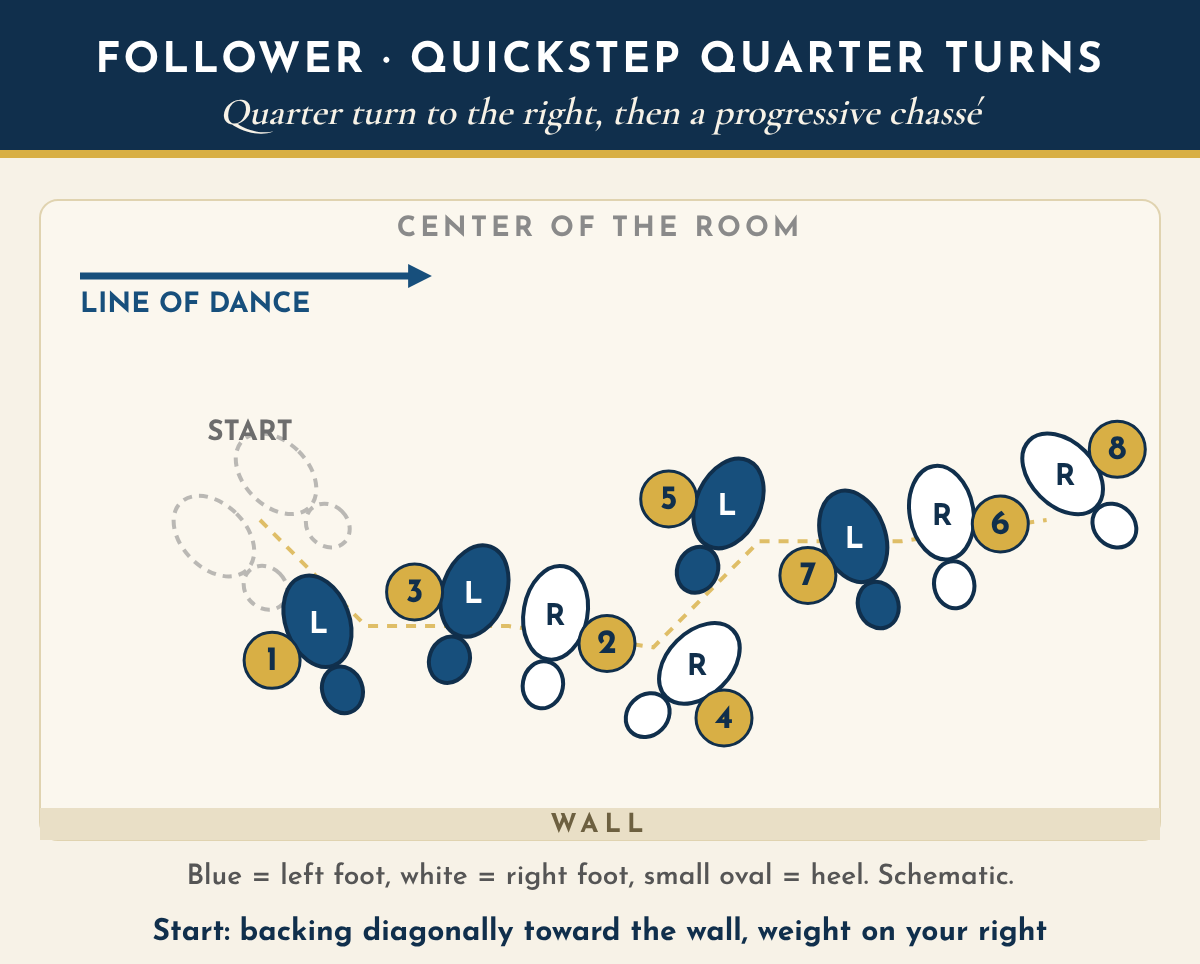
Start: closed hold, backing diagonally toward the wall, weight on your right foot.
Quarter turn to the right
- 1, slow: step back on your left foot, starting to turn right.
- 2, quick: right foot to the side.
- 3, quick: close your left foot to your right.
- 4, slow: right foot to the side and slightly forward.
Progressive chassé
- 5, slow: step forward on your left foot, turning left.
- 6, quick: right foot to the side.
- 7, quick: close your left foot to your right.
- 8, slow: right foot to the side and slightly back. One full set, done.
Your part is the natural opposite of your partner’s: when the leader goes forward, you go back. Both chassés travel down the line of dance, to your right and to your partner’s left.
Step 5: Add the quickstep feel
Once the footwork is steady, add the light quality that makes quickstep sparkle. Keep it gentle at first.
- Stay off your heels on the quicks. “Don’t dance flat-footed,” advise Sandi and Dan Finch; use your knees and ankles like shock absorbers.
- Less rise than waltz. The same article notes quickstep figures have less rise and fall than their waltz counterparts. Think light, not tall.
- A steady frame. Round Dancing’s quickstep introduction stresses keeping a strong frame, especially in turning figures, while the feet do the work.
Exactly how much rise to use, and where, is something teachers shape in person. Start soft and let Amy fine-tune it.
Step 6: Put it together
Take your hold and your starting direction. Dance the quarter turn to the right, then the progressive chassé, then start again with the quarter turn. Four sets in a row will take you a good way along one wall. Slowly at first: hold each slow for its full two beats.
Ballroom teaching has long started here. In their notes on quickstep, Sandi and Dan Finch write that the ballroom author and teacher Alex Moore recommended walks and chassés first, then quarter turns, then the progressive chassé. Ballroom Pages lists the quarter turn to right and progressive chassé among the common first concepts.
Watch the count-along lesson (under 3 minutes)
This short video walks both parts step by step, then counts along with you at a slow practice tempo and again at a faster tempo. Press play and dance along; captions are available.
Read the video transcript
Let’s learn the quickstep. It’s light, bright and fast, and it travels around the floor like the foxtrot’s happier cousin. You’ll start with the quarter turns: a quarter turn to the right, then a progressive chassé.
Quickstep uses slows and quicks. A slow takes two beats, and a quick takes one. Each figure is slow, quick, quick, slow. Take a closed hold and face diagonally toward the outside wall. Leaders, start with your weight on your left foot. Followers, on your right.
Leaders, here’s the quarter turn to the right. Slow, step forward on your right foot, starting to turn right. Quick, left foot to the side. Quick, close your right foot. And slow, left foot to the side and slightly back. You’ve turned about a quarter to the right.
Now the progressive chassé. Slow, step back on your right foot, turning left. Quick, left foot to the side. Quick, close your right. And slow, left foot to the side and slightly forward. You’re facing the wall diagonal again, ready to repeat.
Followers, you dance the opposite. In the quarter turn: slow, step back on your left foot. Quick, right foot to the side. Quick, close your left. And slow, right foot to the side and slightly forward.
In the progressive chassé: slow, step forward on your left foot. Quick, right foot to the side. Quick, close your left. And slow, right foot to the side and slightly back. Together, the two figures zigzag down the floor.
Now let’s practice with the count. You’ll hear a long, low tone on each slow and a short, bright tone on each quick. Here we go, nice and slow.
[Practice tones at 120 beats per minute: after four count-in clicks, a long, low tone on each slow and a short, bright tone on each quick, through two sets of quarter turns.]
Now a little faster, at 160 beats per minute. Full quickstep tempo is about 200, so stay light and keep your steps small.
[Practice tones at 160 beats per minute, three sets of quarter turns.]
Two quick reminders. Keep your frame steady, so your upper body stays calm while your feet move. And don’t dance flat-footed. Stay light on the balls of your feet through the quicks.
Want to dance it with an instructor? Ballroom by Amy teaches private lessons across the Twin Cities. Visit BallroomByAmy.com.
Instructor tip
Fast music doesn’t mean big steps. Keep them small and let the slows breathe; the speed takes care of itself.
Teaching sources agree: learn below full tempo first.
Hear the counts: two practice tracks
These original practice tracks (no music, just tones) play the quarter turns for you. After four count-in clicks, you’ll hear a long, low tone on each slow and a short, bright tone on each quick. Press play, stand up, and dance along. Neither track plays automatically.
Slow practice · 120 beats per minute
Faster practice · 160 beats per minute
What you’ll hear (text version)
Each track has no words or music. It opens with four clicks to count you in. Then each set of quarter turns gets eight sounds over twelve beats: long, short, short, long for the quarter turn, and long, short, short, long again for the progressive chassé. The slow track plays 6 sets in about 40 seconds and the faster track 9 sets in about 44 seconds. Both are well below full quickstep tempo, about 200 beats per minute, on purpose.
Beyond the quarter turns: what comes next
Beginner quickstep builds on the quarter turns with figures like these, best learned with a teacher:
Forward lock
A traveling figure where one foot crosses behind the other, often danced right after the progressive chassé.
Natural turn
A turning figure to the right that lets you get around the corners of the room.
Tipple chassé and more
Turning chassés, spins and runs come later; the quarter turns prepare you for all of them.
Common mistakes and quick fixes
Rushing the slows
Fix: say “slo-ow” out loud and hold it for two full beats. The quicks only feel quick if the slows are slow.
Turning too much
Fix: turn about a quarter each way. Overturn and you stop traveling down the line of dance.
Dancing flat-footed
Fix: stay light on the balls of your feet through the quicks, with soft knees and ankles.
Big steps at speed
Fix: keep every step small and practice below full tempo until the pattern is automatic.
Your five-minute practice
- Minute 1: clap “slow, quick-quick, slow” with the slow practice track, holding each slow for two beats.
- Minutes 2-3: chassés only (side, close, side) along the room, on the balls of your feet. Then add the slow step in front.
- Minute 4: both figures in a row with the slow track, then try the faster one.
- Minute 5: play the count-along video above and dance with it.
If finding the beat is the hard part, read why some songs make the beat hard to find.
|
Print the one-page quickstep practice sheet |
Music, clothes and where you’ll dance it
The steps are only half the picture. Here’s what to play, what to wear, and where quickstep will come in handy.
What music works for quickstep?
Quickstep is danced in 4/4 time to bright, upbeat music: swing, big band, jazz and show tunes (Ballroom Pages). It’s fast. The World DanceSport Federation’s rules set 50 to 52 bars a minute, about 200 to 208 beats, and Ballroom Pages’ quickstep music guide lists 50 bars (200 beats) for NDCA events. Full tempo is advanced, so learners practice slower.
Songs to try
- Mr. Pinstripe Suit, Big Bad Voodoo Daddy
- I’m Sitting on Top of the World, Bobby Darin
- Friend Like Me, from Disney’s Aladdin
- Suddenly I See, KT Tunstall
- I Get a Kick Out of You, Rosemary Clooney
From the quickstep lists of RPI Ballroom and Ballroom Pages. Tempos vary by recording, so test yours: count “slow, quick-quick, slow” along with it. If the slows still feel like two calm beats, it will work. The practice tracks above are a good warm-up first.
What should you wear?
For lessons and practice
Clothes you can move and travel in, with nothing tight at the knees. Shoes with smooth suede or leather soles help you glide.
For socials and events
Dress for the event, then check you can take long, easy steps. A skirt with some movement shows off the turns.
For competitions
Rules vary by event. Some collegiate competitions, like Rutgers’, don’t allow costumes at newcomer level but do from bronze up. Read the rules first.
Skip flip-flops, rubber soles that grab the floor, and loose or chunky heels. Lower heels are steadier while you learn (Capezio’s heel guide), and many competitions require heel protectors on high heels (Rutgers competition rules). You don’t need special shoes to start; ask Amy before you buy.
Where will you dance quickstep?
- Competitions and showcases. Quickstep is one of the five International Standard dances (World DanceSport Federation). It isn’t part of American Smooth, which has waltz, tango, foxtrot and Viennese waltz (DanceVision). Curious about competing with your teacher? See Pro-Am and competitive dancing.
- Ballroom socials, galas and big-band nights. When a fast swing or big-band song comes on, the quarter turns let you travel around the floor with everyone else. A limited version of quickstep is taught and danced socially in some American venues (Wikipedia). Find Twin Cities nights on Where to Go Dancing in the Twin Cities.
Quickstep travels, so floorcraft matters: move with the line of dance, keep your steps small on a busy floor, and look where you’re going. Thank your partner after the song.
A little history
Where did quickstep come from?
In the 1920s the foxtrot was often danced to fast ragtime and jazz, and the faster version mixed with crazes like the Charleston, the one-step and the peabody. In England that quicker dance became the quickstep, while the slower one became the slow foxtrot (Round Dancing). Wikipedia dates its standardization to 1927. Accounts differ on where it began: MasterClass places its roots in 1920s New York, while most sources call it English in origin.
Next steps
Learn
How to dance the foxtrot
Learn
How to dance the waltz
Watch
Free video lessons and step-by-step guides
|
Learn with Amy Ready to dance quickstep with an instructor? Ballroom by Amy offers private lessons for dancers across the Twin Cities, whether you want to float around the floor at a gala or start working toward a Standard competition. Beginners are welcome, and no partner is needed. See private lessons Or call or text 612-308-7708. Amy typically replies within one business day. |
About Amy
Amy Hanson is the three-time defending Dancer’s Cup Tour Top Teacher. She has danced professionally and internationally and built friendships with dancers many people recognize from Dancing with the Stars. People who believe they’re not coordinated, confident, or good enough are exactly the beginners Amy loves to teach, and she also helps experienced dancers keep improving. No experience or partner is required.
Sources & Further Reading
- Round Dancing: Quickstep Figures. Quarter turn and progressive chassé footwork, alignment and slow, quick, quick, slow timing.
- Round Dancing: Phase IV Figure Notes. Progressive chassé danced after the first four steps of the quarter turns; backward on the right, side and slightly forward on the left.
- Round Dancing: A Few Notes on Quickstep (Sandi and Dan Finch). Alex Moore’s teaching order; not flat-footed; less rise than waltz; same hold as waltz and foxtrot.
- Round Dancing: Quickstep, An Introduction. Closed position and a strong frame; SQQS rhythm; history from the faster foxtrot.
- Ballroom Pages: Quickstep Dance Style Guide. Slows and quicks; character; common first concepts.
- Ballroom Pages: Quickstep Music and Timing. NDCA 50 bars (200 BPM); practice below full tempo; songs to test.
- Ballroom Pages: Ballroom Music Tempo Chart. Quickstep tempo range 48–52 bars a minute.
- World DanceSport Federation: Competition Rules (2012, PDF). Quickstep tempo of 50–52 bars a minute.
- World DanceSport Federation: Dance Styles. Quickstep among the five Standard dances.
- DanceVision: American Style vs International Style. International closed hold; American Smooth dances.
- Wikipedia: Quickstep. 1920s English origins, 1927 standardization, closing feet in chassés, social dancing in the U.S.
- MasterClass: Quickstep Dance Guide. Alternative account of the dance’s New York roots; slow, quick, quick, slow.
- Roundalab Quickstep Standards (PDF). Quarter turns and progressive chassé as standardized figure names.
- RPI Ballroom: Music. Practice songs.
- Rutgers Ballroom: Competition Rules. Costume rules by level; heel protectors.
- Capezio: Ballroom Shoe Heel Height Guide. Lower heels for stability.
AI-Assisted Content Disclaimer
This educational guide was created with assistance from artificial intelligence (AI), including portions of the written content and visual materials. While we strive to provide accurate and helpful ballroom dance information, AI-generated content and illustrations may contain errors or inaccuracies, including in dance positions, footwork, timing, and technique.
Please independently verify important information and use your own judgment when practicing. Images are intended to support learning and may not always represent technically precise movements. For personalized guidance and instruction, consider learning directly with a qualified ballroom dance instructor.
Some images are AI-generated illustrations and do not show real people. The narration in the count-along lesson is an AI-generated voice. The footprint charts and practice tones were created for this guide.