Ballroom How-To · Paso Doble · Beginner
Proud, sharp and theatrical. Start with a 16-count pattern you can learn today.
Illustration (AI-generated): a rehearsal studio with a matador’s cape.
Quick Answer
Start paso doble with two beginner figures, one step on every beat. First, the sur place: march in place on the balls of your feet for eight counts (leaders start with the right foot, followers with the left). Then chassés: side, close, side, close, a small sharp “appel” in place on 5, then side, close, side back the other way. Stand tall and proud, and keep every step small.
Paso doble is the most theatrical dance in the ballroom. It’s danced to Spanish march music, and its character comes from the bullfight: the leader plays the matador, and the follower most often represents his cape. Of the five International Latin competition dances, it’s the one most often seen at competitions and showcases rather than social dances.
This guide teaches a 16-count starter pattern built from the first figures in the paso doble syllabus, the sur place and the chassés, for both leader and follower. You’ll get footwork diagrams, a count-along video, two practice tracks and a five-minute drill. No partner or experience needed to start.
In this lesson
What you’ll learn
Skill
Sur place and chassés, both parts
Style
Paso doble (International Latin)
Level
Beginner
Partner?
Optional. Practice it solo
Step 1: Learn the count
Paso doble music is a march with two beats to a bar, and you take one step on every beat. Teachers count it “1, 2, 1, 2” to feel the march, and count the figures in eights. Our starter pattern is two sets of eight: eight counts of sur place, then eight counts of chassés. Dan and Sandi Finch note that paso doble figures are counted in multiples of four, which is why an eight-count pattern fits the music so well.
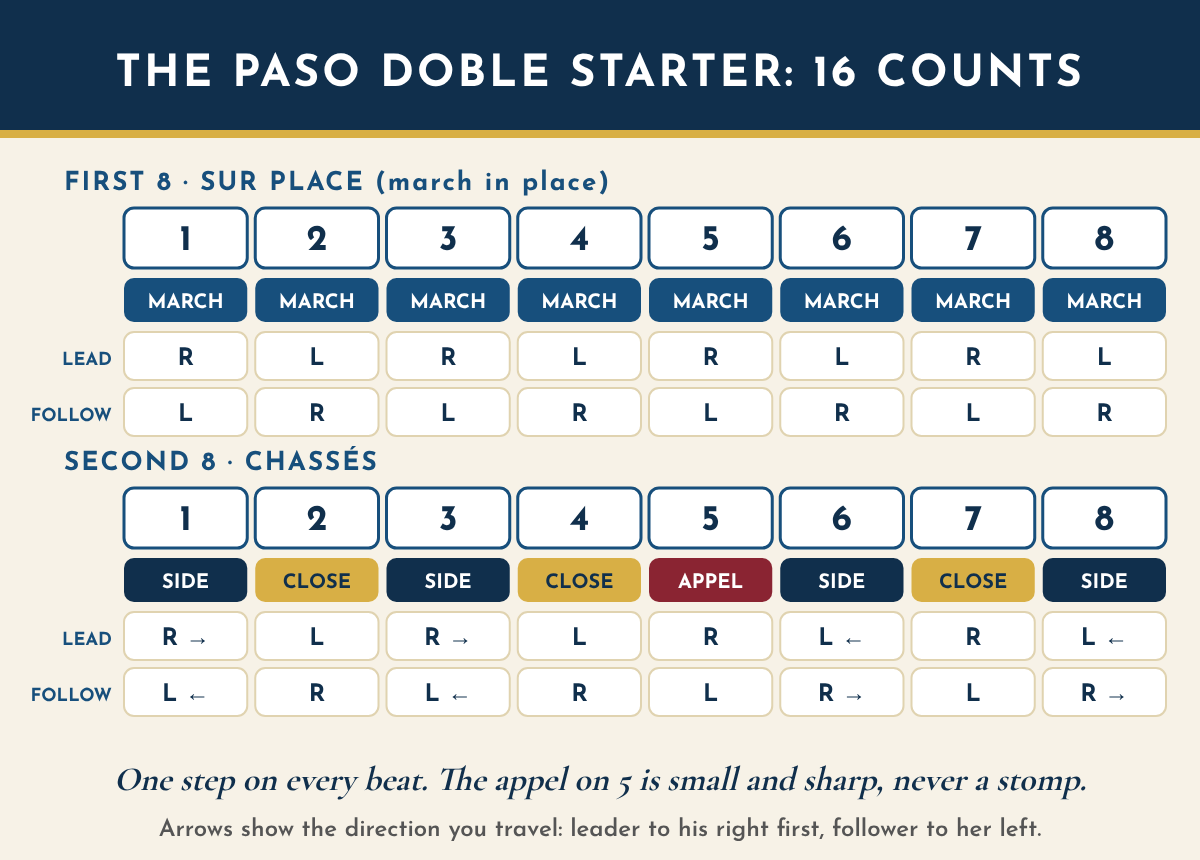
One quirk to know: in paso doble, many figures start on what feels like the “wrong” foot. Leaders usually begin with the right foot and followers with the left, the opposite of most ballroom dances. The round-dance paso doble figure guide and the Finches both describe it.
Step 2: Find the paso doble posture
Paso doble is about presence. Stand very tall with your chest lifted, shoulders down and your weight over the balls of your feet. The Finches describe the leader as very upright with the stomach in and the ribcage lifted. There’s no Latin hip action here; the look is proud and sharp.
With a partner, take a closed hold with a little more space than usual, the leader’s right hand on the follower’s back and his left hand holding her right. Practicing alone? Put your hands on your hips and lift your chest.
Who’s the matador, who’s the cape?
Most teaching sources agree the leader plays the matador. DanceVision and Wikipedia describe the follower as his cape. Others, like the Finches and the Oxford University DanceSport club, say she is most often the cape but can suggest a flamenco dancer, or even the bull, in some figures. Either way, both partners dance with the same proud posture.
Step 3: The sur place (first eight counts)
Sur place is French for “in place,” and that’s exactly what it is: marching on the spot. It’s the first figure in beginner paso doble syllabi; the British Dance Council’s Latin figure list opens with it.
- Leaders: start with your weight on your left foot. March right, left, right, left, right, left, right, left: eight steps in place, one per beat.
- Followers: start with your weight on your right foot. March left, right, left, right, left, right, left, right.
- The feel: stay up on the balls of your feet with your heels just off the floor, feet close together and steps tiny. The round-dance guide describes each step as on the balls of the feet, in place.
If your feet are a little apart at the start (for example, after the chassés), let the first march step bring them back together.
Step 4: The leader’s chassés (second eight)
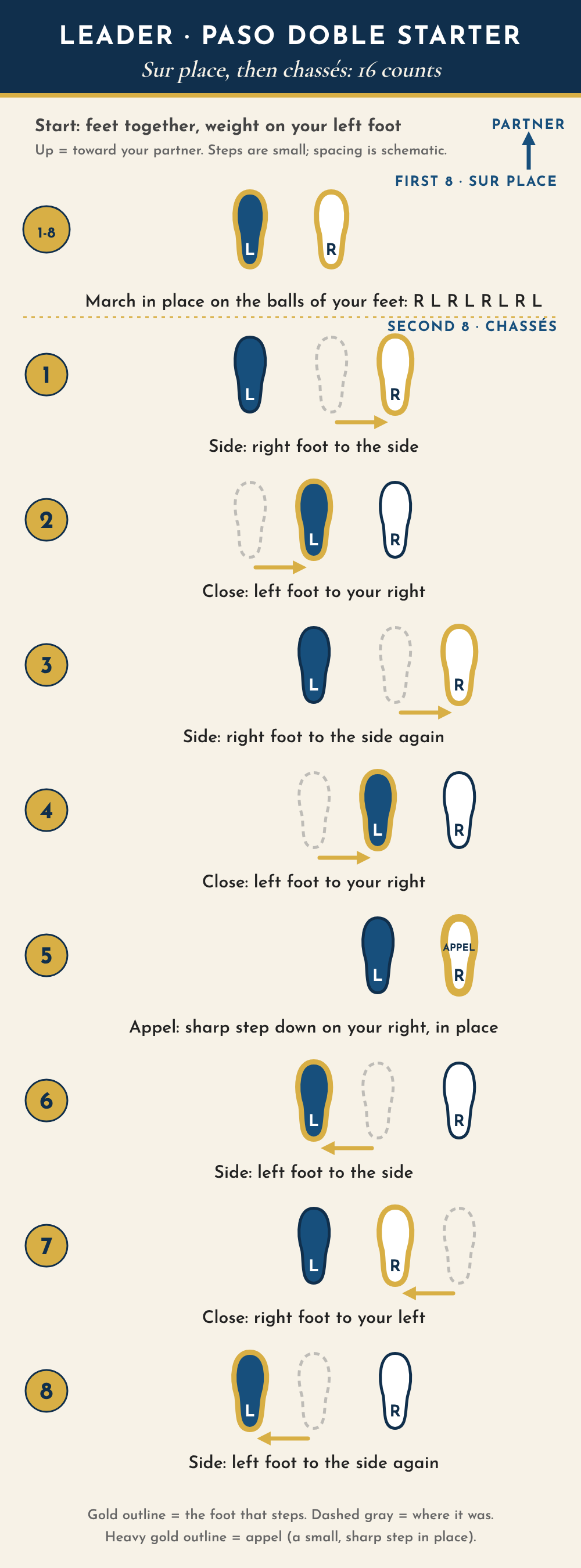
Start: weight on your left foot after the sur place, so your right foot is free.
Counts 1-4: chassés to the right
- Count 1: step to the side with your right foot, on the ball of the foot. (side)
- Count 2: close your left foot to your right. (close)
- Count 3: step to the side with your right foot again. (side)
- Count 4: close your left foot to your right. (close)
Counts 5-8: appel, then chassés to the left
- Count 5: appel: a small, sharp step down onto your right foot, in place. (appel)
- Count 6: step to the side with your left foot. (side)
- Count 7: close your right foot to your left. (close)
- Count 8: step to the side with your left foot again. You’re back near where you started, ready to march again.
A chassé is just side, close: two small steps that travel. The appel on 5 lets you change direction: it puts your weight on your right foot so your left can step to the side on 6.
Step 5: The follower’s chassés (second eight)
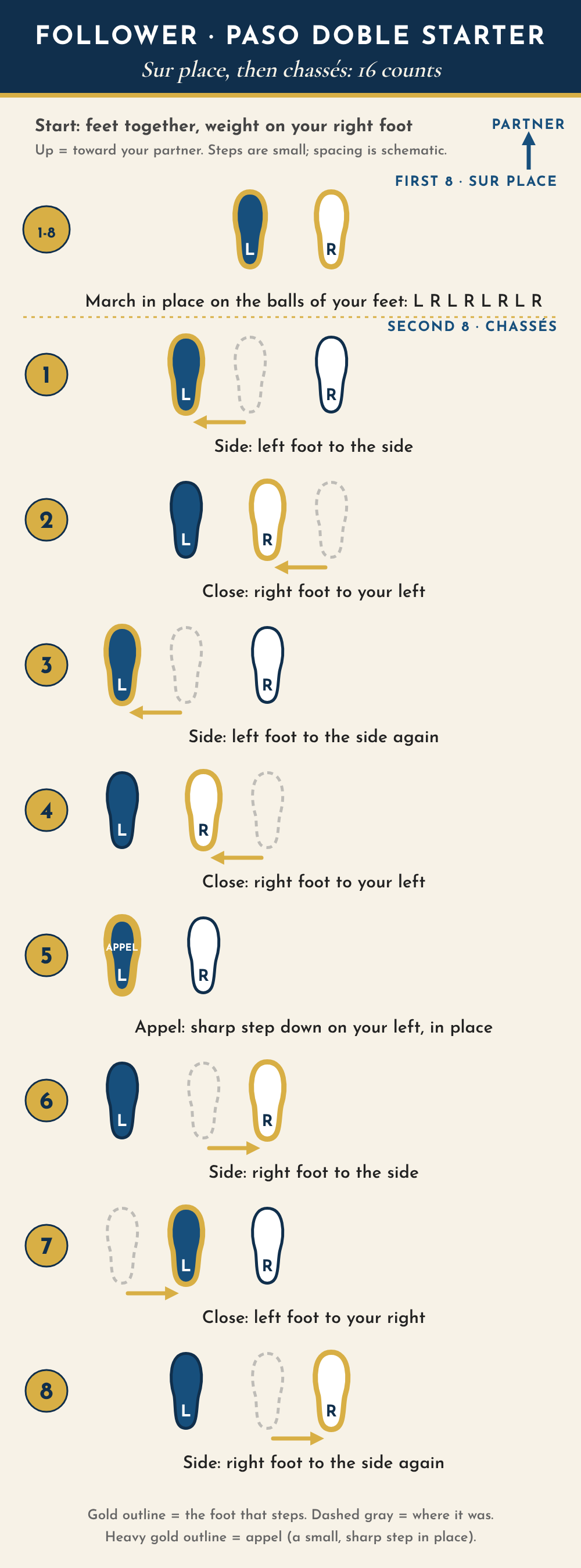
Start: weight on your right foot after the sur place, so your left foot is free.
Counts 1-4: chassés to your left
- Count 1: step to the side with your left foot, on the ball of the foot. (side)
- Count 2: close your right foot to your left. (close)
- Count 3: step to the side with your left foot again. (side)
- Count 4: close your right foot to your left. (close)
Counts 5-8: appel, then chassés to your right
- Count 5: appel: a small, sharp step down onto your left foot, in place. (appel)
- Count 6: step to the side with your right foot. (side)
- Count 7: close your left foot to your right. (close)
- Count 8: step to the side with your right foot again. Then the sur place begins again.
You travel the same way in the room as your partner: his right is your left. Keep your steps small so you stay in front of each other.
What’s an appel?
The appel (French for “call”) is a small, sharp step down onto a flat foot, in place, like a matador calling the bull’s attention. It’s the leader’s right foot and the follower’s left. Keep it crisp but quiet: the Finches say a matador makes “only a scuffing sound,” and another round-dance teacher warns not to stamp so loud that it hurts.
Step 6: Put it together
Take your hold. March the sur place together for eight counts, then chassé together: the leader travels to his right while the follower travels to her left, so you move the same way in the room. Appel together on 5, then chassé back. Repeat the whole sixteen counts four or five times, first slowly, then at tempo.
These two figures are building blocks. The ISTD’s own entry-level paso doble routine uses the sur place and chassés alongside other early figures, so you’re learning real syllabus material.
Watch the count-along lesson (about 3 minutes)
This short video walks both parts step by step, then counts along with you at a slow practice tempo and again at dance tempo. Press play and dance along; captions are available.
Read the video transcript
Let’s learn the paso doble. Paso doble is a proud, dramatic Latin dance inspired by Spanish bullfighting music. The leader plays the matador, and the follower most often represents his cape. It’s danced to a strong march, with one step on every beat.
We’ll learn a sixteen-count starter pattern: eight counts of sur place, which means marching in place, then eight counts of chassés, small side steps. Stand tall, chest lifted, shoulders down. Leaders, start with your weight on your left foot. Followers, on your right.
First, the sur place. Leaders, mark time in place on the balls of your feet, starting with your right: right, left, right, left, for eight counts. Keep your feet under you and your heels just off the floor.
Now the chassés to the right. On one, step to the side with your right foot. On two, close your left foot to it. On three, side right again. On four, close left.
Then back to the left. On five, an appel: a small, sharp step down onto your right foot, in place. On six, step to the side with your left foot. On seven, close your right. On eight, side left again.
Followers, you dance the mirror image. Sur place for eight counts, starting with your left foot. Then side left, close right, side left, close right. On five, an appel on your left foot. Then side right, close left, and side right.
Now let’s practice with the count. You’ll hear a click on every march step, a bright tone on each side step, a softer tone on each close, and a low tone on the appel. Here we go, nice and slow.
[Practice tones at 84 beats per minute: after four count-in clicks, a click on each march step for eight counts, then a bright tone on each side step, a softer tone on each close and a low tone on the appel.]
Now at dance tempo, about 110 beats per minute. Keep your steps small and sharp.
[Practice tones at 110 beats per minute.]
Two quick reminders. Stay tall and proud, but let the drama come from your posture, not from stomping. And keep the side steps small, so you never fall behind the music.
Want to dance it with an instructor? Ballroom by Amy teaches private lessons across the Twin Cities. Visit BallroomByAmy.com.
Instructor tip
Get the timing right before you add the attitude. The drama comes from your posture, not from stomping.
Ballroom Pages lists acting intense before your timing is solid among common paso doble mistakes.
Hear the counts: two practice tracks
These original practice tracks (no music, just tones) play the 16-count pattern for you. After four count-in clicks, you’ll hear a click on each march step for eight counts, then a bright tone on each side step, a softer tone on each close and a low tone on the appel. Press play, stand up, and dance along. Neither track plays automatically.
Slow practice · 84 beats per minute
Dance tempo · 110 beats per minute
What you’ll hear (text version)
Each track has no words or music. It opens with four clicks to count you in. Then each 16-count pattern plays as eight march clicks (a little louder on 1 and 5), followed by side, close, side, close, a low appel tone on 5, then side, close, side. The slow track plays the pattern three times in about 40 seconds and the dance-tempo track four times in about 39 seconds.
Beyond the starter: what comes next
Once the sur place and chassés feel easy, beginner paso doble syllabi build on them with figures like these, best learned with a teacher:
Basic movement
Marching steps forward and back. Sources describe its footwork differently, so learn it from your teacher’s syllabus.
Attack
An appel followed by a quick turn and side-close: one of the first figures with a real paso doble flourish.
Separation and Huit
Figures where the couple moves apart and the follower travels like the matador’s cape. Both are on beginner (bronze) lists.
Common mistakes and quick fixes
Stomping the appel
Fix: keep it small and sharp. Lower onto a flat foot with control; it should sound like a scuff, not a thud.
Steps that are too big
Fix: keep the side steps small. Big chassés make you late and pull you away from your partner.
Collapsing the posture
Fix: stay tall with the chest lifted and the eyes up. Looking at your feet shrinks the whole dance.
Adding Latin hips
Fix: paso doble has no Cuban hip action. Keep the hips quiet and let the shape come from your upper body.
Your five-minute practice
- Minute 1: posture check in a mirror, then march the sur place to the slow practice track.
- Minutes 2-3: the chassés alone, no music. Say “side, close, side, close, appel, side, close, side.”
- Minute 4: the whole 16 counts with the slow practice track.
- Minute 5: play the count-along video above and dance with it.
If finding the beat is the hard part, read why some songs make the beat hard to find.
|
Print the one-page paso doble practice sheet |
Music, clothes and where you’ll dance it
The steps are only half the picture. Here’s what to play, what to wear, and where paso doble will come in handy.
What music works for paso doble?
Paso doble is danced to the Spanish pasodoble, a bright march in 2/4 time with dramatic “highlights” where the music stops or crashes. Competition tempos vary by organization: the World DanceSport Federation’s rules set 60 to 62 bars a minute (about 120 beats), and Ballroom Pages lists 55 bars (about 110 beats) for NDCA events. Competition routines are often choreographed to the highlights of one classic piece.
Songs to try
- España Cañí, Pascual Marquina Narro (composer)
- Amparito Roca, traditional paso doble march
- El Gato Montés, paso doble march
- La Virgen de la Macarena, paso doble march
España Cañí (written around 1923) is the piece most competitions use, per Wikipedia and DanceVision; the other three come from Ballroom Pages’ paso doble list. Tempos vary by recording, so test yours: march along and count to eight. If you can keep the sur place small and on the beat, it will work. The practice tracks above are a good warm-up first.
What should you wear?
For lessons and practice
Clothes you can move and stand tall in. Shoes with smooth suede or leather soles; dance sneakers are fine to start.
For showcases and events
Dress for the event, then check you can march, appel and turn comfortably. Black, red and gold suit the dance’s character.
For competitions
Rules depend on the event and level. Some collegiate competitions, like Rutgers’, don’t allow costumes at newcomer level and allow them from bronze up. Read the rules first.
Skip flip-flops, rubber soles that grab the floor, and loose or chunky heels. Latin dance shoes have suede soles; women’s heels often run about 2 to 3 inches and men’s Latin shoes have a modest heel (Move Dancewear’s shoe guide). Lower heels are steadier while you learn (Capezio’s heel guide). You don’t need special shoes to start; ask Amy before you buy.
Where will you dance paso doble?
- Competitions and showcases. Paso doble is one of the five International Latin dances, and it’s mostly danced in competition and performance (Ballroom Pages). It isn’t part of American Rhythm (Dance Spirit). If you’re curious about competing with your teacher, see Pro-Am and competitive dancing.
- Studio parties and the occasional social. You’ll rarely hear a paso doble at a social dance, but when one plays, a few rounds of sur place and chassés let you join in. Find Twin Cities nights on Where to Go Dancing in the Twin Cities.
On a shared floor, keep your chassés short and check the space beside you before you travel. And thank your partner after the song.
A little history
Where did paso doble come from?
The music is Spanish: the pasodoble is a lively march long played at bullfights. The ballroom dance, though, took shape in France in the 1920s and ’30s; the Library of Dance finds early French descriptions calling it a Spanish version of the one-step, and sources differ on the exact decade. In England, the ISTD included paso doble in its first Latin American syllabus in 1947, alongside rumba, samba and jive.
Next steps
Learn
How to dance the cha cha
Learn
How to dance the rumba
Watch
Free video lessons and step-by-step guides
|
Learn with Amy Ready to dance paso doble with an instructor? Ballroom by Amy offers private lessons for dancers across the Twin Cities, whether you want to try a dramatic new style, prepare a showcase number or start working toward a Latin competition. Beginners are welcome, and no partner is needed. See private lessons Or call or text 612-308-7708. Amy typically replies within one business day. |
About Amy
Amy Hanson is the three-time defending Dancer’s Cup Tour Top Teacher. She has danced professionally and internationally and built friendships with dancers many people recognize from Dancing with the Stars. People who believe they’re not coordinated, confident, or good enough are exactly the beginners Amy loves to teach, and she also helps experienced dancers keep improving. No experience or partner is required.
Sources & Further Reading
- British Dance Council: Rules Appendix 1, Latin Figures (PDF). Paso doble beginner figures: basic movement, sur place, chassés to right and left, appel and more.
- Oxford University DanceSport: Paso Doble. Bronze figure list; the follower as cape, flamenco dancer or bull.
- ISTD: Box Dance Level 2, Paso Doble. Entry-level routine using sur place and chassés.
- Round Dancing: Paso Doble Figures. Sur place on the balls of the feet; chassés side-close; appel; man starts right, woman left.
- Dan and Sandi Finch: Paso Doble. Figures counted in fours; the “wrong foot” start; the follower’s roles.
- Dan and Sandi Finch: Paso Doble, The Beginning. Upright posture; heel leads when traveling; “only a scuffing sound.”
- Round Dancing: Paso Doble Tips. Head high, chest up; don’t stamp too loud.
- DanceVision: How to Dance Paso Doble. Matador and cape; España Cañí; 116–124 BPM.
- Ballroom Pages: Paso Doble Dance Style Guide. Mostly competition and showcase; common mistakes; songs.
- Ballroom Pages: Paso Doble Music. NDCA 55 bars (110 BPM); song list.
- World DanceSport Federation: Competition Rules (2012, PDF). Paso doble tempo 60–62 bars a minute.
- Wikipedia: Pasodoble. Matador and cape; danced mostly competitively.
- Wikipedia: España Cañí. Pascual Marquina Narro, around 1923; common in competition.
- Library of Dance: Paso Doble. Early French descriptions of the dance, from the 1920s.
- ISTD: Latin American. Paso doble in the first ISTD Latin syllabus, 1947.
- Dance Spirit: Breaking Down Ballroom Styles. American Rhythm vs. International Latin dances.
- Rutgers Ballroom: Competition Rules. No costumes at newcomer; costumes from bronze up.
- Move Dancewear: Ballroom and Latin Shoes. Suede soles and Latin heel heights.
- Capezio: Ballroom Shoe Heel Height Guide. Lower heels for stability.
AI-Assisted Content Disclaimer
This educational guide was created with assistance from artificial intelligence (AI), including portions of the written content and visual materials. While we strive to provide accurate and helpful ballroom dance information, AI-generated content and illustrations may contain errors or inaccuracies, including in dance positions, footwork, timing, and technique.
Please independently verify important information and use your own judgment when practicing. Images are intended to support learning and may not always represent technically precise movements. For personalized guidance and instruction, consider learning directly with a qualified ballroom dance instructor.
Some images are AI-generated illustrations and do not show real people. The narration in the count-along lesson is an AI-generated voice. The footwork diagrams and practice tones were created for this guide.