Ballroom How-To · Nightclub Two Step · Beginner
Slow, quick, quick. The easiest way to look good on a slow song.
Illustration (AI-generated): a slow dance in an evening piano lounge.
Quick Answer
To dance nightclub two step, use a slow, quick, quick rhythm counted “one, two and.” Leaders step to the side with the left foot (slow), rock back on the right foot (quick), and replace the weight onto the left (quick), then repeat to the right. Followers dance the mirror image, starting to the right. Keep the steps small and the movement smooth and level.
When the band slows down, most people just sway. Nightclub two step gives you something better to do with a slow song: a simple, flowing side-to-side basic that fits ballads, country love songs and soft pop. It was made for exactly those songs, which is why it shows up at weddings, socials and country dance nights.
This guide walks you through the count, the leader’s and follower’s parts, and the smooth feel that makes it look like a dance instead of a shuffle. You’ll get footwork diagrams, a count-along video, two practice tracks and a five-minute drill. No partner or experience needed.
In this lesson
What you’ll learn
Skill
The nightclub two step basic, both parts
Style
Nightclub two step (Nightclub)
Level
First-timer
Partner?
Optional. Practice it solo
Step 1: Learn the count
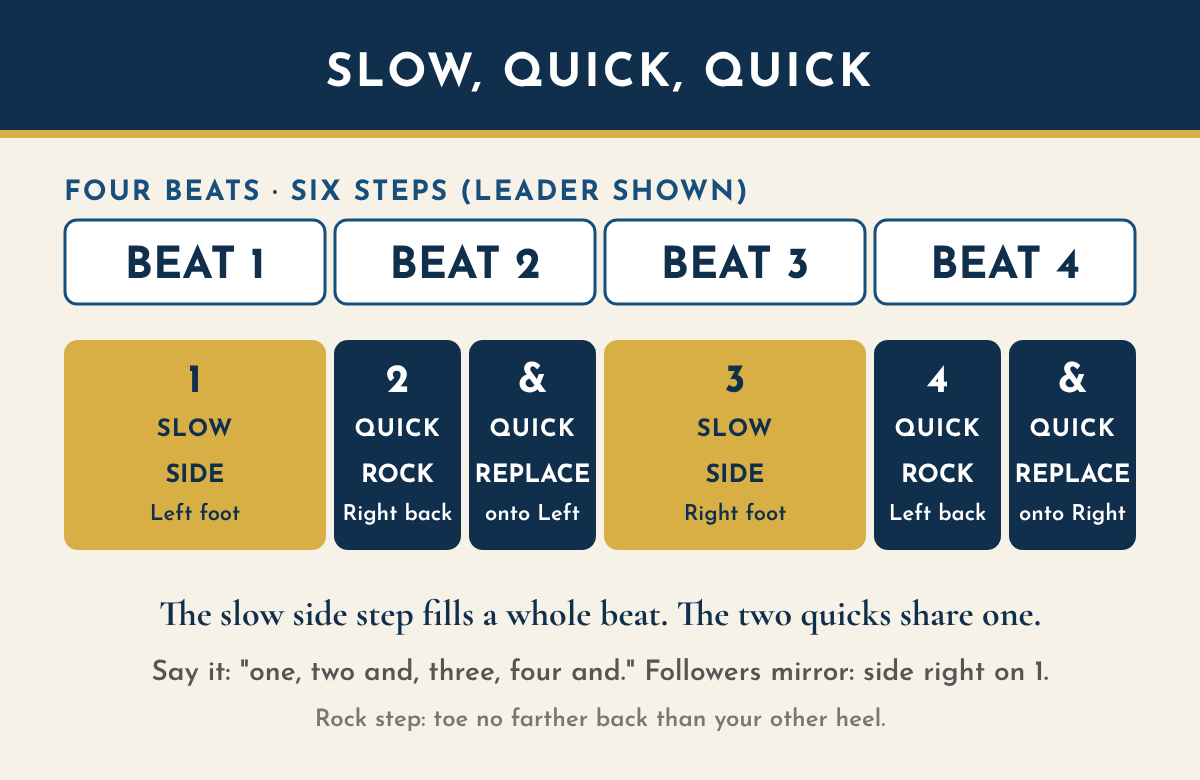
The basic has three steps in a slow, quick, quick rhythm: a side step, a small rock step back, and a replace. Count it “one, two and, three, four and.” The slow side step takes a whole beat (1), and the two quick steps share the next beat (2 and &). Then you do the same thing to the other side on 3, 4 and &.
God’s Ballroom counts it exactly this way (“SQQ SQQ or 1 2& 3 4&”), with the slow worth one beat and each quick worth half, and the Wikipedia entry on nightclub two step describes the same timing: side step on 1, rock step on 2, replace on the “and.”
You may hear it counted other ways
Some teachers start with the rock step (quick, quick, slow), and some count the same rhythm over more counts when they count the music at a faster pulse. Ballroom Pages notes that timing varies by teacher and region, and the country version taught by God’s Ballroom starts the leader to the right. The feel is the same. Amy will show you the version she teaches.
Step 2: Get the nightclub feel
Nightclub two step should look smooth and easy, never busy. These are the things that make the difference:
- Stay level. Glide from side to side with soft knees and no bobbing up and down; a Round Dancing teaching note puts it simply: keep it flat.
- Keep the rock step small. Your toe goes back no farther than your other heel, as both God’s Ballroom (“toe to heel, small step”) and the Wikipedia entry describe.
- Let the slow breathe. The side step is where the dance gets its flow. God’s Ballroom adds a gentle sway on the slow counts.
- Stay over your own feet. Ballroom Pages says it plainly: don’t hang on your partner, and connection should guide, not yank.
- With a partner, use a relaxed closed hold about a foot apart. Leaders guide with the body, not the arms.
Step 3: The leader’s basic, step by step
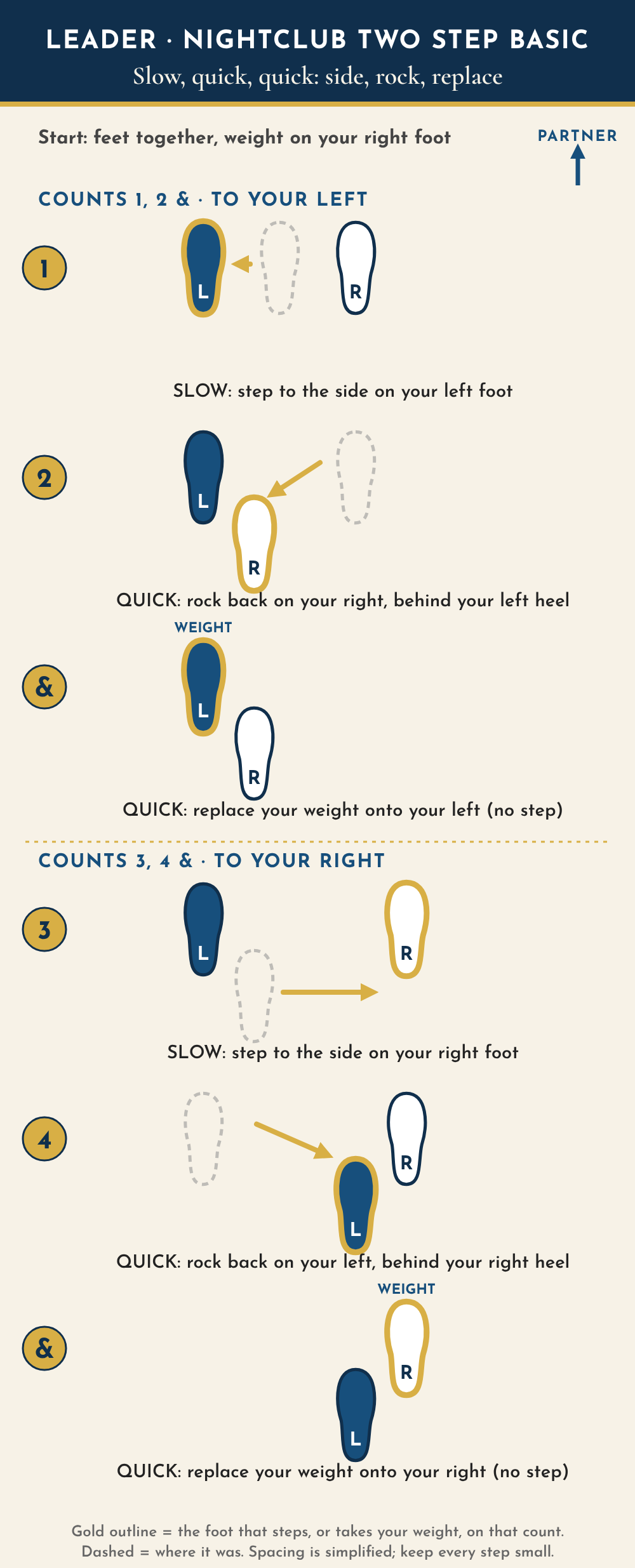
Start: feet together, facing your partner, weight on your right foot, so your left foot is free.
Counts 1, 2 &: to your left
- Count 1 (slow): step to the side with your left foot.
- Count 2 (quick): rock back on your right foot, a small step behind your left heel.
- Count & (quick): replace your weight onto your left foot. It doesn’t move; your weight just goes back to it.
Counts 3, 4 &: to your right
- Count 3 (slow): step to the side with your right foot.
- Count 4 (quick): rock back on your left foot, behind your right heel.
- Count & (quick): replace your weight onto your right foot. That’s one full basic.
Say it out loud: “side, rock, replace.” The side-step-first basic to the leader’s left is the version taught in Ballroom Pages’ nightclub two step guide and described on Wikipedia.
Step 4: The follower’s basic, step by step
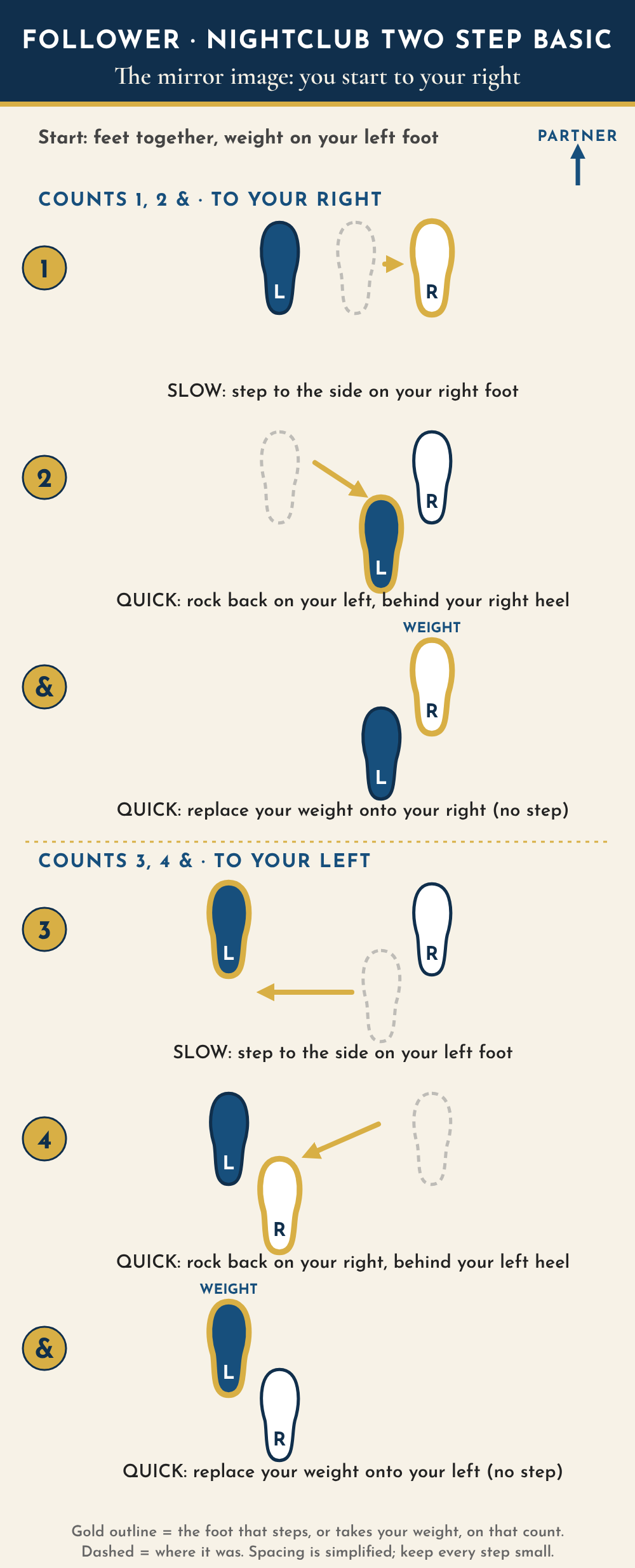
Start: feet together, facing your partner, weight on your left foot, so your right foot is free.
Counts 1, 2 &: to your right
- Count 1 (slow): step to the side with your right foot.
- Count 2 (quick): rock back on your left foot, a small step behind your right heel.
- Count & (quick): replace your weight onto your right foot.
Counts 3, 4 &: to your left
- Count 3 (slow): step to the side with your left foot.
- Count 4 (quick): rock back on your right foot, behind your left heel.
- Count & (quick): replace your weight onto your left foot. You’re ready to start again.
Your part is the mirror image of the leader’s, so the two of you move in the same direction across the floor.
Step 5: Put it together
Face your partner in a relaxed hold. On 1, the leader steps left as the follower steps right, so you both move the same way. On 2 you both rock back a little, away from each other, and on & you both come back to the foot you just left. On 3 you both move to the other side. Dance at least eight basics in a row before you try anything else.
Many teachers simply say “side, rock, replace” or “slow, quick, quick.” It’s the same timing as “one, two and,” and Amy may use either.
Watch the count-along lesson (under 3 minutes)
This short video walks both parts step by step, then counts along with you at a slow practice tempo and again at social dance tempo. Press play and dance along; captions are available.
Read the video transcript
Let’s learn the nightclub two step basic. Nightclub two step is a smooth, romantic partner dance made for slow songs and ballads. You’ll see it at weddings, socials and country dance nights.
The basic has three steps: slow, quick, quick. Count it one, two and. The slow side step takes a full beat, and the two quick steps share the next beat. Then three, four and, to the other side.
Stay smooth and level. Keep your knees soft, your steps small, and your weight over your own feet. Leaders guide with the body, never by pulling with the arms.
Leaders, start with your feet together and your weight on your right foot. On one, step to the side with your left foot. On two, rock back on your right foot, a small step behind your left heel. On and, replace your weight onto your left foot.
Then go to the other side. On three, step to the side with your right foot. On four, rock back on your left foot, behind your right heel. On and, replace your weight onto your right foot. That’s one full basic.
Followers, you dance the mirror image. Start with your weight on your left foot. On one, step to the side with your right foot. On two, rock back on your left foot. On and, replace onto your right. On three, step to the side with your left foot. Rock back on your right foot on four, and replace onto your left on and.
Now let’s practice with the count. You’ll hear a bright tone on each slow side step, one and three, and two quick clicks for the rock and the replace. Here we go, nice and slow.
[Practice tones at 48 beats per minute: after four count-in clicks, a bright tone on each slow side step (1 and 3), a click on each rock step (2 and 4) and a lighter click on each replace (&).]
Now at social dance tempo, about 60 beats per minute. Slow, quick, quick.
[Practice tones at 60 beats per minute.]
Two quick reminders. Don’t rush the slow step. Let it fill the whole beat. And keep the rock step small, with your toe no farther back than your other heel.
Want to dance it with an instructor? Ballroom by Amy teaches private lessons across the Twin Cities. Visit BallroomByAmy.com.
Instructor tip
Think of the rock step as a tiny check, not a step backward. Touch back, come right home, and save your travel for the slow.
Based on the “toe to heel” rock step described by God’s Ballroom and in the Wikipedia entry.
Hear the counts: two practice tracks
These original practice tracks (no music, just tones) play the basic for you. After four count-in clicks, you’ll hear a bright tone on each slow side step (1 and 3), a click on each rock step (2 and 4) and a lighter click on each replace (&). Press play, stand up, and dance along. Neither track plays automatically.
Slow practice · 48 beats per minute
Social tempo · 60 beats per minute
What you’ll hear (text version)
Each track has no words or music. It opens with four clicks to count you in. Then each basic plays as: a bright tone on 1 (slow side step), a click on 2 (rock back), a lighter click on & (replace), and the same again on 3, 4 and &. The slow track plays 8 basics in about 48 seconds and the social-tempo track 12 basics in about 55 seconds.
Beyond the basic: what comes next
Once the basic feels automatic, nightclub two step opens up, and every figure keeps the same slow, quick, quick timing. These are best learned with a teacher, but here’s what to look forward to:
Follower’s underarm turn
The follower turns under the leader’s raised hand while both keep the slow, quick, quick rhythm going.
The traveling cross
A side, cross, side figure that travels across the floor. Wikipedia notes it grew out of a 1960s dance called the Surfer Stomp.
Sway and shaping
A gentle sway on the slow counts, which God’s Ballroom calls part of the dance’s gliding, romantic character.
Save dips for later. Ballroom Pages recommends learning any dip from a qualified instructor once your balance in the basic is solid.
Common mistakes and quick fixes
Rushing the slow
Fix: let the side step fill the whole beat. Ballroom Pages lists rushing the slow count as a common beginner mistake.
A big rock step
Fix: keep your toe no farther back than your other heel. A small rock is easier to recover from.
Bobbing up and down
Fix: keep your knees soft and your head level, and glide from side to side.
Pulling with the arms
Fix: leaders, guide with your body and a relaxed hold. Followers, keep your own balance over your own feet.
Your five-minute practice
- Minute 1: play the slow practice track and just say the count out loud: “one, two and, three, four and.”
- Minutes 2-3: dance your part of the basic alone, no music. Say “side, rock, replace” and keep the rock step tiny.
- Minute 4: play the count-along video above and dance along with it.
- Minute 5: try the social-tempo track, then put on a slow song you love and dance eight basics in a row.
If finding the beat in a slow song is the hard part, read why some songs make the beat hard to find.
|
Print the one-page nightclub two step practice sheet |
Music, clothes and where you’ll dance it
The steps are only half the picture. Here’s what to play, what to wear, and where nightclub two step will actually come in handy.
What music works for nightclub two step?
Slow and moderate ballads in 4/4 time: smooth ballads, slow pop, country ballads, soft rock and R&B-style songs, as Ballroom Pages describes. The Library of Dance says the dance was invented in the mid-1960s for the popular slow ballads of the time and still fits a large share of pop songs today. For tempo, the UCWDC competition music table (2023-2025) lists nightclub at 54 to 60 beats per minute, and God’s Ballroom gives 58 to 62 for the country version. Counted that way, each basic takes four beats, or about four seconds.
Songs to try
- Lady in Red, Chris de Burgh
- Amazed, Lonestar
- (Everything I Do) I Do It for You, Bryan Adams
- Have I Told You Lately, Rod Stewart
- She Believes in Me, Kenny Rogers
From Dave Tompkins’ nightclub two step music list. Tempos vary by recording, so test yours: count “one, two and” along with it. If the slow side step feels relaxed and the quicks don’t feel rushed, it will work. Music lists may show these songs at about double the tempo above, because they count a faster pulse. The practice tracks above are a good warm-up first.
What should you wear?
For lessons and practice
Clothes you can bend your knees and turn in. Shoes with smooth soles that let you glide, like suede or leather; dance sneakers or a low heel are fine to start.
For weddings and socials
Dress for the event, then check you can step and turn in it. A skirt or dress with some movement looks lovely on a slow song; a tight pencil skirt does not.
For competitions and shows
Nightclub two step appears in country-western competition and some showcase events, which set their own costume and shoe rules by event and level. Read them before you buy anything.
Skip flip-flops, rubber soles that grab the floor, and loose or chunky heels. Leave scarves and long jewelry at home for lessons (Supadance’s guide to dressing for dance has more). You don’t need special shoes to start; ask Amy before you buy.
Where will you dance nightclub two step?
- Weddings. Ballroom Pages names wedding first dances and reception slow songs as a natural fit, and it works for a father-daughter or mother-son dance too. See wedding dance lessons.
- Country dance nights. God’s Ballroom describes a country version danced to slow, romantic country songs, and the dance is part of country-western competition.
- Socials, galas and holiday parties. Whenever the DJ plays a slow song. Find Twin Cities nights on Where to Go Dancing in the Twin Cities.
- Cruises and anniversaries. One smooth basic and an underarm turn will carry you through almost any ballad.
God’s Ballroom notes that nightclub two step doesn’t travel around the floor the way a foxtrot does, which makes it easy on a crowded floor. Keep your steps small, watch the couples around you, and thank your partner after the song.
A little history
Where did nightclub two step come from?
Nightclub two step is a young dance, and an American one. It’s credited to Buddy Schwimmer, who created it in the mid-1960s as a teenager. A Round Dancing article says he didn’t like the clutch-style slow dancing of the day and wanted a better way to dance to the ballads everyone was listening to. Sources differ on the exact year, and Ballroom Pages gives a working range of the 1960s and 1970s. It has also been called the disco two step and California two step, according to the Wikipedia entry, and today it’s danced at socials, in studios and in country-western competition.
Next steps
Learn
How to dance the rumba: another romantic favorite
Learn
How to dance merengue: the easiest Latin party dance
Watch
Free video lessons and step-by-step guides
|
Learn with Amy Ready to dance nightclub two step with an instructor? Ballroom by Amy offers private lessons for dancers across the Twin Cities, whether you want a first dance that feels natural, a confident slow dance at the next wedding, or something new for date night. Beginners are welcome, and no partner is needed. See private lessons Or call or text 612-308-7708. Amy typically replies within one business day. |
About Amy
Amy Hanson is the three-time defending Dancer’s Cup Tour Top Teacher. She has danced professionally and internationally and built friendships with dancers many people recognize from Dancing with the Stars. People who believe they’re not coordinated, confident, or good enough are exactly the beginners Amy loves to teach, and she also helps experienced dancers keep improving. No experience or partner is required.
Sources & Further Reading
- Ballroom Pages: Nightclub Two Step Dance Style Guide. Side-step-first basic (slow, quick, quick) for leader and follower; timing varies by teacher and region; ballads in 4/4; small steps, balance, connection; common mistakes; weddings, socials, country events.
- God’s Ballroom: How to Dance at a Country Club. Counted SQQ or 1, 2&, 3, 4&; slow = one beat, quicks = half a beat; rock step toe to heel; sway on the slows; doesn’t travel the line of dance; country version at 58–62 BPM.
- Wikipedia: Nightclub Two Step. Slow side step on 1, rock on 2, replace on the “and”; toe no farther back than the heel; also called disco or California two step; Surfer Stomp roots of the traveling cross.
- Round Dancing: A Few Notes on Slow Two Step. Created by Buddy Schwimmer in the mid-1960s as a teenager, as an alternative to clutch-style slow dancing; keep it flat.
- Library of Dance: Nightclub Two Step. Invented in the mid-1960s by a teenage Buddy Schwimmer for the slow ballads of the time.
- UCWDC: Couples & ProAm Music Timings, 2023–2025. Nightclub competition tempo, 54–60 beats per minute.
- Dave Tompkins’ Music Database: Nightclub Two Step. Songs tagged for nightclub two step.
- Supadance: How to Dress for Ballroom Dancing. Lesson clothes and shoes to avoid.
AI-Assisted Content Disclaimer
This educational guide was created with assistance from artificial intelligence (AI), including portions of the written content and visual materials. While we strive to provide accurate and helpful ballroom dance information, AI-generated content and illustrations may contain errors or inaccuracies, including in dance positions, footwork, timing, and technique.
Please independently verify important information and use your own judgment when practicing. Images are intended to support learning and may not always represent technically precise movements. For personalized guidance and instruction, consider learning directly with a qualified ballroom dance instructor.
Some images are AI-generated illustrations and do not show real people. The narration in the count-along lesson is an AI-generated voice. The footwork diagrams and practice tones were created for this guide.